My first film festival came with an unexpected problem: Middleburg made everything easy except deciding what to miss.
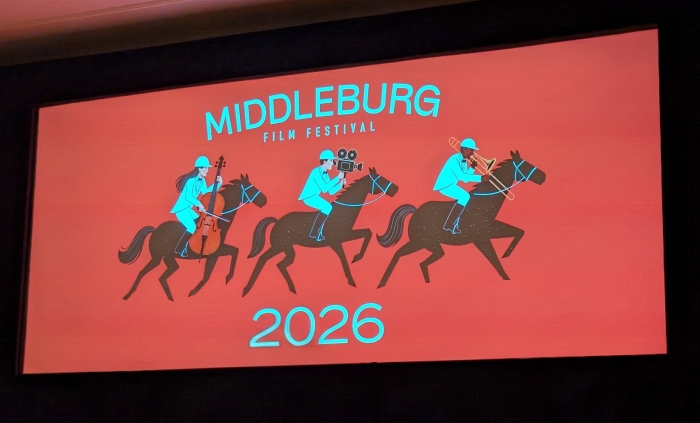
The Middleburg Film Festival unfolds against a small-town Virginia backdrop that's beautiful in the autumn, with Salamander Resort & Spa as its hub. The main screening venue is a ballroom at the Salamander, with additional screenings spread among The Hill School, the National Sporting Library & Museum, and the Middleburg Community Center. The setting is part of the appeal, but what struck me most as a first-time attendee was how approachable the whole experience felt. There's ample public parking with a frequent shuttle linking the venues. I rode it several times, enjoying plenty of conversation about the festival and its films along the way.
Across the venues I visited, projection and sound were excellent. Seating proved a less consistent pleasure, particularly as the screenings accumulated. Seasoned Middleburg attendees arrived carrying their own seat cushions. I initially registered this as a curiosity; several films later, I recognized it as wisdom.
The lineup of films, panels, and special events was generous, and occasionally a scheduling quandary. Maximizing screenings meant skipping everything that wasn't a film or a Q&A tied to one, including several panel discussions and the special concert honoring Daniel Pemberton, whose "Project Hail Mary" score is still stuck in my head. Overlaps cost me several films I badly wanted to see as well: "Bunker," the documentary "Carl Sagan: We Are Made of Star Stuff," and both of Sandra Hüller's films, "Rose" and "Fatherland." My enthusiasm never waned. The hours simply ran out first.
My festival linuep ultimately encompassed 17 films: four seen before the festival, 12 at Middleburg, and one afterward. What follows is a snapshot of that viewing, in the order I saw the films, with brief reactions offering a preview of fuller reviews to come closer to theatrical release. Where we've already published coverage, links follow the blurb.
"I Play Rocky": Sylvester Stallone's fight to get the first "Rocky" made gets its own underdog treatment, and Anthony Ippolito disappears into the role so completely that you stop noticing the resemblance and just root for the guy. The supporting cast gets real room to shine too, especially Jay Duplass as director John G. Avildsen, P.J. Byrne as a producer, and a scene-stealing Tracy Letts as the skeptical studio exec. It's a simple, crowd-pleasing story that works whether or not you know the original, and it hits its big moments. I caught it in full before the festival, then watched a good chunk of it again with the Middleburg audience. Full review coming soon.
Interview: At the festival, I sat down with Jay Duplass and P.J. Byrne to talk about what the ensemble does without words, why "Rocky" isn't really a boxing movie, and how little the script needed tweaking. Read the interview.
Q&A: Highlights from the festival panel following the screening, where the pair talked about the pressure of playing real Hollywood legends, watching Ippolito turn into Stallone, and what the shoot did for their faith in moviemaking. Read the Q&A.
"Misty Green": Chris Rock's drama follows an actress with serious talent as she runs out of chances in Los Angeles. Rosalind Eleazar is riveting and keeps Misty believable even at her worst. The supporting cast adds a lot, and the film makes great use of Los Angeles locations to create a naturalistic world, including the city's struggles with poverty. It stumbles in places: Rock's stand-up voice sometimes slips into the dialogue, a countdown set up early is quietly dropped, and the ending wraps too fast. Still, it's well worth catching. Read our full review.
"Wild Horse Nine": Two CIA operatives, played by John Malkovich and Sam Rockwell, take a break from a Chilean coup plot with a trip to Easter Island, and each has his own reasons for going. It's a smart, funny spy caper, but the real draw is the pair themselves, who bicker like an old married couple. Malkovich is superb, with a performance that's hard to read in the best way, and the story earns its emotion without losing its sense of humor. A second viewing would pay off. Full review coming soon.
"Ink": Danny Boyle's latest delivers style and just the right swagger to capture the rise of the bawdy British tabloid the Sun, starting in 1969, with Guy Pearce as Rupert Murdoch and Jack O'Connell as editor Larry Lamb. Its stage roots show in the heavy dialogue and in-room blocking. The film grants Murdoch scruples he's quick to trade for profit, a generous premise given the historical record. It's sharpest when it traces a line from that newsroom to the cultural wreckage that followed. The closing montage that drives that point home feels a bit on the nose, but it holds attention throughout. Full review coming soon.
"Fjord": Cristian Mungiu's Palme d'Or-winning drama is about a Romanian-Norwegian family whose children are removed by Norwegian authorities over how the parents discipline them. It deliberately won't pick a side, and it shows how much depends on who's telling the story and which words they choose. Sebastian Stan and Renate Reinsve are excellent, and the film leaves you with an uneasy verdict of your own. Read our full review.
"The Debut": Jesse Eisenberg's delightful crowd-pleaser stars Julianne Moore as an overlooked housewife who turns method-acting diva in a community theater production. Paul Giamatti is energetic and slightly melancholy as director Jerry, who inspires fear, awe, and love in his cast. Eisenberg wrote, directed, and composed the songs, and his affection for theater and performers runs through every scene. Full review coming soon.
Q&A: Highlights from the panel with Jesse Eisenberg and Julianne Moore, covering a lead role Eisenberg wrote for Moore with no backup plan, the black wig that came out of her hairstylist's kit, and a supporting cast so stacked with Broadway veterans that even the smallest roles went to Tony nominees. Q&A coming soon.
"Gentle Monster": It's a tough watch, but Léa Seydoux makes it worth the emotional bruising. She's terrific as a woman trying to reconcile her love for her husband with increasingly disturbing revelations about him, and director Marie Kreutzer lets that struggle do the work without piling on lurid details. A subplot about the investigating officer's family keeps pulling us away from the story that matters most, costing the film some of its punch. Still, Seydoux makes every revelation hit, and Kreutzer's restraint leaves it all the more unsettling. Read our full review.
Q&A: Highlights from the panel with writer-director Marie Kreutzer and Léa Seydoux, covering the film's unsettling premise, performing emotional scenes in a language Seydoux doesn't speak, and the approval she now insists on for intimate scenes. Read the Q&A.
"Tangles": A young woman's life is finally coming together, with a new career and a new love interest, until her mother's Alzheimer's diagnosis pulls her back to help her family. Abbi Jacobson, Julia Louis-Dreyfus as the mother, and Bryan Cranston as the father lead a voice cast that handles both the love and the heartbreak beautifully, and plenty of people in my screening were in tears. It's a reminder that animation can hit as hard as any live-action drama, the way the Carl and Ellie sequence in "Up" did. Full review coming soon.
Q&A: Highlights from the panel with director Leah Nelson and producers Lauren Miller Rogen and Seth Rogen, covering how Sarah Leavitt's memoir of notes and drawings became a linear script, why the film never goes inside the mother's head, and recording Julia Louis-Dreyfus, Bryan Cranston, and Abbi Jacobson in the same room. Q&A coming soon.
"La Bola Negra": Javier Ambrossi and Javier Calvo, known in Spain as Los Javis, go all in on the historical epic, tracing gay lives in Spain across 1932, 1937, and 2017, and they mostly pull it off. The craft and central performances are impeccable, with Penélope Cruz and Glenn Close adding star power in consequential supporting roles and Lorca's unfinished play of the same name serving as the spine of all three stories. The pacing is another matter: the film runs too long, and a firmer hand in the cutting room could have delivered the same sweep with more force. Full review coming soon.
Q&A: Highlights from the post-screening conversation with Guitarricadelafuente, making his acting debut as Sebastián, on working with Los Javis, Miguel Bernardeau, and Penélope Cruz. Spain's Ambassador to the United States, Ángeles Moreno Bau, was on hand for the presentation of his International Spotlight Award. Q&A coming soon.
"Everybody Digs Bill Evans": Grant Gee's film looks at jazz pianist Bill Evans during a brief pause from making music after the death of his close collaborator and bassist, Scott LaFaro. It's a soulful, meditative look at creative partnership, grief, and family love, told across different periods of Evans's life. Anders Danielsen Lie gives a strong, inward performance that still lets the feeling through, and Laurie Metcalf and Bill Pullman are excellent as parents who clearly love their son but don't always know how to engage with him. It's a must-see for jazz fans and well worth the time for anyone who appreciates character- and relationship-focused dramas. Full review coming soon.
Q&A: Highlights from the panel with Bill Pullman and executive producers Albert Berger and Ron Yerxa, covering shooting 1961 New York and Florida entirely in Ireland, how Pullman's own father shaped his performance, and how little jazz a jazz film needs. Q&A coming soon.
"Wicker": In a storybook village, a lonely woman half-jokingly asks for a husband made of wicker, and she gets one who turns out to be devoted, affectionate, and very eager. Alexander Skarsgård's suit work is the standout, and the film is funny, warm, and surprisingly dark in places. Its jabs at marriage and gender roles are fun but light, and the ending feels hurried. Read our full review.
Q&A: Highlights from the post-screening panel with directors Alex Huston Fischer and Eleanor Wilson and Olivia Colman, covering how a few lines of a short story grew into full scenes, why they went practical over VFX with the wicker suit, and how the love scenes were choreographed (contains spoilers). Read the Q&A.
"Elsinore": Simon Stone's film follows the final months of Scottish actor Ian Charleson as he fights through AIDS to play Hamlet at London's National Theatre. It's a powerful, emotional watch, with Andrew Scott superb both in the Shakespeare and in the tragedy around it. Olivia Colman is strong as Dr. Margaret Johnson, who tries to keep Charleson healthy while the role asks everything of him. It's a hard film to sit through but a deeply rewarding one, and a pointed reminder of how differently an HIV diagnosis plays out today. Full review coming soon.
Q&A: Highlights from the panel with Olivia Colman and makeup and hair designer Nadia Stacey, covering Colman's portrayal of the real-life Dr. Margaret Johnson, how Stacey avoided '80s cliché while turning Andrew Scott into Ian Charleson, and Colman's love of a wig. Stacey received the festival's Distinguished Makeup & Hair Design Award. Q&A coming soon.
"Club Kid": On paper, it's "Big Daddy" with far more queer characters and far more drugs: an irresponsible man forced by surprise fatherhood to get serious, fast. But the film quickly finds its own footing and turns out to be about much more than that setup. Jordan Firstman, who wrote, directed, and stars as the lead, makes a confident debut. There's real warmth and honesty here, even when his character is hard to like. The buzz around it at the festival was hard to miss, and while it didn't fully win me over, I get why people were so fired up. Full review coming soon.
"Behemoth!": My subjective favorite of all the festival films stars Pedro Pascal as a drifting cellist with uncertain motives, told in director Tony Gilroy's nonlinear structure. The plot is minimalist, but there's a lot of nuance to take in. Its driving concept entwines the story, the nine-composer score, and a cast of musicians into a cinematic symbiosis with no obvious peer. Full review coming soon.
Q&A: Highlights from the panel with writer-director Tony Gilroy and composer Lukas Frank, covering the movies Gilroy invented for his composers to score, the one piece of music that wasn't "gettable," and what it's like to rewrite the director's song.
"Give Me the Ball!": Liz Garbus and Elizabeth Wolff's documentary on Billie Jean King's life and career sticks to a familiar formula, pairing talking-head interviews with archival footage and breaking no new ground in how it's built. It works anyway, because King is such a magnetic presence that the film feels satisfying and meaningful even when it's conventional. It's a smart, affectionate look at a legend. Full review coming soon.
"Being Heumann": Siân Heder follows up "CODA" with a stirring look at disability rights activist Judy Heumann and the fight to get Section 504 of the Rehabilitation Act enforced. Its biggest strength is the casting of disabled actors in the key roles, led by Ruth Madeley as Heumann. It captures the feel of the era well, and it covers a chapter of American history that deserves to be far better remembered. Full review coming soon.
Q&A: Highlights from the panel with casting directors Adam Caldwell and Bernard Telsey, covering the search for Judy Heumann and the activists around her, which took them through community organizations, social media, and a local news clip about a high school trash pickup, and how Mark Ruffalo came to play the official on the other side of the protest. They also received the festival's Special Achievement in Casting Award. Q&A coming soon.
"Possible Love": Lee Chang-dong's film pairs a struggling couple with a wealthy one after a documentary filmmaker takes an interest in the first couple's story. It starts slowly and leans on exposition, but it gets absorbing once the four characters share scenes. You're never sure what anyone really wants, and I kept second-guessing motives well after the credits. Read our full review.
Middleburg was an embarrassment of riches: excellent presentation, a welcoming setting, and a lineup that made missing something good practically inevitable. Much of the credit for how easy it all felt goes to the staff and volunteers, who were clearly excited to be there and very good at their jobs. I left with plenty to write about and a longer list of films I still want to see, and I'm already looking forward to next year. The first decision will be easy: bring a seat cushion.