Following a screening of "Gentle Monster" at the Middleburg Film Festival, writer-director Marie Kreutzer and star Léa Seydoux discussed the film's unsettling premise, the challenges of performing across languages, and the collaboration behind its intimate scenes. The conversation also turned to Seydoux's experiences making "Blue Is the Warmest Color" and the boundaries she now sets in her work.
The film follows Lucy, a concert pianist whose move to the countryside with her husband and young son is upended by a police investigation into her husband's suspected crimes involving child sexual abuse material. Seydoux plays Lucy opposite Laurence Rupp, with Jella Haase as the investigator and Catherine Deneuve as Lucy's mother.
For more about the film, check out our full review of "Gentle Monster".
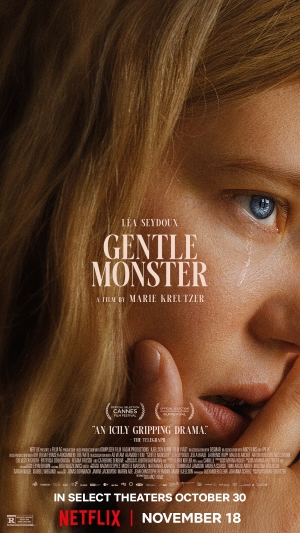
"The article made it very clear to me how close the perpetrators mostly are in most cases," she said. It also prompted a disturbing personal realization: "I must certainly also know - not only victims of child sexual abuse, but also perpetrators myself."
Further research forced her to confront the stereotypes she had brought to the subject. Rather than create a husband whose behavior would immediately invite suspicion, she wanted an audience to recognize the couple as people they might know.
"I really wanted to show a man and a couple that could feel like friends to an audience," Kreutzer said.
That familiarity was essential to the film's construction. The audience needed to share Lucy's hope that an explanation might preserve the life she believed she had.
"I think we've all heard in our lives and also said that sentence, ‘He would never do that,' about someone," Kreutzer said.
"When it's someone we know, that's way harder to accept, because everyone has different sides to them, and also monstrous people have likable sides, unfortunately."
Seydoux's agents initially approached the script with a warning: its subject might make her reluctant to take the role, particularly as a parent.
"They told me about the subject, and I have to say that I was a bit scared of it," she recalled. Reading the screenplay changed that. "I just fell in love with the character."
A Zoom meeting with Kreutzer followed.
"We fell in love," Seydoux said.
Asked about Lucy's fear of confronting the truth, Seydoux offered a different description.
"It's not really afraid, I wouldn't say afraid. I think she's just like in a state of shock," she said. "It's a shock after another shock."
The attraction was the opportunity to follow the revelations through Lucy, rather than approach the story directly through either the perpetrator or a victim of the child sexual abuse.
"What I thought was so interesting is that I was able to really bring a lot of different emotions and things that are not really explainable with words."
That meant letting the performance carry what dialogue could not. Seydoux described working through her body and facial expressions, internalizing emotions rather than explaining them.
Lucy's isolation also presented a practical acting challenge: Seydoux had to perform emotionally demanding scenes in German, a language she does not speak.
She recalled struggling with the pronunciation of a particular word during a scene opposite Haase. The effort to get it right, while sustaining the emotion of the scene, eventually brought her to tears.
But the frustration also connected her to Lucy.
"Actually it was like what Lucy's experiencing, the fact that she can't really express herself, and she doesn't speak the language either," Seydoux said. "And so she's even more isolated."
What could have remained a technical obstacle became part of the character's predicament. Lucy is trying to understand what has happened to her family while struggling to make herself understood.
German was not the only skill Seydoux had to work on. Playing a pianist required preparation in Vienna with Kreutzer and a piano teacher, and she described the instrument as the hardest technical part of the role.
Singing was another matter.
"And the singing you loved," Kreutzer prompted.
"So it's my voice. That is my voice, and I'm proud of it," Seydoux said. "And I've always loved singing, so that was for me also a dream come true."
Lucy's musical identity developed gradually during the writing. Kreutzer knew early that the character would play piano, but gravitated toward pop songs rather than classical repertoire. She assembled songs, studied their lyrics, and sent selections to the colleague handling music clearances.
Then he noticed something she had not.
"At one point he called me and said, ‘Are you aware that all of these songs are written by men? Why is that?'" Kreutzer recalled. "And I was like, ‘Oh, I didn't even realize.'"
The observation became part of Lucy's artistic approach: a woman interpreting songs written by men, bringing her own perspective to their words.
Asked by the moderator how her experience making "Blue Is the Warmest Color" had changed the boundaries she sets in her work, Seydoux described both the production and the response to her speaking publicly about it.
Seydoux described that production as deeply distressing and said she first saw the finished film, including its explicit scenes, at Cannes without having approval over those scenes.
She also recalled pressure to stop discussing her treatment during production. According to Seydoux, producers warned that speaking publicly could damage the film's awards prospects.
"I want to explain how mistreated we've been on this film," she said. "And I didn't say like half of what happened, really, it was horrible."
Seydoux said she was subsequently removed from promotional activities and was unable to attend the Golden Globes despite the film's nomination. She also described feeling humiliated when a question at an event with Golden Globe voters invoked her privileged family background to challenge her account.
Those experiences changed what she required on later productions.
"From that experience, I want, of course, to have an approval, a final approval on the sex scenes," she said.
With Kreutzer, she described a collaborative process in which the director showed her the intimate scenes.
"Of course, I need to have the approval on that, because it's so intimate."
After the discussion, Seydoux received Middleburg's Outstanding Achievement in Acting Award. Her acceptance speech revealed that this was not her first visit to the area.
"I'm very happy to be honored with this particular award here in Middleburg, Virginia, because this is where my parents used to send me to summer camp!"
She recalled making her first trip to the United States alone at eight years old, equipped with three English phrases: "Yes," "No," and "Sorry, I don't understand."
The experience was difficult, she said, but rewarding. It introduced her to a new culture long before she knew that crossing borders would become part of her profession.
"I didn't know then that I'd become an actress," Seydoux said, "and that this would be my life: traveling, discovering new cultures, and exploring human nature."
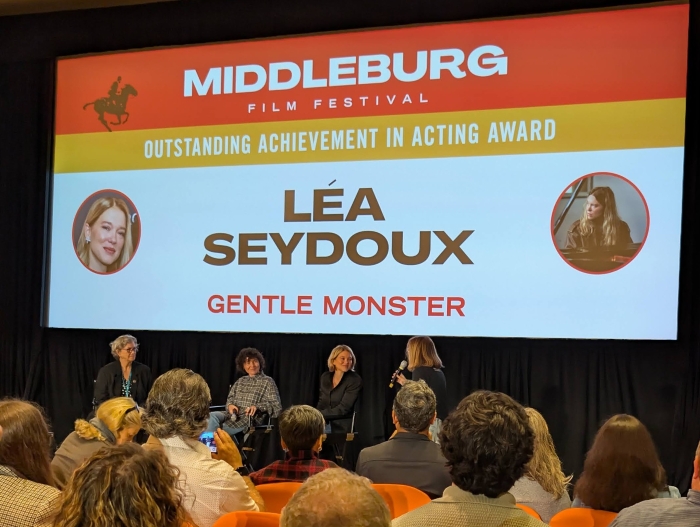
Gentle Monster panel at Middleburg Film Festival featured writer-director Marie Kreutzer (center left) and star Léa Seydoux (center right) and moderated by Anne Thompson of IndieWire. (Photo credit: Stuart Shave)