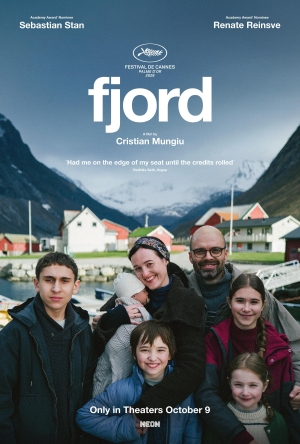
Loosely inspired by a real case of Romanian parents whose children were taken by Norwegian authorities, Cristian Mungiu's "Fjord" follows Mihai Gheorghiu (Sebastian Stan) and his Norwegian wife, Lisbet (Renate Reinsve). When the couple settles in a remote Norwegian village with their five children, the children's friendships with the neighbors' kids give the family an initial sense of belonging. Then their teenage daughter, Elia (Vanessa Ceban), shows up at school with bruises. Child Protection steps in, the children are abruptly removed, and the Gheorghius begin a long, grinding fight to try to bring them home.
The film carefully withholds how Elia got her bruises, but does reveal that the Gheorghius physically discipline their children. Spanking is unacceptable, and certainly in Norway, where corporal punishment is outlawed. But viewers who grew up being spanked may not regard the Gheorghius as inherently evil for what the parents describe as a slap on the butt. The film trusts each viewer's background to shape that verdict.
Reinforcing the complexity of "Fjord" is its nuanced approach to communication and understanding. Language barriers and clashing perspectives shape the conflict: the same discipline gets a different name depending on who is speaking. The parents tend to downplay it as a "slap," often "a slap on the butt." Child Protection's representatives reach for harsher words like "kick" and "punch," which serve their own case. The children, too, may be describing events inaccurately without intending to. But our glimpses of the incidents are obstructed, and much of their testimony to Child Protection takes place offscreen, leaving us without a clear account against which to measure anyone's language. The question extends beyond whether a law was broken to matters of intent and context. Every word choice is a small act of persuasion, and the film makes you notice each one.
For much of its running time, "Fjord" offers no obvious villains, which isn't the same as having none. The Gheorghius' devout Christianity is never in doubt, but "Fjord" avoids the caricature of American evangelicalism that audiences might expect. Their faith isn't what condemns them, and the film doesn't absolve them either. Their children preach clumsily at school (they are children, not rhetoricians), which only turns authority figures against them. Mihai and Lisbet's strict household, with no video games and no YouTube, strikes the other parents as hopelessly archaic. The disapproval in these everyday encounters is mostly understated. That restraint doesn't excuse the judgment, but it makes those passing it more recognizably human.
Those tensions become overt as the struggle to bring the children home builds toward a contentious hearing, with a criminal trial still to come. Feeling powerless, Mihai turns to Christian influencers for help. But the support they rally swells into an angry mob outside the building, while inside, Child Protection's lawyers are openly antagonistic. The help Mihai sought brings pressures of its own. The family's predicament becomes a vehicle for other people's convictions.
The performances are natural and emotionally precise without showiness. Stan is brilliantly reserved, almost chameleonic with his shaved head, as the taciturn Mihai. His ease speaking Romanian adds another layer of texture to the performance. Reinsve gives Lisbet rage, shame, sadness, love, and steel as her children are taken from her and she endures humiliations perpetrated by state agents who are less neutral than they should be. Both communicate as much through expression and silence as through dialogue.
Norway's changing seasons mark the long months the Gheorghius spend fighting to get their children back. Tudor Vladimir Panduru's crisp, steady images of the mountain landscape and the village below let you feel the cold from your seat. Indoors, handheld cameras (mercifully not too shaky) bring us close to the intimate reactions in these difficult situations. Mungiu's pacing is deliberate, even slow at times, but never aimless. He frames this intense, human drama against the landscape without letting the scenery take over.
"Fjord" occupied the Middleburg Film Festival's pre-fest showcase slot, following such formidable selections as "Parasite" and "Anora."After seeing it, I understand why it won the Palme d'Or at Cannes and was selected as Romania's submission for Best International Feature Film. It is a measured, compelling drama about perspective, cultural relativism, and how progressive thinking can become oppressive despite itself. "Fjord" doesn't hand you a verdict. You leave the theater considering your own, but not necessarily feeling comfortable with it.
| Movie title | Fjord |
|---|---|
| Release year | 2026 |
| MPAA Rating | R |
| Our rating | |
| Summary | Cristian Mungiu’s 2026 Palme d'Or-winning film finds unsettling power in the space between protecting children and understanding a family, with Sebastian Stan and Renate Reinsve anchoring a drama where conviction is abundant but certainty is elusive. |