Written and directed by Alex Huston Fischer and Eleanor Wilson, and adapted from Ursula Wills's short story "The Wicker Husband," "Wicker" builds its world with the same care it gives its unlikely romance. I caught it at the 2026 Middleburg Film Festival, and its lightly medieval fantasy setting evokes "The Princess Bride" in the balance between broad storybook strokes and small, telling details. This is a village with a life beyond the immediate demands of the plot: a place of work, ritual, tradition, and superstition, all rendered with enough texture to make its fantastical premise feel at home. Production designer Renátó Cseh, whose credits include "Poor Things," supplies much of that detail. The film is rich and beautifully crafted: funny, moving, and surprisingly ribald.
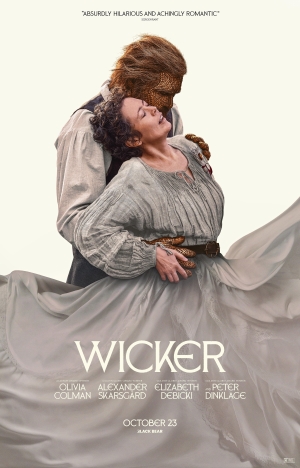
It's less a meet-cute than a sarcastic custom order. Tired of being the village's favorite punchline, Olivia Colman's reclusive Fisherwoman asks the Basket Weaver for a husband made of wicker, and the weaver takes her at her word.
The costumes, by Tóth András Dániel and Godena-Juhász Attila, do much of the world-building. Each character has a distinct style that helps establish a place in the community, making clothing an extension of personality and social position rather than merely attractive period dress. The most extraordinary achievement, though, is the wicker suit designed by Weta Workshop for Alexander Skarsgård. It's an excellent piece of practical craft, with smart and subtle VFX enhancements, but its success goes beyond the construction: the suit gives us a convincingly woven figure without preventing the actor inside from making him a character. The facial prosthetics, designed by Joe Dunckley, are especially impressive; behind a mask this elaborate, Skarsgård still emotes, his eyes in particular doing remarkable work.
The film's look and sound are just as attentive. Lol Crawley, who shot "The Brutalist," favors a natural look with a pastoral softness that gives way to clearer, harder images in the darker emotional moments. Anna Meredith's score is ethereal and whimsical, which suits a story that never lets its fairytale logic go unquestioned.
The same balance between the fanciful and the recognizably human extends to the performances. A sharp script gives its three leads room to play to their strengths while finding real richness in characters who might initially seem like storybook types. Elizabeth Debicki makes the Tailor's Wife a tightly wound knot of haughtiness, repression, and calculation. Colman's Fisherwoman, meanwhile, wears an air of cheerful unconcern that doesn't quite conceal her loneliness. She seems broadly untroubled by what others think of her, but that doesn't mean she has stopped wanting someone to love.
Skarsgård brings some of his "Murderbot" skills to the wicker husband: the stilted speech and the stiff, robotic physicality, both of which contrast with the simplicity and directness of his affection. He loves the Fisherwoman, tells her so, and expresses that love with considerable enthusiasm. The sex is plentiful; the tenderness is just as important. His physical strangeness becomes less remarkable than his lack of embarrassment about either.
The supporting ensemble makes the village feel equally alive. Clever dialogue gives nearly every scene something to do beyond advancing the story, developing the inhabitants along with the customs and assumptions that govern them. At the edge of this activity sits Peter Dinklage's Basket Weaver, whose handiwork sets everything in motion. Possibly a witch or a warlock, certainly more than an ordinary craftsman, he appears sparingly, serving as a kind of Greek chorus at key moments. Dinklage makes each appearance count without exhausting the character's mystery.
"Wicker" is hardly coy about its satire of masculine and feminine roles, or of marriage itself. The men are identified by their occupations; the married women are known only by their husbands' trades. Debicki's character shows how it works: she's known as the Tailor's Wife but was previously the Doctor's Daughter. Meanwhile, the Tailor's Wife's Sister points to a second tier for unmarried women attached to influential people, until she marries and becomes the Bottlewasher's Wife. Identity, work, and marriage are woven into the village's social order before its newest resident arrives to tangle them up.
This new wicker man is the perfect husband, devoted and uncomplicated in a manner befitting a fairy tale, and the film uses that simplicity as a catalyst for everyone around him. At first, he provokes revulsion, then curiosity and gossip. But the real disruption is the couple's conspicuous happiness. She plainly loves him, and he plainly loves her, a mutual devotion that inspires fierce jealousy and more than a few fantasies among their neighbors. The satire's targets are unmistakable, with gender roles and the institution of marriage both squarely in its sights, though it doesn't interrogate either too deeply.
If the film has a weakness, it's pacing. The tone shifts across the story's major arcs, but it's the final third that feels compressed next to the first two-thirds as the plot wraps itself up. That compression leaves some of its stranger ideas unexamined, including what it means to make things beyond a husband out of wicker. It isn't terribly damaging, but it is noticeable against what has come before.
There is plenty of comedy in watching the village struggle with the couple's happiness, but "Wicker" is doing more than finding increasingly outrageous ways to tell a story about a woman having sex with her newly made companion. As Dinklage's Basket Weaver insists, the wicker husband is not just "f---able furniture," and the film agrees. Its bawdiness opens onto more complicated territory: loneliness, desire, prescribed roles, and the resentment that someone else's happiness can provoke. Some of that territory is considerably darker than the premise might suggest. The film's particular achievement is making room for that darkness without losing its humor, tenderness, or unabashed pleasure in an improbable love.
Read more from the filmmakers and Olivia Colman in our Middleburg Film Fest "Wicker" Q&A recap (warning! contains spoilers).
| Movie title | Wicker |
|---|---|
| Release year | 2026 |
| MPAA Rating | R |
| Our rating | |
| Summary | This beautifully crafted, ribald fairy tale romance sees Olivia Colman’s lonely Fisherwoman commissioning a husband from wicker, and Alexander Skarsgård bringing the premise to life with the help of an expressive, practically built suit. The film’s satire of marriage and gender roles is pointed but shallow; nonetheless, it balances humor, tenderness, and some surprising darkness. |