I'm no mountain climber, so it's no surprise that my first encounter with the name Tenzing Norgay was a joke on Archer, a show with a gift for slipping surprisingly deep-cut references into deeply unserious situations. An unlikely introduction, perhaps, but "Tenzing" gives that passing acquaintance the substance it deserves. Director Jennifer Peedom, working from a script by Luke Davies and with Genden Phuntsok in the title role, delivers a visually magnificent dramatization of the first successful summit of Mount Everest. Its greatest strength lies not in the suspense of reaching a summit, but in what the mountain means to the man climbing it.
The film reaches the peak by a roundabout route. Rather than march up the mountain in order, Peedom cuts back and forth among three periods of Tenzing's life, letting each interrupt and illuminate the others. One thread follows a boy (Samdrup Dorje Lama) who forms his bond with Chomolungma (the Tibetan and Sherpa name for Everest) in its shadow and meets the European climbers drawn there, George Mallory among them. Another follows a young man (Tenzin Dalha) working as a farmhand while he woos his future wife, Dawa (Thinley Lhamo), before they set off together for Darjeeling so he can join the climbing teams. The third finds the adult Tenzing a widower who has already come within reach of the summit with the Swiss. The British want his experience, but not his ambition, and he has to fight to be a climber rather than a porter. By intercutting these periods, Peedom lets the mountain's pull be felt throughout, not just announced at base camp.
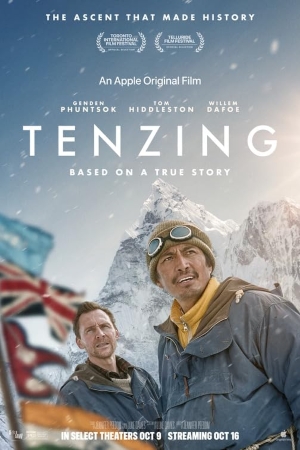
The story is straightforward in content, if not in order, with a clear objective and outcome already known to history. What the film offers in place of conventional suspense is contrast. The expedition treats the summit as a prize, its ambitions shaped by the jockeying of European nations. Willem Dafoe's Colonel John Hunt supplies the military and national context that makes those stakes concrete without becoming their dramatic centerpiece. For Tenzing, the summit is something else entirely, and that is where "Tenzing" finds its emotional footing in the relationship between an extraordinary climber and a landscape of deep personal and spiritual gravity. A quieter, but still essential, anchor is his partnership with Edmund Hillary (Tom Hiddleston), built on mutual respect. Phuntsok makes those bonds visible, not just stated.
The film builds that partnership with care, and its dramatic license never feels forced. Hillary backs Tenzing steadily, giving him room to prove himself without ever tipping into white-savior territory. When the ice gives way beneath Hillary, it is Tenzing's rope, ice axe, and quick thinking that keep a crevasse from claiming him, an incident drawn from real events. The scene lifts Tenzing without diminishing Hillary, who publicly credited the partnership, and it never lets friendship overshadow Tenzing's achievement.
Phuntsok is the film's quiet center. His Tenzing is built on stillness and resolve, not barnstorming speeches, but he's no taciturn mountain man either. He is open with his team, and his candor and conviction make it plain that he is every bit as capable as any climber in the party. Phuntsok builds a man, not a monument, even when the film around him makes room for the latter. It's a lead turn that holds the three-era structure together: the adult Tenzing carries enough weight to pay off what his younger selves set up.
The performances are earnest without being stiff. With the title role split across three actors, Samdrup Dorje Lama and Tenzin Dalha are as convincing in their eras as Phuntsok is in his. Hiddleston brings his usual charm, tempered by smart restraint. The script leans Hunt toward a familiar type, the rigid British regimental man, but Dafoe plays him with enough humanity that the colonel never reads as a trope. That humanity also makes Hunt's willingness to heed Tenzing's counsel feel like judgment rather than plot necessity.
Caitríona Balfe and Thinley Lhamo make the most of roles that seem underwritten. Balfe's Jill Henderson is positioned as consequential in getting Tenzing his first expedition and in connecting him to the crucial final one, but has little to do otherwise. Lhamo's Dawa is there mainly to encourage and inspire Tenzing, then, in her absence, to serve as his emotional background. Neither gets much room, which suits a film that keeps its eyes on Tenzing.
That tight focus on Tenzing keeps the world around him at the edges of the frame. The racism on display is the polite, paternal kind: the British prize Tenzing's strength and experience, and may even like him, but treat his ambition as something to be managed rather than honored. A similar pecking order has them teasing Hillary for being a Kiwi, a jab milder in tone but cut from the same cloth, and it runs down through the ranks, too. Pasang (Tenzin Jigmey), an ethnic Sherpa, dismisses Tenzing, who is not Sherpa, when he arrives in Darjeeling. Peedom registers all of this, along with the European climbers' presumed dominion over the Sherpas and other Asians who make the ascent possible, but only lightly examines it.
Interpersonal friction is where the story is less sure-footed. Pasang is the film's only real human antagonist, but he is resentful rather than oppositional. He's less a rival than a speed bump with opinions. By the time of the expedition, the two have settled into a tolerant working relationship, and Pasang grudgingly grants Tenzing his respect along the way. It's believable enough, but his resentment adds flavor more than weight, never meaningfully complicating the plot or Tenzing himself. That points to a portrait more intent on lionizing its heroes than subjecting them to the ambiguities of a thornier character study. The admiration is sincere; occasionally, it is also a little too protective.
What offsets these shortcomings is the spectacle. When "Planet Earth" arrived in 2006, nature photography this spectacular seemed the BBC's exclusive province, a standard to marvel at rather than expect other productions to match. Twenty years later, Peedom and cinematographer Stefan Duscio match that standard in a dramatic feature and fold that imagery into a story with real feeling. These are images worth seeing on the largest screen available, but their value is more than scenic. The cold, the thin air, and the boulders of ice shearing off the mountain make the danger tangible, and in doing so give substance to Tenzing's connection with a place that the expedition's competitive ambitions cannot fully explain.
The costuming deserves a mention, too. Kirsty Cameron's wardrobe is period-specific and culturally grounded across an impressive range: Tibetan herders and farmers, Buddhist monks, the Europeans, and the Indian and Sherpa communities of both Darjeeling and the path to the Everest base camp. The variety of mountaineering gear gets the same attention, and the film's world feels dressed with care rather than costumed.
Credit for the film's sense of place extends well beyond the cinematography. Nothing here ever feels like a soundstage, and that is the work of many hands: Melinda Doring's production design, the visual-effects teams who extend and blend the landscapes, and the stunt and alpine crews who made it possible to shoot on real ice. The production worked in Nepal before wrapping on the glaciers and peaks of New Zealand, which stand in for the higher stretches of the climb, and the join is invisible. By Peedom's account, Hiddleston and Phuntsok did their own climbing, with doubles reserved for the widest shots, and the physical stakes show it.
Peedom's film is gentler than it is probing, more inclined to honor its hero than to interrogate the world that underestimated him. That is a limit, but not a fatal one: the craft gives the story somewhere meaningful to go, and Phuntsok gives it someone worth following. History has already told us how the ascent ends. "Tenzing" restores attention to the man who made it possible, and what he carries to the summit is the reason to watch: a bond with the mountain that predates the expedition, and one with Hillary that the film earns. Though it will soon stream on Apple TV, "Tenzing" is worth seeking out in a theater.
| Movie title | Tenzing |
|---|---|
| Release year | 2026 |
| MPAA Rating | PG |
| Our rating | |
| Summary | This reexamination of the first successful summit of Mount Everest is a handsome, sincere portrait of the man history too often left in Edmund Hillary's shadow, and even if it admires its hero more than it examines the world around him, lead actor Genden Phuntsok's understated performance and the film's immersive craft make it well worth finding on the biggest screen possible. |