David Leitch has never met a set piece he didn't want to speed up, and "How to Rob a Bank" finds the director of "Bullet Train" and "The Fall Guy" with his foot to the floor from the opening frame. It is a heist movie built for the age of the algorithm: hyper-stylized, relentlessly kinetic, and wired into the same attention economy its characters learn to exploit.
Nicholas Hoult leads a crew of masked bank robbers who don't just pull off their jobs - they also publish the instructions. Their videos, posted to satirical takes on YouTube, TikTok, and Instagram, turn every completed robbery into a step-by-step tutorial, and every tutorial into a bigger following. The larger the audience grows, the less the crew looks like criminals and the more it looks like content creators with a cause, and a pointed one at that. On their trail are a veteran FBI agent (John C. Reilly) and a software engineer (Zoë Kravitz), an unlikely pair trying to catch a crew that brags about its work once the job is done.
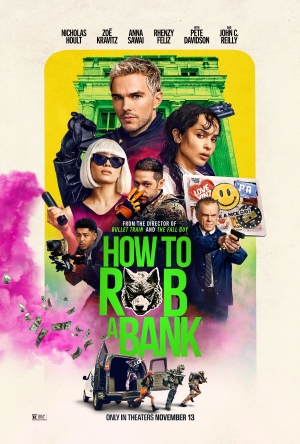
Whatever you make of the film's politics, the craftsmanship holds up. Leitch stages more than one inventive chase, and a pair of practical car crashes land with real weight. The stunt work and fight choreography are strong, with parkour, acrobatics, and brawls you can actually follow from punch to punch, a clear sign of his years as a stunt performer and coordinator. He even scatters QR codes through the frame, effectively daring the audience to do the one thing theaters beg them not to: point a phone at the screen.
Hoult carries the whole thing. Following his take on Lex Luthor in last year's "Superman" he's charismatic all over again, but as the story unfolds, we see what the swagger is covering: a profound emotional wound papered over with showmanship. It's a turn that gives the character more weight than the slick surface around him suggests.
Reilly matches his charisma, and the setup tips its hat to "Heat": the veteran lawman and the professional thief, circling each other. But Leitch doesn't try to recreate that great dynamic. These two men never really come to understand each other, and the script only bothers to give one of them an inner life. Hoult gets a backstory and a real emotional stake, while Reilly is given almost no meaningful background. He never quite becomes the cop who grudgingly admires the thieves, either, but he fares better alongside Kravitz. The two develop an easy chemistry as ad hoc partners and double as something of a Greek chorus, reacting in real time as the crew commits its robberies and cuts promos for its work.
Among the supporting cast, Christian Slater leaves the strongest impression as a gloriously weaselly bank executive. Pete Davidson is less fortunate. His character is saddled with an overwrought subplot involving his daughter that strikes an entirely different tone from the rest of the film. The rest of the ensemble is perfectly fine without anyone breaking out.
Leitch and screenwriter Mark Bianculli know their heist-movie conventions and pick which ones to keep. They skip the crew-assembly sequence entirely, opening on a team already in place and filling in their relationships as they go. The planning montage gets flipped, too: instead of blueprints before the job, the crew's online video tutorials walk through each heist after the fact, folding the genre's favorite exposition into the premise itself. Other staples survive intact. The final job isn't one last score before retirement but the endgame the whole scheme has been building toward; the getaways go sideways more than once; and an inside-man double-cross is held back until the last possible moment.
What they never skip is the defining habit of the modern heist movie: making the crew's intentions the real puzzle. Nobody in these films robs a bank just for the money anymore. The vault is only a means, and the question of what the thieves are really after drives the story more than that big score ever does.
Beneath the polish, "How to Rob a Bank" has a central argument, and it isn't subtle: unchecked capitalism and profits over people are the real villains. It hits every "of the moment" button within reach to make its case - and the film means every word of it. For some viewers, especially those watching housing and tuition costs climb out of reach, that sincerity will land as rousing. Others may find it naive. For me, it captures today's economic angst but boils it down too neatly. Once the crew's motivations come into focus, the story loses some of its tension. The surprises taper off and the narrative settles into a straight line, even as the action continues to escalate.
The film wears its influences openly. Beyond the "Heat" nod, there's a strong strain of "Dog Day Afternoon" in how the robbers use the media to win public sympathy, and a touch of "Fight Club" in how the ultimate target turns out to be different from what most of the runtime suggests. Sharp-eyed action fans will also catch a wink to "Die Hard 2" in the weapon magazines marked with red and blue tape to tell live rounds from blanks. Leitch doesn't reach the heights of those films, but he isn't aiming for them, either. These feel like deliberate nods rather than attempts to compete, and he fills the borrowed shapes with his own energy.
None of that borrowing slows him down, and none of it adds much depth. This is a fun, flawed, and slightly thin movie that knows exactly what it's selling, and it's a better time than its star rating might suggest. For anyone in the mood for a loud, slick action ride, it's the cinematic equivalent of junk food: satisfying in the moment, if not especially filling. Come hungry for chases, crashes, and swagger, and "How to Rob a Bank" pulls off the job.
| Movie title | How to Rob a Bank |
|---|---|
| Release year | 2026 |
| MPAA Rating | R |
| Our rating | |
| Summary | David Leitch’s latest is hyper-stylized action-movie junk food: loud, kinetic, and satisfying in the moment, with a charismatic Nicholas Hoult and a sincere anti-capitalist streak, but a story too thin to really seem filling. |