At first glance, "Club Kid" looks like "Big Daddy" with far more queer characters and far more drugs. The setup invites the comparison: a man with no business raising anyone suddenly finds himself responsible for a child. But Jordan Firstman's feature directorial debut finds its own footing fast. It leaves Adam Sandler's 1999 comedy behind, developing an entirely different emotional angle and building toward an ending that reckons with its premise far more seriously.
Firstman, who also wrote the film, stars as Peter, a fixture of New York's queer nightlife who has spent a decade throwing parties and is well known as the scene's go-to party drug dealer. Then one morning a visitor turns up at his door: Arlo (Reggie Absolom), the 10-year-old British son Peter never knew he had.
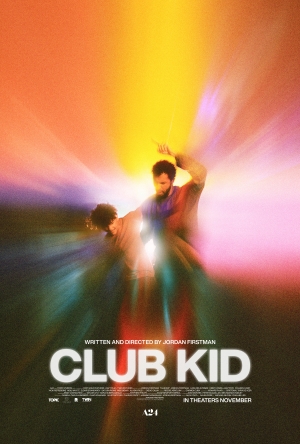
That's where I struggled with the film, and with Peter's character. When we meet Peter, he's a drifting mess of a person, using his party organizing as a fig leaf to keep partying himself and as a means to both sell and use drugs. The film doesn't judge him, but I can, and do. He's fundamentally unlikeable, and saddling him with a child feels a bit cruel to everyone involved. Arlo's arrival kickstarts a second act in Peter's life, and the whole film is in service of redeeming that problematic origin. Redemption arcs are hardly uncommon at the movies, but I had a hard time getting on board with this one. The constant tonal shifts didn't help either, and as the film lurches from funny to serious to absurd, I found it harder to settle in.
What softens my resistance is that Peter doesn't redeem himself alone. Arlo forces Peter's whole circle to adapt, and his nightlife network becomes an unorthodox co-parenting unit. The main responsibility still falls to him, but the film convincingly shows an entire subculture rallying around a child, without sanding off any of that crowd's quirky energy and personality. The film also passes no particular moral judgment on club culture, casual sex, or drug use; it's matter-of-fact about all of it, in a way that feels natural.
There's real warmth and honesty here, even when the lead is hard to like, and much of the credit goes to Firstman the actor. Whatever my reservations about the character on the page, he plays Peter with genuine charisma and heart, and he has a strong scene partner in Arlo. The boy is well written as a slightly confused kid rolling with the punches of his changing situation, never overly cutesy. Absolom brings real pathos to the role, giving Firstman something to bounce off in their more emotional scenes, including a father-son duet of Ethel Cain's "Thoroughfare" at the piano.
The regulars orbiting them hold their own, led by Eldar Isgandarov's Nicky, Peter's couch-crashing friend, who steals scene after scene. Cara Delevingne is magnetic as Sophie, Peter's slightly unhinged, manic business partner until the two part ways early on. Diego Calva is handsome as Oscar, Arlo's social worker and Peter's romantic interest, but I never felt electric chemistry between the two men.
For a first-time writer-director, it's impressive work behind the camera. Firstman's script and direction are competent and engaging, and despite those tonal shifts, the film is well paced, with no obvious lags. At about two hours it does run long, but I never once checked my watch.
Firstman also knows how to put you in the room. The club sequences are a barrage of heavy beats and intense, pulsing strobes that genuinely make you feel like you're on the dance floor, to almost disorienting effect, with Arlo even running the DJ booth. The sound design alone leaves an impression, and when the film quiets down, the music follows, with emotionally fitting cues that carry those moments.
Cinematographer Adam Newport-Berra, shooting on 35mm, plunges the nights into near-total darkness punctuated by strobes and spotlights. By day, his camera turns much more naturalistic as sudden parenthood drags Peter through school enrollment, the playground, a doctor's visit, and sit-downs with Oscar. The editing keeps both worlds moving without stalling, cutting Peter's late-night chaos into his daytime parenting duties so that his disorientation becomes ours. The collision makes the film surprisingly impressionistic; yet even at its most heightened, it stays believable in its New York context.
"Club Kid" earns plenty of laughs, too, and my screening was full of them. Not every joke hit me the way it hit my seatmates, but humor is subjective, and the room clearly found more to laugh at than I did.
The buzz around the film was hard to miss at Middleburg, where Firstman received the festival's Breakthrough Filmmaker Award. It took a while for his performance to overcome my dislike of Peter's first impression, and the tonal swings still nagged at me, but I get why people were so fired up about "Club Kid."
| Movie title | Club Kid |
|---|---|
| Release year | 2026 |
| MPAA Rating | R |
| Our rating | |
| Summary | Jordan Firstman’s directorial debut drops an unexpected-fatherhood story into the pulsing heart of New York’s queer nightlife, with immersive craft and strong performances that earn its warmth even when its lead and tonal swings test your patience. |