Following the screening of "Being Heumann," the Middleburg Film Festival's closing film, casting directors Adam Caldwell and Bernard Telsey said the film took them well off their usual map. The actor lists they normally rely on were no help, so they went looking. They tried flyers and cold calls, emails from strangers who knew someone they should meet, and a local news clip of a high school student with a cane picking up trash around his school. They came back with an ensemble of disabled actors, some of whom had never been on a set, and more talent than one film could hold. Then they accepted the festival's Special Achievement in Casting Award. Moderated by Deadline's Ted Johnson.
For more on "Being Heumann" read Stuart Shave's review from the Middleburg Film Festival.
Adapted from Heumann's memoir, written with Kristen Joiner, Heder's film follows Heumann (Ruth Madeley) as she leads a coalition of disabled activists in a 1977 occupation of San Francisco's federal building. They demand that the government sign regulations to enforce Section 504 of the Rehabilitation Act. Mark Ruffalo plays HEW Secretary Joseph Califano, with Madeline Delp, Dylan O'Brien, and Daniel Durant rounding out the cast. The film opened this year's Toronto International Film Festival.
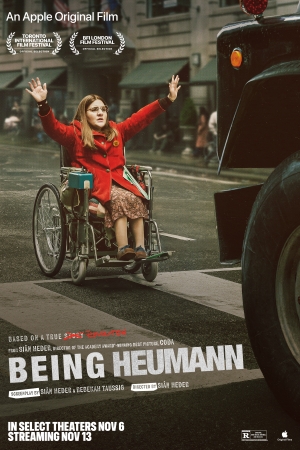
Heder came to the casting process with extensive research and a personal connection to Heumann. Caldwell said the director had worked with her for two years, continuing until Heumann's death, and had spoken with other participants in the Section 504 sit-in. Information from those conversations helped the casting directors understand the people behind the roles.
Telsey recalled that Heder's interest began with "Crip Camp" and Heumann's book. Before "CODA" had been released, she contacted Heumann directly about telling her story. Heumann's response, as Telsey recounted it, came with a deadline:
"I'm this close to making a decision on who I'm giving the rights. If you want to talk to me, you have to do it by 5:00 today."
"Now that you know who Judy is, it sounds just like [her]," Telsey said.
Johnson asked what Heder wanted in her Judy.
"A real spirit, a real force, a sense of humor about things were really important," Caldwell said.
"I always say Brooklyn chutzpah," Telsey added. "Anybody know what that word is?"
Then he defined it.
"Just someone who was a go-getter, and someone who was just a fighter and funny."
Caldwell also emphasized "a vulnerability underneath," because the role required more than determination.
"A big part of the story is, how do you become a leader?" he said. "How do you kind of unite a group of people that, in some ways, have overlapping shared needs, but who also are really individual and want different things?"
Ruth Madeley was already on their radar. Telsey made sure the audience caught one detail.
"She's English, maybe you know or don't know that, so that's all [being done] with an accent."
They had met Madeley a year earlier, when she auditioned for Nessarose in the "Wicked" movie. That role wasn't the right match, but the meeting stayed with them. When "Being Heumann" came along, other people were recommending her to Heder, too.
Telsey remembered "glimmers of everything you needed to see" in Madeley's first audition. More scenes and Zoom sessions followed, then work with Heder and a few days together in New York.
Johnson asked how much they had relied on "Crip Camp," the documentary in which Heumann appears. Caldwell's answer was brief.
"Somewhat."
Then he described a cafeteria scene in which a teenage Heumann organizes her fellow students, fully passionate even though the subject is lasagna.
"It's like her total essence was there," he said. "So we often said, ‘We've got to find the person who feels like they would talk about lasagna in that same way.'"
They also had guidance from someone who knew many of the people being portrayed. Jim LeBrecht, who co-directed "Crip Camp" and served as an executive producer on "Being Heumann," could weigh in on whether a performer captured something familiar about an activist.
Caldwell recalled LeBrecht's verdict on one audition:
"Yes, I think that's it, that feels like that's Dennis Billups."
For Telsey, those memories and impressions mattered regardless of a character's screen time.
"When you're doing a movie about real people, no matter what the size of the role, you want to feel like everyone's a lead role," he said, "even if you're only going to see them for five minutes on screen."
Asked how this search differed from their usual process, Caldwell described working through conventional casting channels while also distributing flyers, using social media, and cold-calling organizations. Sometimes an introduction began with an email from someone who had heard about the film and knew a person they should meet.
"We were connecting with people that we wouldn't have otherwise," he said, "just because there was this swell of support about this film and wanting it to be told authentically and in the right way."
For Telsey, it was eye-opening.
"When you start to work on a movie, you can't help but make lists and lists of everyone that should be seen for this part or that part," he said. "And then you get a movie like this, you know, I get emotional when I talk about it because you go, the list is maybe four people long."
"I don't know these people, and now it's my job to go find them."
Johnson noted that they had looked for actors all over the country. Caldwell corrected him.
"The world!" he said. "I mean, we were flyering, we had United States, Canada..."
"Australia, we saw Australia," Telsey added.
"England, any English-speaking country, because our characters were American," Caldwell finished.
The search introduced them to more actors than the film could hold.
"The amount of actors that we met that didn't even get in the movie, I owe it to them and to myself to see them for other projects," Telsey said.
That made some decisions difficult. Caldwell described turning down actors who felt that this film represented their one chance.
"It felt especially heartbreaking because they often felt like this is their chance, they won't get another chance, this is their only shot that they'd ever be considered to be in a movie," he said.
His hope was that other filmmakers would see the ensemble and respond: "I want these people to be in my other projects."
Two roles stood out when Johnson asked about the most difficult casting challenges: Hale Zukas, played by Andrew Pilkington, and Dennis Billups, played by Charlie Rush-Reese.
Zukas communicated using a board and a pointer. Caldwell described conversations with people with cerebral palsy about the ways they were and weren't like Zukas, including his speech, his fine motor skills, and his humor and wit.
"He's just such a funny guy."
"You actually know everything he's feeling and saying, even if it's not through the way that we're all speaking right now," Telsey said of the character. Finding an actor who could "cross the footlights and be so telling without words" was the challenge.
Then, of Pilkington:
"And, boy, he does it."
Rush-Reese was a college freshman when the team found him, and he had never done an audition like this before.
"Remarkable person," Telsey interjected.
Heder hoped to cast a singer as Billups, and Rush-Reese could sing. But a local television interview revealed something else: he was organizing a trash pickup at his high school.
Caldwell described footage of Rush-Reese moving around the school grounds with his cane, collecting trash and explaining to a reporter why helping his community mattered. Watching it with Heder, he saw qualities they wanted for Billups.
"Look how charismatic this kid is, look how lovable he is. He's doing all the things naturally that you're looking for in the character, so let's work with him as many times as we need to, to let him shine, to let him blossom, to let him be comfortable with all the things we need him to do in the movie," Caldwell recalled saying.
"We loved that kid."
For Telsey, Heder's patience was an important part of the collaboration. Rather than treating an audition as a single opportunity to deliver, she gave performers room to develop.
"You're so used to, in the audition world, it's like you come in, you go out, and a decision is made, and maybe you'll see them one more time," he said.
"She made them all feel so comfortable being who they are and doing what was in the script," he continued. Seeing people "more than once, more than twice" allowed them to shine when auditioning was not something they did regularly.
That attention extended to the ensemble's presence during production. Telsey recalled Heder wanting viewers to recognize the activists as people before their individual speeches or featured scenes arrived.
"I don't want them in the movie just when they're saying their lines," he remembered her saying. "I want them all here for three months so that if they're just walking by or wheeling by, you'll know who they are by the time they have their actual lines or monologue."
An audience member asked about Daniel Durant, who played the brother in "CODA." Caldwell explained that Durant, a close friend of Heder's, wasn't guaranteed a role, though he was always a strong possibility for one of the deaf characters.
"I know him, I love him, I trust him, and I think he'll bring what we need," Caldwell recalled her saying.
In an ensemble of people who had maybe never been on a set, he said, it helped Heder to have collaborators she had "a shorthand with," which "would ultimately help everyone."
Telsey had a question of his own.
"Wasn't Lynette Siân's interpreter?"
Caldwell explained that Lynette Taylor was the interpreter in the film. Telsey tried to help.
"Right, the female interpreter with the curly blonde hair," he said.
"Not blonde, well..." Caldwell said. "Hey, it's dark in here!"
Caldwell explained that the real Taylor, who worked as an interpreter on set, hadn't been sure she needed to be represented in the film, so the character briefly carried a different name. The detour drew a nudge from Telsey.
"This is very interesting, I don't want you to lose the narrative."
At Siena Rafter's final callback, Heder asked whether she happened to know a professional interpreter named Lynette. Caldwell recalled Rafter's answer:
"I've known Lynette for 20 years, she is the reason that I know ASL."
"There's a lot of coincidence moments in this film about people connecting in the community," Caldwell said.
Mark Ruffalo was an early choice for Califano. Caldwell saw an intriguing possibility in asking an actor known for his own activism to play the person on the other side.
"He's an activist himself, he's very vocal, very passionate about a lot of things," Caldwell said. "So if he can buy into the story about being the other side of that, it could be a really exciting thing to do."
Ruffalo responded to the material, despite the relatively small role.
"He just loved this story and just wanted to be part of it," Telsey said. "He, like all of us, just believed in the story."
An audience member asked whether Heder's research had reached the other side of the story: Califano's team, or Evan White, the television reporter played by Dylan O'Brien. Caldwell said Heder had tried to talk with White and finally did, in the week before shooting, though he was a little reclusive. She also had plenty of his footage as a reporter.
"That's an actual real scene that happened when he actually chased Califano into the elevator, like that happened."
For Califano, Heder drew on his book, which supplied small details of the man.
"The fact that he would drink his beer over the ice, the way it's poured in the movie, all those little details."
Caldwell didn't know whether she had spoken to anyone from Califano's team.
"I hope he sees the movie. I think he'd be fine."
Telsey also pointed to the practical changes needed to put a cast like this on screen. Recounting a story Heder tells, he said that in all of Hollywood there had been one accessible trailer available to rent.
"Wow," Caldwell said.
"Well, there was, because there wasn't the need, right?" Telsey said. "And they're expensive, but [thanks to] Apple and Siân, there are now 12 accessible trailers."
He wants every production to know that.
"It's moments like that, or little things like that, that create change."
When Johnson raised the continuing fight over Section 504, Caldwell spoke about what he hoped the film could contribute.
"We hope the power of seeing a movie like this keeps the conversation going, provides humanity to these people, and gives support and, if something is going to be threatened, that there will be enough of us to take collective action to help things from going backwards."
For Telsey, the answer was not to be afraid.
"If you engage in the conversations, if you allow yourself to be in a community of people with disability, they're just like everybody else, and that's what I hope this movie reminds everybody of."
Following the Q&A, festival executive director Susan Koch presented Caldwell and Telsey with the Special Achievement in Casting Award. Telsey's thanks started with the category itself.
"First of all, thank you so much for acknowledging casting, even if it didn't go to us!"
"This is something that I know our peers have all been wanting to be recognized with," he continued, "and everybody knows we now have an Oscar category as of last year."
Caldwell thanked the festival, Heder, the cast, and the community they had worked with. Telsey reflected on how much the project had taught him.
"No matter how much you know, there's still so much to learn, and there are so many actors that are out there that I don't know, and this was a perfect example of why that works when you really, really do the work and you really look for someone that you don't know."
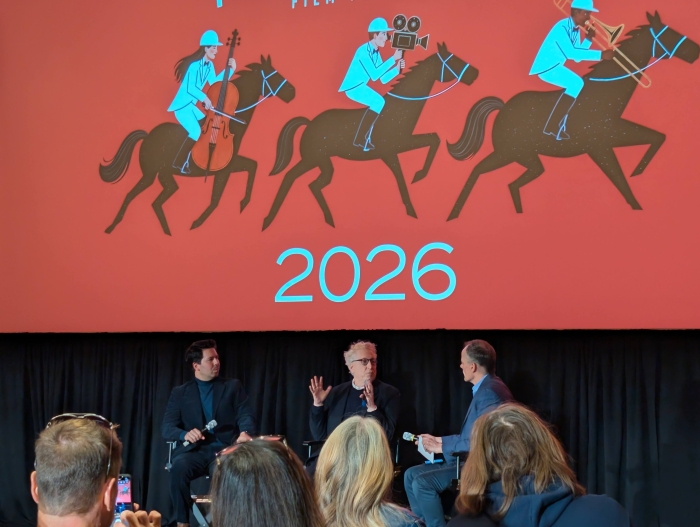
Being Heumann panel at Middleburg Film Festival featured casting director Adam Caldwell (left), casting director Bernard Telsey (center), and moderated by Ted Johnson of Deadline. (Photo credit: Stuart Shave)