"La Bola Negra" opens with music. Sebastián is playing trumpet with his village band when Italian warplanes appear overhead, strafing and bombing until everyone he knows is dead. Soon after, he is conscripted at gunpoint into the very army those planes were fighting for.
It is a devastating overture, and Javier Ambrossi and Javier Calvo, the duo known as Los Javis, build outward from it in every direction. The story moves between 1932, 1937, and 2017, tracing gay lives in Spain across a century of upheaval and repression. They go all in on the historical epic, and the bet largely pays off. The craft and central performances are impeccable. The pacing is not.
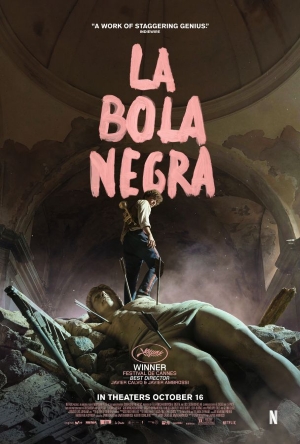
Sebastián, played by musician Guitarricadelafuente in his first acting role, has no faith in the cause and doesn't fit in with his regiment, in more ways than one. Assigned to guard an injured Republican prisoner, Rafael (Miguel Bernardeau), he finds his wariness gradually giving way to something gentler and far more dangerous. Their story draws its power from how little room the two men have. Every kindness is shadowed by the fact that one of them holds the rifle.
Guitarricadelafuente delivers an impressive first performance, capturing the repression, tentativeness, and soulfulness of a young man misplaced at war and discovering who he is. Bernardeau gives Rafael fire and spirit, the sense of a man who lived a rich life before the war found him. They make a handsome pair with real chemistry, and the contrast between them is much of why their attraction reads so well.
In 1932 Granada, Carlos (Milo Quifes) applies to join an exclusive casino and is turned down because of whispers about his sexuality. Members vote with white balls and black balls, and Carlos is blackballed in the most literal sense; the film's title translates as "The Black Ball." The ritual has all the trappings of discretion, yet everyone can see how the votes fall, and it stings more than open hostility would. It is a story about wanting to belong somewhere that would rather not have you.
By 2017, Alberto (Carlos González) is a queer historian trying to make sense of a surprise inheritance from a grandfather he barely knew, beyond the man's fascist politics. The contrast with 1937 is pointed: Sebastián and Rafael's love is never made explicit, while Alberto summons a hookup on Grindr, and the camera shows exactly what follows.
Lola Dueñas is superb as Alberto's mother, Teresa, whose long-held anger at her own father has soured her relationship with her son. The script builds the distance and friction between mother and son deliberately, so that when a long-buried family truth finally surfaces, it recasts everything for her, just as it does for Alberto. Dueñas's performance of this shift is subtle and heartbreaking.
Penélope Cruz and Glenn Close bring star power to consequential supporting roles. Cruz plays Nené Romero, a wartime entertainer who performs for Sebastián's regiment and whose loyalties are not what her audience assumes. She dazzles in a pair of elaborate showgirl-style numbers, but her best scene is a quiet one-on-one in which Nené sees Sebastián more clearly than anyone else has. Close plays Isabelle Durand, a Lorca historian who helps Alberto understand what he has been left, causing him to reexamine everything he thought he knew about his family. Her Spanish carries an unmistakably American accent, but she is a welcome presence all the same.
The title also nods to Federico García Lorca's unfinished play "La bola negra," of which he wrote only four pages, and the directors build their narrative around that fragment. Co-writer Alberto Conejero draws as well on his own play, "La piedra oscura." Lorca himself, played by Alberto Cortés, appears only for a few minutes near the end, yet his work is the spine of all three stories. His appearance works less as a showcase than as a key, unlocking how they fit together, and it lands because the film has spent its running time building the absence it fills.
The craft lives up to the ambition. Ambrossi, Calvo, and cinematographer Gris Jordana compose striking images indoors and out, but the camera is never too clever for its own good. Across a sprawling run of eras, locations, and set pieces, from the war scenes to Nené's stage numbers to the casino, I never once struggled to follow the action. Roger Bellés's production design builds each era into a detailed, convincing world, and Jordana frames that world as if it were made for a gallery wall as much as a cinema screen. Ana López Cobos's period costumes look authentic and made for their era, while the modern wardrobe feels entirely ordinary, in the best way.
Raül Refree's score supports the emotion of each scene, from the tender intimacies between Sebastián and Rafael to the war sequences to an over-the-top flamenco number in Carlos's storyline. Ambrossi and Calvo sometimes test the line between drama and melodrama, and the score follows suit, leaning hard into the big moments. Some may find it intrusive. I found it fit every time. Guitarricadelafuente also co-wrote the original song "La nieve" with Refree, a soul-stirring piece that suits the film beautifully and has a genuine shot at an Oscar nomination.
How the three timelines connect is the film's central puzzle, and the answer is not the one it first invites you to assume. The Carlos thread is the hardest to settle into. It plays a notch too arch beside the other two, and the screenplay eventually accounts for that. The explanation makes the design clearer in retrospect, but it doesn't smooth over the tonal wobble while you're watching.
The bigger problem is length. Nené's two showgirl numbers could easily have been one. For all the dramatic riches between Sebastián and Rafael, the film also devotes several minutes to his regiment's nude beachfront calisthenics, and it is in no hurry to move on. Perhaps the display is meant to suggest Sebastián's repressed desires, but time spent admiring the regiment's bodies is time not spent developing his relationship with Rafael. The daring is never in question. What's missing is a firmer hand in the cutting room. A tighter version would deliver the same sweep with more force.
It's hard to overstate the momentum behind "La Bola Negra." It left Cannes with a reported 20-minute standing ovation and a shared best director prize, won Toronto's People's Choice Award, and is Spain's Oscar submission, with awards watchers now calling it a genuine Best Picture threat. At Middleburg, where I saw it, it won the Audience Award for Best International Feature, and Spain's ambassador to the United States was on hand to present Guitarricadelafuente with the festival's International Spotlight Award. Having seen it, I understand the enthusiasm, even if I don't share all of it.
Still, this is an epic whose execution keeps pace with its reach more often than not. Lorca was killed before he could finish "La bola negra." Los Javis have taken his four pages and given them flesh and bone: an intricate history and a future, entwined by a richly textured imagining of what a fuller version of that play might have been. The lives that history buried become a surprising and priceless inheritance. The film's flaws are the flaws of excess, never timidity, and even when it sags, it never stops being affecting.
Read more from Guitarricadelafuente, in conversation with Variety's Clayton Davis, in our Middleburg Film Festival 2026: "I Had to Truly Live in Sebastián's Skin": Guitarricadelafuente on "La Bola Negra" Q&A Recap.
| Movie title | La Bola Negra |
|---|---|
| Release year | 2026 |
| MPAA Rating | R |
| Our rating | |
| Summary | Los Javis’ sweeping queer epic, built around four pages of an unfinished Lorca play, boasts impeccable craft and moving performances from Guitarricadelafuente, Miguel Bernardeau, and Lola Dueñas, though its excesses and length keep it from fully matching its daring. |