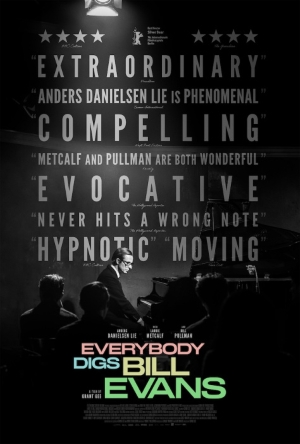
Following the 9 a.m. screening of "Everybody Digs Bill Evans" at the Middleburg Film Festival on Saturday, Oct. 17, at The Hill School, Bill Pullman joined executive producers Albert Berger and Ron Yerxa of Bona Fide Productions, the "Little Miss Sunshine" producers who sit on the festival's advisory board. They talked about shooting 1961 New York and Florida entirely in Ireland, adapting Owen Martell's novel, Pullman's own father, working with Anders Danielsen Lie and director Grant Gee, and how little jazz a jazz film needs. Moderated by IndieWire's Anne Thompson.
In 1961, days after the Village Vanguard sessions, bassist Scott LaFaro dies in a car crash and Bill Evans stops playing. Gee's film follows him through that silence, from his brother's home in New York to his parents' retirement in Florida. Danielsen Lie plays Evans, with Pullman and Laurie Metcalf as his parents, Harry and Mary, and Barry Ward as his brother, Harry Jr. For his work on the film, Gee won the Silver Bear for Best Director at this year's Berlin International Film Festival.
Mild spoiler alert: The discussion touches on the film's final scenes.
As the moderator, Thompson's questions started with geography. Was Florida Ireland? Was New York?
"The whole thing was Ireland," Berger said.
Gee works in experimental theater and does a kind of live cinema built on old-fashioned rear-screen projection.
"Obviously, that came in handy, walking around New York or walking at the ocean when Anders is walking in Florida. All of that is rear screen techniques done in a studio."
The city's scale came from somewhere else. Gee had the idea of using D. A. Pennebaker's first film, "Daybreak Express," a short of New York waking up to Duke Ellington, and the production leased 45 seconds of it.
"It's all these techniques to do things on an incredibly low budget."
Most of the film was shot on a stage, with the occasional bar. A golf course in Ireland stood in for both New Jersey and Florida.
"I never knew Bill Evans was a good golfer," Thompson said.
"Yeah, he was an excellent golfer," Berger said.
Martell's novel, "Intermission," picks up after LaFaro's death, when Evans fell into a tailspin and moved in first with his brother, then with his parents in Florida. Berger said the record gave Martell very little to go on.
"Really, the only thing in his biography written [about that time] is that he would walk around New York in Scott's jacket."
From that, Martell wrote a novel told from the points of view of different members of the family. Gee found the book, and producer Janine Marmot brought in the Irish playwright and actor Mark O'Halloran to adapt it. The adaptation reworked the novel's structure.
"It's very different from the novel. The novel's almost a jumping-off point from this little incident in his life."
Financing was its own problem.
"You couldn't make a movie like this in America," Berger said.
He credited Marmot and Alan Maher with securing government funding.
"There was very little equity in this movie."
Marmot also had the early idea, before Berger and Yerxa came aboard, of casting Danielsen Lie, a regular in Joachim Trier's films. The other two leads mattered too.
"Bill and Laurie had a huge amount to do with this getting made, just their value as actors and their reputations."
Thompson asked about Danielsen Lie.
"Isn't he something?" Pullman said.
The role had a built-in difficulty.
"To play a passive character..." Pullman began.
"Oh, that's hard," Thompson said.
"It's hard to really keep it compelling, because you get frustrated with him. Maybe it's my character."
Then Pullman ran through the rest. Danielsen Lie is Norwegian, and yet:
"He has a good American accent... and then he played piano really well, and he has a steady practice as a medical doctor."
Someone in the audience said, "Wow!"
"Yeah! Jesus, give it a break!" Pullman said.
Berger had one more item.
"He was also married to a supermodel who's turned into an architect."
The piano in the opening scene and at the very end was Danielsen Lie. The British pianist Joe Webb played "Suicide Is Painless," the theme from "M*A*S*H," in the color sequence. Berger said Webb also played in the scene where Pullman and Metcalf are in bed, and was brought in to clean up a passage Danielsen Lie had played on a badly out-of-tune piano.
The ending was all Danielsen Lie.
"But Anders's final performance, that was him."
An audience member had read an interview Pullman gave in Stratford, in which he said memories of his father shaped Harry. She asked how.
"My father was a doctor, and most of my family was in medicine, and there was a lot of the Hippocratic Oath, never focus on your own problems. He had a lot of problems."
Danielsen Lie's father was also a doctor, and Pullman found the parallels ran deep.
"My father had an addiction, and his father had an addiction."
Pullman described what that does to a family.
"We greatly loved our fathers. And it's that, what happens around people, when you have the designated patient kind of syndrome in a family where everybody walks on eggshells because somebody's getting wayward."
"You still love them, you still laugh at them. You spend most of your time thinking how your father's so embarrassing in certain ways."
His father made one more contribution.
"I was six of seven kids, and he was pretty tired, I think, by the time all the rest, and so he gave me a godfather. I was the only one that had a godfather. His name was Mr. Bill. And so there's quite a bit of Mr. Bill in there, too."
Thompson singled out one of Harry's speeches as a favorite. Berger had a story about it.
"You came up with that one. I remember you changed it," Berger said.
Pullman explained what was behind his version.
"Squeezed into a life so small. Being next to somebody really creative can be wonderful when you can celebrate it, but you also have these times where you recognize that you didn't get to a place, that you can see you hadn't achieved everything you thought you might have wanted to achieve."
Thompson noted that the Florida sequence gives Pullman room and time. Pullman said some audience members had remarked after the screening on how much silence there was in the film, something he called useful and rarely heard in movies.
Yerxa said he could have kept watching the parents.
"It seems like it's universal that your parents don't quite understand who you are. And they're trying in some well-meaning way to connect."
Even in a film this quiet.
"It's such a, to me, profoundly moving portrayal of existence, really. And there's so much to take of it, even though it's a quiet film in many ways."
Another audience member noted that the film never wallows in the pain, and asked how the filmmakers avoided it.
"Everybody was aware of the circumstances, and they all gave 110%. Maybe that's the Irish side of some of that crew," Pullman said.
Then he thought of the last scene between Harry, Harry Junior, and Bill, when Harry goes out the door.
"He can't open it very far. He kind of slides through it, and you realize 'cause if he opened it too far, you'd see there was no set!"
"That's how tight the money was, and Albert and Ron really know what it takes to make a movie, and do as much as you can, but don't open that door too far!"
Berger went back to the scene itself. By then, viewers have seen what happens to Harry Junior in an earlier flash-forward.
"His love for his brother, and how difficult that must have been to say to your younger brother that you have made a perfect piece of art, and hats off to you."
He also credited the parents.
"I also have to say that Bill and Laurie as anchors for this movie made the story feel authentic and American."
Yerxa mentioned in passing that Berger "knew Bill Evans very well." Thompson followed up.
"So, you knew Bill Evans?" Thompson asked.
"Well, no, I knew of him, because I was a big fan, but I also saw him perform late in his career. Yeah, when I was in college and stuff, in Boston," Berger said.
"It's remarkable that he went on for so long after. At the end of the movie, there was still years and years of productive work."
Thompson asked whether Evans went back to heroin.
"He was basically a junkie for his entire career. People said about him, it was the slowest suicide in history."
That shaped how Gee and Danielsen Lie played it.
"It was very important to both Grant and Anders that there's no self-pity, and when he is playing music, there is real joy in the music."
The audience member who had asked about wallowing said movies rarely capture the jazz milieu, and asked how much jazz the filmmakers wanted. Berger said the timing helped.
"Part of the way we got by was this was a period when he wasn't playing music, and so that was helpful."
Berger said the Village Vanguard opening was Gee's call, shot in a warehouse by a production designer from the theater who had never done a movie.
"Made you feel like you were in the Vanguard," the audience member said.
"In the Vanguard. Yeah, it's like two walls or something, and some audience, and there you were for this historic moment," Berger said.
"But a little goes a long way."
The music at the end is his favorite example.
"I love that ‘Lucky to Be Me,' the last song in the movie that he plays naked at the piano. So we were able to do a lot with a little."
He found the image itself moving.
"That ending, I think, is so beautiful in a weird way, after all he'd been through, that there's something transcendent about the... bathed in white and him naked at the piano, and all that."
Thompson agreed.
"I loved the last shot, actually. I was sitting in my seat going, ‘Make that the last shot.'"
Thompson asked Pullman about working with Gee.
"He's a tall, lanky Brit, and he's got a boyish nature to him, and also an obsessive side," Pullman said.
Gee came from documentaries, and Pullman said it was essentially like working with a first-time director. He watched Gee lean on his cinematographer, Piers McGrail.
"He really bonded with Piers, the cinematographer. And they had a lot of trust in each other, I think. And Piers is a very quiet guy, and the whole thing kind of was quiet around the setups of the shots and the rehearsals."
"He took the path of least resistance, in a way, to just not overthink some of this stuff."
Berger said Gee used Super 16 lenses for the heroin material and 35mm lenses for Florida and the more traditional scenes.
"Grant is a real visualist. His documentary about Radiohead, ‘Meeting People Is Easy,'... is mind-blowing, and really connected to this stylistically, I think."
Pullman saw the result as bigger than its budget.
"We're always thinking, ‘What is the glass ceiling of this movie?', because it's not general fare... But there's something so, even in black and white, it's vibrant. It feels like it's life. It's really poignant life."
He saw it in Gee's taste from the first frames.
"He was so tasty. He knew exactly. When you see those fingers on that bass at the start of the movie, you know this guy knows tasty."
And in the scene where the Evans family listen to the album.
"There's just one slight moment where Anders turns and Piers lit it just right, and you see him glistening with a tear."
"It's all punctuated by the music, and then you see that tear as a downbeat on that bass. So Grant Gee was the guy for this job."
Yerxa admitted he hadn't known whether he'd sit through the film again that morning.
"Then I thought, if everybody else is here at 9:00, I better be..."
His verdict:
"It's just an interestingly intense way to start Saturday morning. But a very satisfying one to me."
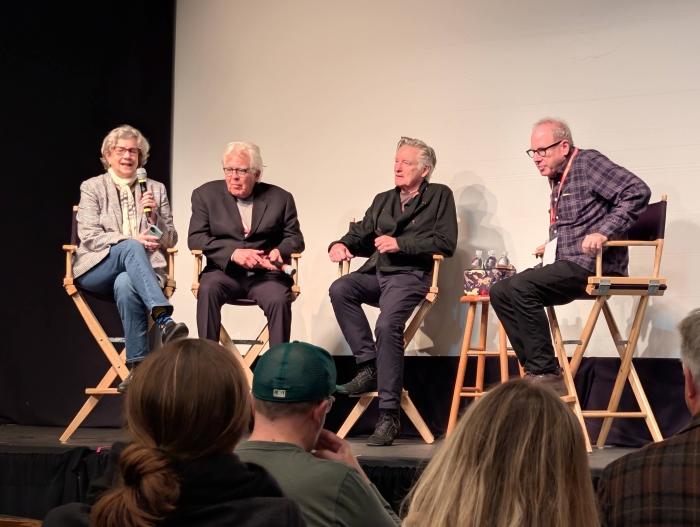
Everybody Digs Bill Evans panel at Middleburg Film Festival featured exexcutive producer Ron Yerxa (center left), star Bill Pullman (center right), executive producer Albert Berger, and moderated by Anne Thompson of IndieWire. (Photo credit: Stuart Shave)