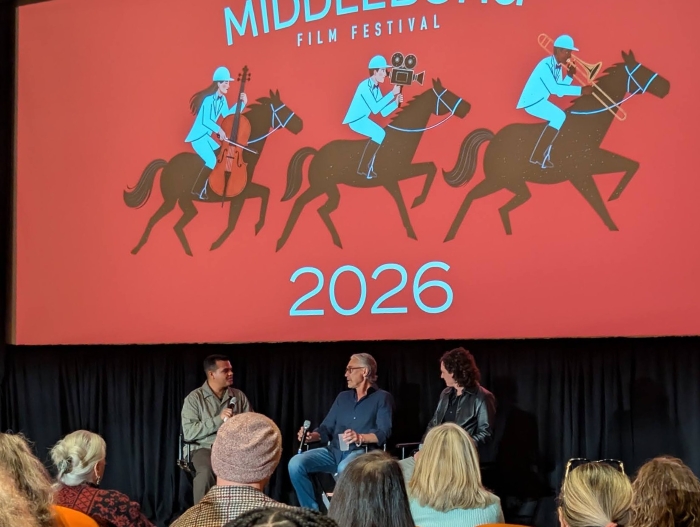
Following the Sunday Spotlight screening of "Behemoth!" at the Middleburg Film Festival, Academy Award-nominated writer-director Tony Gilroy and composer Lukas Frank discussed the movies Gilroy invented for his composers, the one piece of music that wasn't "gettable," and what it's like to rewrite the director's song. Moderated by IndieWire's Marcus Jones, the conversation followed the 10 a.m. screening on Sunday, October 18, at Salamander Middleburg.
The film is Gilroy's first feature as director since 2012's "The Bourne Legacy." Pedro Pascal plays Alex Serian, a cellist who comes home to Los Angeles after two decades on the road and takes work in the city's scoring studios. Olivia Wilde, Eva Victor, Will Arnett, and Hank Azaria co-star. Frank is one of nine composers credited as the "Behemoth!" Collective. Searchlight Pictures opens the film December 4.
Note: the discussion touches on contours of the film's plot, but it doesn't include especially detailed spoilers.
Jones began with Pascal's instrument. Gilroy started with what he called the easy answer.
"The cello is the octave of the human voice. It sounds the most like the human voice. But the corollary advantages of it are just huge."
One was physical.
"It's an instrument you must accept between your legs. There's an embrace to it that's both affectionate and somewhat sensual in a way."
Another was the weight of it, in every sense.
"You're carrying a substantial other being on your back... It's almost like carrying a papoose or carrying a child or something with you everywhere you go. To be an elite musician, man, you can never be too far away from your instrument, 'cause you got to be on point all the time."
Alex spends much of the film recording scores for other movies, and Gilroy had to invent every one of them.
"The movie is the script, pretty much," he said.
With nine independent sources of music, he had to make up the films they came from and give each composer something specific to play against.
"Henry Jackman has to write an escape. And Alan Silvestri has to write this big heist thing, and I have to give them a tone of the kind of movie. I don't want them to be the same movie."
Some of the inventions came with a franchise attached.
"The first one is 'Spies Don't Run,' and it's part of the 'Spies Don't' franchise. There's 'Spies Don't Pray,' 'Spies Don't Love.'"
The art department even made posters for the whole series.
Then there is "Look Away Jones," a TV theme the Serian family's father wrote and Arnett's character introduces. Composer Brandon Roberts, who scored the second season of "Andor," wanted to know the vibe. Gilroy told him:
"It's like a late '70s, early '80s TV show. It's [about] an Alabama quarterback who never looked at his receivers when he threw, so they called him Look Away Jones. And then he ruined his knee, and he won the Heisman Trophy, became a private detective in LA."
Roberts's answer, as Gilroy tells it:
"I got it. I got it."
Jones joked that a "Look Away Jones" review might be next. Gilroy wasn't sure it was his to make.
"Do I own them or not? I wonder if I've given them away as work for hire, and I've given a lot of s*** away for free over the years that I shouldn't have. A lot! So, I don't know who owns 'Look Away Jones.'"
Jones had a suggestion: "Coming soon from Searchlight Pictures."
Even music that never reaches the screen got a backstory. Jones asked about Andy, Arnett's character, whose rock band the film mentions but never plays.
"He was in a band called Circle Factory. He was the bass player, and they were like The Goo Goo Dolls' next/kind of adjacent... he had four or five gold records. He gets Spotify money, but like he says, it's vapor."
Frank saw himself in the character.
"I identify with his character the most."
"There's a lot of that in there," Gilroy said.
"That's why I want to hear Circle Factory!" Jones said.
Jones noted that Gilroy has described assembling the Collective as a casting process. Frank's route into it was personal.
"Lukas and I have a relationship that goes back like 10 years. His father and I are very good friends."
Frank was a touring drummer before he started his band, Storefront Church, and Gilroy had been listening for years. Still, he said, "it wasn't like he was an obvious choice."
The obstacle was the piece referred to as Viviana's requiem.
"All the music in the film was gettable, except the Viviana requiem."
The page called for a six-year-old "beyond a prodigy," a "proto-Mozart."
"It's like when a writer says, 'Oh, the greatest sunset ever.' The director goes, 'F*** you!' I'm on both sides of that equation."
He tried outside collaborators, then his own piano. "It was really, really desperate at a certain point."
Meanwhile, Frank kept lobbying.
"Lukas is like, 'What are you doing? What's happening? What's happening? What's going on? Let me try it.'"
Frank sent cue after cue, and their friendship let Gilroy be blunt.
"Our relationship is different. I could just say, 'No, no, no, no, no... Don't stop, but no, forget it. I don't see this happening.'"
Gilroy eventually took the problem to James Newton Howard.
"We picked the lock on the Viviana thing. It's a very long set of criteria. I could do a half an hour on that one cue. But we got it."
Then he handed Howard the rest of her music.
"At that point, I said, 'Oh my god, James, you know what? Now that you have the genetics of this, now that we know who this is, you should take the rest of the Viviana cues.' And he just destroyed them."
Frank, for his part, hasn't forgotten.
"Someday I'm going to release my four rejected piano requiems."
Gilroy had already titled the piece "My Mother." Frank sent one he was especially proud of, and Gilroy's feedback was less than he hoped.
"I mean, it's great, I'm sure your mother will love it."
Another drew a different verdict.
"This is the definition of 'interesting for interesting's sake.'"
Then came track four. Frank put that melody on his own record without telling Gilroy, and sent it to him anyway.
"He goes, 'Ah, track four is great!' I go, 'Motherf***er, that's the one that you said!'"
Frank's assignment was the song "Your God Is Sleeping," which the 16-year-old Viviana performs in a club. The script gave him only a title, and Frank saw the risk right away.
"If you're not careful, it could be a song that's kind of lecturing you."
Gilroy had pitched Viviana, as Frank remembers it, as "Björk meets Beethoven, except cooler."
"No pressure there," Frank added.
Gilroy then supplied the part Frank had skipped.
"Lukas left out one part of the story, which is that James and I wrote a version of it. I wrote a version of it, I brought it to James, he tweaked it up, and we were like, 'Wait, this is pretty good.'"
They took it to Frank.
"Lukas listened to it, he goes, 'It's really good.' He goes, 'It's really old.'"
"I didn't know I was allowed to tell this story," Frank said.
Jones had planned to ask: "What is it like rewriting Tony Gilroy?"
"Tony wrote this great song. Felt like a '70s protest song," Frank said.
"It gets worse, go ahead," Gilroy said.
"It was a good song. It did not feel like something a 16-year-old girl could write, I think was my complaint about it."
Jones asked whether Frank's background in contemporary art shaped the work. Frank, who has made music for a video artist, wasn't sure the label fit. What mattered more was the job.
"It was somewhere between a cue and a song, where it had to function equally effectively as both."
The scene includes a full minute of dialogue, an argument between Pascal's Alex and Erik Griffin's Bobby, before everyone takes the stage and picks up their instruments. Gilroy had it worked out in advance.
"Every composer has said this about how you had a vision for how it was going to go, and then that's what we saw on screen. It really is the script to a T."
The finished song made an impression on Frank's colleagues, Howard included.
"James was like obsessed with what Lukas was doing, 'cause after 'Your God Is Sleeping'... James was like, 'Wow!' They all think it's the dopest. It's really hard to be that simple and that effective."
Gilroy set himself one strict rule.
"I was really adamant [that] there'd be no underscore except the score that came from the film. I wanted this really disciplined grammar to it."
His brother wasn't convinced.
"My brother's like, 'Okay, cool, man. We'll see, we'll see, we'll see.'"
The rule gave way in the edit.
"We finished, we came back, and watching the movie, put together, I was trying to really stick to my guns, and we're arguing a lot. And he keeps throwing things up to show me, and like, 'Look how good this works, look how good this works.'"
Eventually, Gilroy gave in.
"There was a couple places in the film that I thought, 'Oh my god, I really could use something.' I couldn't really call any of the other composers, 'cause they're all really busy. But I knew someone who wasn't busy."
The result is the cue that opens the film, which Gilroy calls "this sort of Serian family headache that goes through the film."
"It develops in a really sneaky way."
The first hint comes when Alex goes upstairs to use the bathroom and hears Viviana in her room while her sister tells her to wash her hands.
"You hear this little dah, dah, dah, and that's actually the first three notes of that cue."
From there, the cue is "reserved for unpleasantness within the Serian family."
"It's such a subtle, creepy, wonderful cue, and Lukas just crushed it."
Frank had a version of the story too.
"Tony ships over this, all this gear for me to detune my own piano in my studio and for us to record it. He's like, 'Okay, we got to have underscore, but it can't be underscore. I have to win. It can't be music. It can't be music. So, we got to do something. Think like "Seinfeld" theme, but not the "Seinfeld" theme, but detuned piano.'"
"It did leave us somewhere really cool," Frank said.
Gilroy didn't dispute any of it.
"It's the beauty of obsessive moviemaking. You want to do all the crazy things and see what works, and it usually leads somewhere cool, but it's play, a lot of play."
Jones closed with a distinction that has come up in Gilroy's interviews: Alex is a prodigy, and Gilroy has described Viviana as a genius. Gilroy didn't want to underline it.
"I'm not trying to super underline that and say, I want you to come away knowing that there's a difference. I do think there's a big difference."
That difference is what made the Viviana cue so hard.
"I didn't want to do a prodigy requiem for her mother. So, what makes a six-year-old mature? Liberation from tempo. Most prodigies are machines, they hit every tempo. She's completely liberated from tempo, that piece just flows."
The requiem also had to tell a story.
"Most prodigies will not tell you a story; her requiem has a story. She doesn't want to show off. She knows how small her hands are."
Alex is a different kind of talent.
"He's not a writer. You don't see him write anything. She's a writer, she's a creator."
Gilroy pointed to one of his happiest touches, a subtle one:
"She's six years old, you're hearing 'Red River Valley,' you're hearing Clifford Brown's 'Time,' you're hearing this classical piece, you're realizing that this girl has all of these different kinds of music in her head."
Frank's last word was a dry one.
"Tony and I talked a lot, too, about how prodigies oftentimes have really bad taste. Which is why I make sure that I'm bad at all my instruments, so that I have good taste, still."
The song he wrote for her, he said, had to come from "someone who has facility, but isn't afraid to ignore their chops."
Behemoth! panel at Middleburg Film Festival featured writer-director Tony Gilroy (center), composer Lukas Frank (right), and moderated by Marcus Jones of IndieWire. (Photo credit: Stuart Shave)