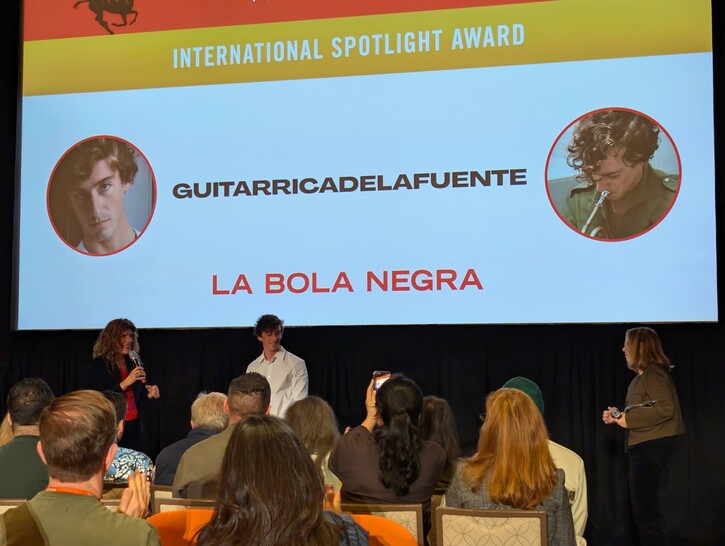
Following the Friday Spotlight screening of "La Bola Negra" at the Middleburg Film Festival, Guitarricadelafuente sat down with Variety's Clayton Davis to talk about how a Spanish singer-songwriter with no acting experience ended up leading one of the year's most talked-about international films. He plays Sebastián, a young Spanish Civil War soldier who falls for Rafael (Miguel Bernardeau), a wounded prisoner he guards in a hospital. As it turns out, the role started with a couple of drinks at a music festival in Barcelona with directors Javier Calvo and Javier Ambrossi, known in Spain as Los Javis. Along the way, he explained why he and Bernardeau weren't allowed to meet outside their scenes, and why Penélope Cruz is, as he put it, "the queen of Spain."
After the conversation, the festival's Susan Koch and Ángeles Moreno Bau, Spain's ambassador to the United States, presented Guitarricadelafuente with the International Spotlight Award. The film earned Calvo and Ambrossi Best Director at Cannes and went on to win Middleburg's Audience Award for Best International Feature.
Want to know more about the film? Check out Stuart's review from the fest.
Davis began with the name. Guitarricadelafuente was a musician long before he was an actor, and his music has deep roots.
"I learned music from a really kind of old background. I grew up between Benicàssim, which is a small town in the east coast of Spain, and my grandparents' village, that is in Teruel, one of the least populated areas in Spain, and actually in Europe. There was an 80-people village, actually."
The village has close ties to jota, the region's folk music. The boy who was always carrying his guitar picked up an Aragonese diminutive of the word: Guitarrica.
"And 'Lafuente' is my surname, and where I learned music from, and my family."
The name began as a nickname and an alter ego, a way to share songs on SoundCloud without anyone knowing who he was.
"Not anymore!"
Davis asked how he met Los Javis. It started at a music festival.
"We met at this music festival in Spain that I was playing at in Barcelona. We never met before. And it was this night, everybody had a couple of drinks, and..."
"We were very enthusiastic about meeting each other. And they were like, 'Okay, we want to tell you about this story where we want you to be part of.' 'Okay, whatever.'"
The follow-up came fast.
"And the day after, they told me, 'Are you coming to Madrid anytime soon?' And we met like two days after that, and I thought it was going to be something music-oriented, but suddenly they had this book above the table that is called 'La piedra oscura.' It was a play by Alberto Conejero that told the story about Sebastián and Rafael, that's kind of the original story."
He wasn't sold right away.
"The screenplay wasn't done yet, and they kind of proposed me to play Sebastián. I wasn't sure about it. It was my first acting ever."
Part of the pull was that performance was already part of his work.
"As a musician, obviously, you get up on stage and you kind of perform different alter egos of yourself, or kind of like aspirations of characters that you cannot be allowed to be in real life."
The other part was timing.
"I just finished an album at that time that was called 'Spanish Leather,' and talked about the journey of a young gay man that leaves his village behind and puts himself through the world, and it's like a journey of self-discovery and finding your own place in the world."
Sebastián is a young man who never gets that journey.
"Even though I play many alter egos on stage, there was something very personal to this, and with who I found a conflict."
"It was a very deep journey, because as the first time, I didn't know where to start or how to do it. And I'm someone that, every time that I approach something, I don't know any way else, like to put my soul to it, and I had to truly live in Sebastián's skin to be able to live the context that he was living and the suffering that he was living inside."
That week's Variety cover featured Guitarricadelafuente and Bernardeau, and Davis joked that the photos were terrible. Then he called their relationship the heart and soul of the film and asked how they built it. They didn't meet until the read-through.
"We actually met the first time that we read our scene together. But I think that was good, because I think that we met each other as Sebastián and Rafael, and we weren't even allowed to meet in our private lives. So that relationship was built up very genuinely."
Bernardeau's experience helped.
"I felt really safe to have Miguel on board, because I was like this new person not knowing how to start, and Miguel was obviously someone that I knew from before, with his acting experience, and he's an amazing actor. And there was a very beautiful symbiosis there."
The characters have little dialogue, so the romance has to build for the audience through "gazes in the eyes, and gesticulation" while no one around them notices. Sebastián has no room to show it.
"Because Sebastián is someone that, they put a rifle in his hands, and he's told suddenly to man up, and heading to war without him being- even noticing about what the f*ck a man has to do in life."
Los Javis set the dial.
"We were really guided by Los Javis. It was really hard to build this intimacy. You need to notice that this is building up, but at the same time no one can notice. So we felt that we were pushing like an intensity button, an explosion."
The notes ran both ways.
"'Just give me a little bit more.'"
"'No, no, you went too far.'"
Sometimes he went much too far.
"There was even a point that I would kiss Miguel sometimes. So it was like his opposite."
Davis noted that the film's other first-timers included Penélope Cruz, Glenn Close and Lola Dueñas, actors with Oscars, Goyas and Cannes prizes among them. The casting news kept arriving.
"I didn't know that Penélope was going to star in the film at the beginning. So it was like every time, it was, 'Okay, Penélope's going to star in the film. Who's next?' And the same way that I met Miguel, that felt like as if Sebastián was meeting Rafael, it happened the same way with Penélope, because she's obviously queen of Spain, everybody knows her in Spain, she's like the biggest actress."
Sebastián's first smile on screen comes when he sees Nené, Cruz's character.
"This is the first time that he's smiling on screen when he watches Nené for the first time. He's representing himself not being able to communicate, to express what he's feeling, and he's constantly being carried or encouraged by music. He leaves his village behind, but, ironically, he keeps his trumpet with him. And that's the only thing that he takes with him, and it represents like the resilience of hope."
Nené is part of that hope.
"And Penélope means that to him, like the representation of art, history, of someone... I tend to say she's like the English teacher that knows he's a gay student."
"She already knows before he knows. And she's going to guide him, and she does in this film. She guides or lights up a pathway to him and gives him hope that they're going to get to Madrid someday and be able to be free."
Then he saw it with an audience at home.
"I remember watching the film for the first time in Madrid when the film was released in Spain, and it was beautiful to see, firstly, how intergenerational this film got, and turned into, but to see- when the film ended, I could see a 16-year-old gay couple sitting next to me holding hands and crying to the credits."
"That was something that really moved me, because I thought, I wish I could have seen this on screen representing this light of hope, and this representation to someone, encouraging him to be himself."
He came back to Cruz.
"And I think I will always feel infinitely grateful for being able to share this scene with her. She's like the most generous and incredible person that I've met, and that's what makes her great. That's why she's the queen of Spain."
"To see that in 20 years' time, that's crazy."
Davis joked that the room's 30-year-olds had been crying through the credits too. He noted the singer's song in the film and asked him to commit, for everyone: this wasn't his last movie, was it?
"When I started to work in the character and everything, I was just thinking that this was going to be complementary to... the music that I was writing at that moment. But suddenly, this has... contagion."
"I think that when I approach something like an album, or a song, at the end, I wish to be someone malleable, and that soaks everything around him and learns and grows and tries to comprehend the world around him. And this profession, I think it can allow that, and it's something that really inspires you to do."
Davis wanted it on the record.
"So, yes?"
"So, we need a script for the next one."