Question:
Dear Big Picture Big Sound,
I've been hearing and seeing a lot about these new LED TV models from Samsung. How are these different from LCD and plasma flat panel HDTV televisions? Is it really a "new species of TV" as they are claiming? And how does this relate to OLED TVs? Are they the same thing?
-Larry
Answer:
Hi, Larry,
I'm glad you asked as this has been coming up a lot lately. Frankly, Samsung's so-called "LED TV" is an LCD TV. The only difference is the backlighting technology - the actual LCD panels are the same as those used in other LCD televisions. Traditional LCD TVs use CCFL backlights (Cold Cathode Fluorescent Lamp) - think thin fluorescent tubes with a diffusing panel inside to spread the light evenly around the screen. Meanwhile, Samsung's "LED TVs" (or to be more precise, LED-lit LCD TVs) use LED elements for the lighting source (think "Lite Brite" pegs, but all of them white). Samsung is trying to promote this LED backlighting technology as an entirely new category of TV, which is a little misleading.
There are some advantages to using LED elements instead of CCFL backlights as the light source for an LCD TV, but not all of the benefits are present in all LED-lit TVs. The biggest potential picture quality advantage of LED backlighting over CCFL backlights is if the TV has what's called "local dimming." In this case, the TV has an array of LED elements behind the LCD panel which lights up the panel. You can think about this like the aforementioned "Lite Brite" toy placed behind the LCD panel with all the holes filled with bright white lights. Having a light source like this allows you to do two things: a.) you can get a nice uniform light source throughout the panel (picture uniformity is a problem for many LCD TVs) and b.) the local dimming feature allows the TV to turn off portions of the backlight array when the picture needs this. This last bit is a big deal and is something you just can't do with the CCFL-lit LCD TVs.
DEAL ALERT: Samsung HDTVs on Sale Up to 35% Off on Amazon.com with Free Shipping (limited to stock on hand, must place TV in cart to see pricing as they are too low to display!)
One advantage of plasma technology over traditional LCD TVs is that plasma pixels (picture elements) are self-emissive (self-illuminating) and independently controlled. If you need a black background in a movie you're watching on a plasma TV, then the plasma pixels can effectively be turned off on a pixel by pixel basis. This produces a deep black picture. Meanwhile, with a traditional LCD TV, the light source is actually a backlight assembly which shines through the LCD pixels to produce an image. But an LCD pixel can never be made 100% opaque - there is always a little bit of bleed-through. This is why most LCD TVs never quite get as black as they should. At best they can get a very dark gray, due to this light bleed.
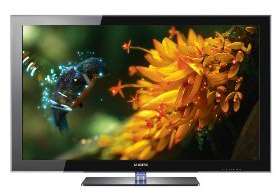
LED edge-lit LCD TVs use a line of LED elements around the edge of the TV which focus their light inward (toward the center of the TV), into a thin multi-layer sandwich of clear and translucent plastic sheets which are designed to diffuse the light, making the backlight source as uniform as possible. They spread the light out evenly behind the LCD panel in order to produce a clear, bright, white light source. But because that backlight has no local-dimming capabilities, it is really not significantly different from a CCFL-lit LCD TV in terms of its black levels and contrast.
The advantages of these edge-lit TVs over traditional CCFL-backlit LCD TVs are primarily in thickness (edge-lit LED/LCD TVs are really thin), and power efficiency (edge-lit LED/LCD TVs are very power-efficient). There also can be some advantages in color reproduction and contrast levels due to the brightness of the LED light source but these are more subtle in actual day to day use compared to the best CCFL LCD TVs.
To a certain extent, I think Samsung may be trying to capitalize on the buzz around OLED (Organic Light-Emitting Diode) TVs, which are something completely different. OLED TVs maintain the contrast benefits of plasma but are even thinner and produce really bright saturated colors. I saw a Sony OLED prototype at CEATEC 2008 in Japan that was the about the thickness of two business cards and could actually be bent without damaging the image or screen. Unfortunately OLED TVs still have some challenges in terms of manufacturing that will probably keep these out of the mainstream for some time. So far the largest OLED TV you can buy (made by Sony) is 11 inches diagonal and sells for $2500 (the XEL-1). LG showed a 15-inch model at CES 2010 but pricing was not available. Most consumers are looking for something a bit bigger (and less expensive).
To make things even more confusing, Samsung does make LED-backlit LCD HDTVs with local dimming technology. Their 8500 series LED/LCD TVs are exactly this, and actually they do offer excellent performance (though they do cost significantly more than traditional LCD TVs). Sony, LG, Sharp and Toshiba also make LED-backlit LCD TVs (some models with with local dimming). Even VIZIO has released a couple of 55-inch LED-lit LCD TV with local dimming that they began selling toward the end of 2009 and in early 2010 (the VF551XVT and VF552XVT). Currently these TVs are much more expensive than traditional LCD TVs, and even more expensive than high-end plasma TVs. But the costs should come down over time.
Hope that helps clear things up.
Regards,
-Chris
2010 Update: At CES we saw new Samsung LED TV models that are even better than the 2009 models, with better off-axis viewing and uniformity so this technology continues to improve and mature. Samsung has told us that they will not longer be offering local dimming LED TVs as they are attaining comparable quality with LED edge-lit models due to improvements in the LCD panels. And by using LED edge-lighting, Samsung is able to offer a feature-packed full 1080p HDTV that is just 0.3 inches thick (the C9000 series). 2010 LED TV models from Samsung will include 3-D capabilities including 2D to 3D conversion, something we have not seen on other 3D-capable TVs.
More Information and LED/LCD TV Deals: