"Heart of the Beast" is a generally uncomplicated man-versus-nature tale, but it is a well-crafted one, unflinching in its depiction of nature's capacity for brutality. Brad Pitt does capable work as the world-weary James, a Special Forces veteran who wants nothing more than peace with his combat dog, Odin. The film settles its most obvious source of tension almost immediately: it is not a spoiler to say the first scene establishes that Odin will survive. What remains for the viewer to discover is James's fate, and that shift in stakes is telling: this was never really a suspense film about whether the dog makes it out.
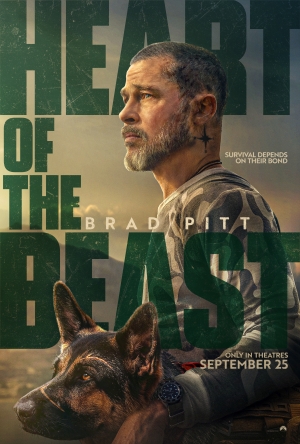
The bulk of the runtime belongs to Pitt, Odin, and the Alaskan wilderness, with neither a supporting cast nor much dialogue to lean on. A handful of early scenes with J.K. Simmons add levity and exposition before that isolation sets in, while doing real work to establish James and Odin's relationship. Once James is on his own, the survival tale begins in earnest, and the film's quieter ambitions become clear: this is as much a story about connection as it is about endurance. James and Odin's shared combat experience gives that bond a layer of nuance and subtext beyond basic "Old Yeller" sentiment. It is less a boy-and-his-dog story than an account of two survivors of the same war, still looking out for one another.
Pitt is well cast, and he knows exactly which register to play James in: weathered, spare with words, carrying his combat history like a physical weight rather than explaining it in a monologue. It is not a performance that breaks new ground for him, nor does it need to. James lives comfortably in the same taciturn wheelhouse Pitt has occupied in prior roles, and he works it with real control. But the performance is doing more work than the script gives it credit for. James is written thinly - a career military man with no family or friends beyond Odin - and the film never bothers to fill in that outline. Pitt makes the most of a part with almost no interior life to draw from, but there is only so much restraint can disguise. The truth is that this film is really about the dog, and once you notice that, James's thinness stops feeling like a minor gap and starts feeling like the point the movie forgot to make.
Odin is played primarily by a German Shepherd named Uber, with three of his own offspring, Ryker, Zika, and their half-brother Hondo, standing in for the film's more punishing physical sequences. Together they give one of the strongest canine performances in recent memory: wounded, alert, and exhausted in ways that never feel like a trick of editing. To find an equal, you would have to go back to Jed, the wolfdog who played the title role in "White Fang." But where Jed had real costars, a genuine wolf pack and Bart the Bear, both appearing alongside him without digital trickery, Odin's performers are stranded among obvious CGI wildlife. Every other animal James encounters is visibly rendered, and the gap in quality is jarring. Their realness only sharpens how synthetic everything else looks by comparison. The reverse is true, too: seen next to obviously artificial animals, the quality and nuance of the real animal performances become even clearer.
The film is also, simply, beautiful. Mauro Fiore's cinematography of the wilderness - New Zealand standing in for Alaska - is striking enough to justify a big-screen viewing for anyone so inclined, and David Ayer stages the action beats with real competence. The river rapids, wildlife encounters, and physical toll of the trek all land with genuine tension. But the film's structure works somewhat against that strength. Stripped down, the plot is essentially a series of escalating trials visited on James, with one obstacle giving way to the next, and the pacing sags in the connective stretches between them.
That shape suits a survival tale, but it also means the film can feel like a checklist of dangers rather than a story building toward something. A few of Ayer's quieter walking-through-the-woods passages could also use tightening. The score generally serves the material well, remaining understated when the visuals are doing the heavy lifting. But a piano cue late in the film swells into something far more conventionally sentimental than anything that came before it - an odd, oversold note in a film that otherwise trusts its own restraint.
The film also takes care to underline the real-world value of dogs like Odin, a touching aspect of an otherwise fairly grim story that lingers as the credits roll. "Heart of the Beast" knows exactly what it is good at and mostly stays there. It will not surprise anyone looking for a reinvention of the survival genre, and its insistence on testing James one hardship at a time eventually wears thin. But what it is actually selling - the bond between a broken man and the animal who has already saved him once - it sells completely. Carried by a canine performance good enough to make you forgive the film's rougher edges, it is a beautifully shot, sporadically moving tribute to loyalty and endurance - one that earns its closing sentiment, even if the road there is a little more repetitive than needed.
| Movie title | Heart of the Beast |
|---|---|
| Release year | 2026 |
| MPAA Rating | R |
| Our rating | |
| Summary | This well-crafted but unremarkable man-versus-nature survival tale is elevated by a strikingly good canine performance, Brad Pitt's capable if underwritten turn as a war-scarred veteran, and beautiful cinematography of the Alaskan wilderness, all of which yields a moving tribute to the bond between man and dog in a film that earns its emotional payoff. |