Paul Greengrass' "The Uprising" has the raw material for a bruising, urgent historical epic: a popular revolt against corrupt authority, a society organized around cruelty and extraction, and Andrew Garfield as a farmer still grieving a family lost to plague years earlier whose impulsive defiance opens into public fury. For long stretches, it works. The production has weight and texture, the cast is committed, and the revolt carries real physical force. Yet it never fully becomes the great, emotionally gripping rebellion movie it plainly wants to be.
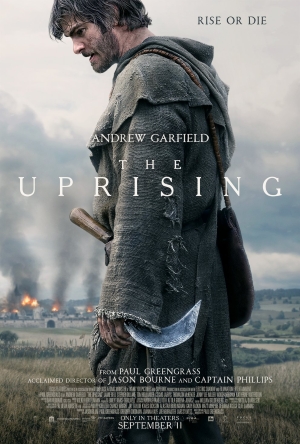
Garfield plays the Ploughman, a commoner pushed toward resistance after acting impulsively in the face of soldiers brutalizing his fellow villagers. Garfield gives the character a quiet moral gravity and avoids turning him into a simple banner-waving saint. Around him, Jamie Bell and Cosmo Jarvis bring conviction and texture to the real historical figures John Ball and Wat Tyler, even when the screenplay gives its characters more archetypal functions than inner lives.
But the Ploughman is an awkward fit for the role the story needs him to play. He is moved to action early, and he can voice the commoners' grievances with clarity, but the film never convincingly shows him accepting or earning the mantle of true leadership. "The Uprising" never quite decides how to distribute those qualities among its three rebel leaders, Ball, Tyler, and the Ploughman. The Ploughman himself seems caught between versions of the movie: an accidental participant swept up by history, a reluctant political conscience, and a folk hero in formation. The screenplay wants all three, but never settles decisively on any one of them, nor does it make his inability to control events feel like its central tragedy. The film even oversells his combat skill, making if feel less like that of a peasant farmer and more like an import from a more conventional action-adventure.
That problem would be easier to overlook if "The Uprising" embraced mythmaking as boldly as "Braveheart." Mel Gibson's historical epic is, of course, loaded with revisionism and Hollywood simplification, but it understands the emotional mechanics of a popular uprising. It begins with personal loss, builds a recognizable leader through escalating choices and sacrifices, gives the movement memorable human faces, and drives toward operatic catharsis. Greengrass' film is less romantic and more interested in the brutal reality of social unrest, which is a legitimate and potentially richer approach, yet it never finds an equally powerful emotional shape.
If it lacks mythic sweep, it at least finds a measure of relevance. For all its medieval grime, "The Uprising" has an unmistakably contemporary political charge. Its portrait of the poor being squeezed by the wealthy, and of authorities answering resentment with violence, needs little translation for a modern audience. Greengrass is also alert to the danger in the anger he validates. When the crowd briefly breaks from the control of Ball, Tyler, and the Ploughman, the film shows how quickly a movement organized around legitimate grievance can become indiscriminate, destructive, and difficult for even its leaders to contain. In one pointed line of dialogue, a character explicitly calls out some participants for using the wider riot to settle private scores, separating the uprising's call for justice from the opportunism and vengeance that chaos can invite. It is an effective idea with an uneasy contemporary resonance, even if the film does not fully develop the leaders' responsibility for what they have unleashed.
That control - over the crowd and over the story's own sympathies - is harder to find in Greengrass' visual approach. His restless, handheld camerawork can bring real force to scenes of violence: crowds surge, bodies collide, and the period setting feels muddy, unstable, and dangerous rather than museum-clean. But he leans on the shaky-cam style far too heavily in scenes where it is disruptive rather than immersive. What may be intended as immediacy becomes distracting, even in scenes that need stillness, clarity, or emotional intimacy. Yet Greengrass remains a gifted director of physical chaos, capable of making violence feel frightening rather than cleanly heroic.
The visual effects are uneven in a way that further undercuts the movie's larger ambitions. At ground level, the production is often persuasive: medieval London's streets and buildings have texture, its close-in crowds feel physically present, and Greengrass can make disorder feel claustrophobic. But the CGI aerial views of old London are notably less convincing, and the same problem undermines the film's attempt to sell the scale of its uprising outside the city. The wide field gatherings, march sequences, and climactic battle are meant to convey a popular movement numbering in the thousands - one capable of threatening the social order. In the widest shots, digital crowd extensions are sufficient to suggest a teeming mass. But in medium shots, the more limited number of real extras becomes apparent, particularly during the battle scenes.
That is frustrating because there is much to admire here. The production has genuine weight and texture: the costuming, grime-streaked interiors, and sense of a society running on forced labor and casual cruelty all feel lived-in rather than arranged for a museum diorama. The cast, especially Garfield, Bell, and Jarvis, does committed work. Jonny Lee Miller is a real standout as William Walworth, the Mayor of London, playing him as a hawk-eyed schemer who seems sinister from his first moment on screen. The film's anger at a system that treats ordinary people as disposable is clear and often potent; it never feels manufactured for the trailer. It is baked into the production design and the performances alike.
Still, "The Uprising" is more effective at conveying the noise, mud, fury, and immediate danger of revolt than at giving its rebellion a cumulative emotional shape. It has a cause, a strong cast, and flashes of genuine power. What it lacks, too often, is the character development, visual conviction, and emotional accumulation that would have turned those elements into the great, emotionally gripping rebellion movie it plainly wants to be - or, for that matter, into the full-blown legend its closing scene so plainly gestures toward.
| Movie title | The Uprising |
|---|---|
| Release year | 2026 |
| MPAA Rating | R |
| Our rating | |
| Summary | Paul Greengrass brings urgency and a formidable ensemble to this dramatic retelling of the 1381 Peasant's Revolt whose class-conscious anger still carries a modern sting, but its reluctant hero never convincingly grows into a leader and the film’s restless camera and patchy digital spectacle leave its most ambitious moments feeling smaller and less affecting than intended. |