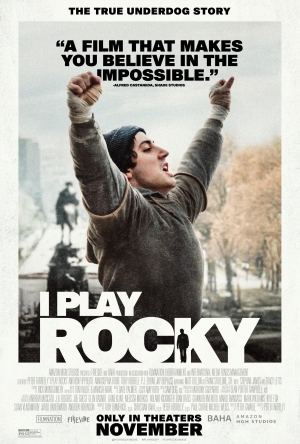
Hollywood wanted Sylvester Stallone's "Rocky" script. It did not want Sylvester Stallone, and he wouldn't sell one without the other. At the Middleburg Film Festival, actors P.J. Byrne and Jay Duplass stopped by for a lively discussion of "I Play Rocky", Academy Award-winning director Peter Farrelly's new film chronicling the fraught, triumphant behind-the-scenes origin story of Hollywood's most iconic sports drama.
As producer Irwin Winkler and director John G. Avildsen, Byrne and Duplass anchor the film's rich, grounded ensemble. Here, Byrne and Duplass talk with Big Picture Big Sound about non-verbal storytelling, why "Rocky" isn't actually a boxing movie, and why Peter Gamble's script needed no improvising.
BPBS: Jay, I know you're a fan of "Rocky," based on prior conversations; I am a fan of "Rocky," and P.J., I'll assume you're a fan of "Rocky" as well.
P.J. Byrne: 100 percent
BPBS: I came into this with a lot of affection for what you were doing, and seeing this story brought to life was a real treat. It struck me how much the ensemble cast delivered in a story that seems so focused on one person. You both really brought a lot of good - the dialogue was strong, and I think your delivery on the dialogue was excellent, but you both were doing things non-verbally as well. P.J., talk about working with Toby [Kebbell] and those exchanges between Winkler and [Robert] Chartoff, where you were perhaps saying something without saying something.
P.J. Byrne: First of all, I'm so glad you picked up on that, because that was like a core motivation for the both of us. I'm not as good in acting in this as I am standing next to this guy [gestures at Jay], and next to Toby, and obviously Anthony [Ippolito] and everyone else in the cast. Toby in particular, because he's my partner.
These guys have a long relationship together. They're like brothers. They finish each other's sentences. You can see great producers here. It's like Albert Berger and Ron Yerxa, who did "Nebraska." Watch those two guys interact. Watch producing partners interact. It's a special thing to behold.
Also, they speak so much. This is the big thing that I'm glad you picked up on. They speak so much just through their eyes, because producers are observers in the greatest way. They're trying to eliminate risk, whatever job they're doing, and then they're there to be the ultimate backstop and put out fires and be calm in the craziness. There's so many times Irwin told me stories about other directors that worked with Irwin, or other actors, that later on found out that, oh, we weren't going to get that, or they wanted to fire me off the movie, and the actor or director had no idea. It's just that Irwin and Bob [Chartoff] took care of it. They just took care of it.
But it was a big thing for me, and it's funny, this is the most grounded I've ever played, because that's what producers are. Yet it's really getting some of the biggest laughs I've ever gotten in my career, which wasn't a conscious effort. It was just like, make moments real, and living it. So that was sort of an interesting thing. Having Toby and Jay to bounce emotions and thoughts and feelings off of - they're great.
BPBS: Jay, let's talk about the moment Avildsen redefines what "Rocky" really is. My very first "Rocky" movie was "Rocky IV," so when I came back to "Rocky 1," I didn't understand what it was doing because all I knew was Stallone literally defeating communism with his boxing gloves. Avildsen says, "It's not a boxing movie; it's about a guy who happens to box." Was that strictly from script, or did you find that on set and in the take?
Jay Duplass: No, that was strictly from script. I mean, but it's wild that you say it, because it's like... Okay, so it's starting to become well documented that "Rocky 1" is my favorite movie of all time.
P.J. Byrne [adding an aside]: It is well documented.
Jay Duplass: I'm saying it a lot.
P.J. Byrne: I'll say it too.
Jay Duplass: But for real, one of the big campaigns that I've waged my entire life, genuinely, since like the mid-'80s, is - people, when I tell them that that's my favorite movie, they're like, "Oh, gross." You go to film school and you say "Rocky 1" is your favorite movie of all time? They're like, "Gross." And I have had to quiz people. My main thing that I say is, "Who won the fight in 'Rocky 1'?"
And, of course, they say, "Of course Rocky won." And then I'm like, "Okay, you know nothing. You don't get it, you don't know." This is a love story. This is an underdog story. It's a movie about a guy who's just trying not to be another bum.
BPBS: That's one of Avildsen's defining contributions. The other is where you're talking about good movie versus great movie, and "the moment." Obviously Anthony (as Stallone) is doing "the moment," but you're signaling to the audience, "Hey guys, if you haven't noticed, this is the moment." Talk about how you found your way into that, that physical reaction.
Jay Duplass: I've been preparing for that speech since 1996, when I started directing movies. Genuinely. And I talk about it a lot in my own life. A lot of people say it's almost impossible to make a movie. I think it's pretty easy to make a movie. Actually, it's almost impossible to make a great movie.
And not to get too inside baseball, but so many things have to go right for a movie to be like [makes explosion noise], and it explodes, and it all works. It's so easy for one of 30 or 40 things to go wrong in a perfect movie, and the movie becomes a B-plus, and not an A-plus or A-minus or whatever it is. And it's something that I am obsessed with as a filmmaker. I have been making movies for a long time. I don't feel like I've gotten even close to what I want to accomplish as a filmmaker, right? And it's because of this almost impossible, unknowable, mysterious thing.
And the way that Peter Gamble wrote that, I didn't add one f****** thing. I didn't add one thing. And I mean, you're talking to two people right now who always add things. We're always adding things. We're always shimmying dialogue. We're always going into a scene, learning all the dialogue they've prepared, and then writing our own version of the scene and learning that. P.J. and I have talked about this. We learned two sets of dialogue for almost every scene that we go into. I didn't have to f****** touch a thing. It was perfect.
But the fact that... it's a battle that I personally have been fighting forever. As a director, I don't put it on an actor. In reality, I don't think necessarily that it is up to one particular actor, or that an actor has to bring some magical thing. But there is something about what you are doing on set: no matter how good the script is, you're trying to capture lightning in a bottle. People have said - [Peter] Farrelly has said - we've all said, this is one of the greatest scripts we've ever read. You read it, and you're like, "Holy f****** s***, how did this thing exist?" But even still, it was ultimately up to Peter [Farrelly], and then Anthony, and then us to just try to capture some kind of lightning in a bottle. And that's what creates that magical feeling that is untenable, that, you know, does get a bunch of Canadians - 1,700, yes - to stand up and not sit down [referring to the standing ovation following the screening at the Toronto International Film Festival].
P.J. Byrne: I have to speak to that point, because it is important. Three things on this. First of all, to see how much he understands and how hard he works on his craft as a director, and...
BPBS: I was really excited that you [gesturing to Jay] were coming to talk, because you played Avildsen, and because of the work you're doing outside of this movie.
P.J. Byrne: That's my point. We've been doing this a long time, and I have friends like Jay who write and direct, and that's like four years before we're shooting. So I know the horror show that they've gone through, and part of the things that alleviate and help their odds, again, of success, and of making the great lightning-in-a-bottle movies, is making sure that we are so hyperly prepared for what this is. And then, in our own roles, we have to pass the writer. We have to pass the director. And make something special and magical.
So there's two moments I speak to. One is that moment that I think we all read that script and went, this moment, we have to service this moment. This is the moment. That's the thing: everyone has to be f****** incredible right now. We have to be. Anthony's f****** incredible. He's f****** incredible [gestures at Jay]. Everyone's shooting has to be incredible when they're zooming in on our face, even when they're going to me and Toby. We can't see his performance, because there's a f****** camera coming right at our face. Yeah, so we have to forget that, then use all the skills you have as an actor. I'm actually thinking about my grandfather coming over from Italy and what he became, like you're putting other things in your brain, because you have to service that moment.
And then there's other moments. Speaking of "the moment," when he goes, "It's not a boxing movie" - whatever, I mean, Jay will take this too - that moment, I feel like, I knew this part so well that I had to demand for the character that Irwin Winkler freaks the f*** out, because it's more interesting than seeing producers work calm the whole time, at least one time, lose it. That's why we're showing up to see the movie. What's different on this day? So that was an interesting moment, like it's almost Irwin Winkler's moment, too. He needs to have the f****** three clicks out [snaps fingers], but that's having great directors, and us naturally, instinctively want to find something and add. So my only line in that scene really, at the end, was, "It's a boxing movie," and then he goes at me, and now he's my fire to click the f*** out. So I came armed and ready with that line about, you know, the Italians.
Jay Duplass: That was more than a line. That was a monologue.
P.J. Byrne: Yeah, a monologue!
Jay Duplass: But he auditioned it for Peter, and Peter was just like, "Yeah, absolutely. That's unbelievable. Let's do it!"
P.J. Byrne: But it's a scary moment as an actor, because you better bring a nuclear weapon joke, because this movie is cruising. We're doing one takes, we're moving on, it's the night before Thanksgiving, everyone wants to f****** go home, and you're like, I can't f****** believe I'm going to ask for this monologue right now that no one's heard.
BPBS: Final question for the both of you: Tracy Letts, who plays executive Sandy Maddox-
P.J. Byrne: The best...
BPBS: Just slays...
Jay Duplass: Scene stealer, that motherf*****.
P.J. Byrne: The best. Happy to have him scene-steal everything.
Jay Duplass: Oh yeah, dude!
BPBS: As you were doing takes, did either of you just lose it when he was firing off one of those...
P.J. Byrne: "Two cheeks, two. Both sides" [quoting a joke from the film]. Yes, yes, I did lose it. Sometimes he's just sticking to the script, and he can make the word "the" have 19 syllables. You know what I'm saying? That's the beauty of an award-winning playwright as well, and just an incredible theater actor.
Jay Duplass: He's a murderer.
P.J. Byrne: Yeah, he's a murderer. He's just pure and in it. And I think when the camera's on, he's not fazed by anything.
Our thanks to P.J., Jay, Amazon MGM, and Middleburg Film Festival for making this interview possible.
Want to know more?
Read our full Big Picture Big Sound Review of "I Play Rocky."
Check out our coverage of the "I Play Rocky" Q&A Panel at MFF 2026.