Nearly three decades after "Practical Magic" turned a critical and commercial flop into a durable cable-era comfort movie, "Practical Magic 2" trades heavily on fond memories. Sandra Bullock and Nicole Kidman return as Sally and Gillian Owens; Dianne Wiest and Stockard Channing return as their idiosyncratic aunts; and the film is stocked with the expected ingredients: witchy domesticity, family curses, romantic peril, midnight rituals, and the promise that familial love is the most potent magic of all. For devotees of the original, there may be real pleasure in seeing its stars slip back into their pointy shoes. Caveat spectator, though: the sequel's nostalgia may just as easily sour a remembered affection for the first film, revealing how little dramatic life the new story has beyond its callbacks.
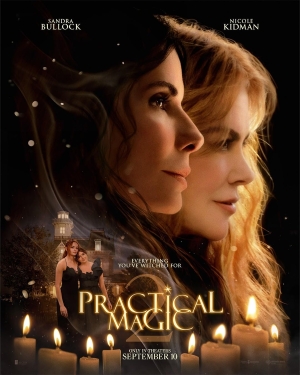
The original was plenty messy, but its tonal cocktail - romantic comedy, gothic fairy tale, family melodrama, and lightly macabre female solidarity - had a particular charm, awkward but earnest enough to endear. "Practical Magic 2," directed by Susanne Bier and adapted from Alice Hoffman's novel The Book of Magic, mistakes that cult affection for a formula, reciting an incantation from a recipe card rather than making anything new from the ingredients.
The greatest problem is that the film seems to believe that "simply more" is a form of enchantment: more family history, more curses, more romantic complications, more magical rules, and more overlapping quests; it's the byproduct of squeezing a dense novel into two hours. At 130 minutes, a story that might have made a brisk 90-minute supernatural comedy gets stretched until every idea is diluted. Scenes repeat emotional beats, exposition arrives after the audience has already grasped its point, and the plot keeps adding obligations instead of momentum.
The premise leans on a complication that plays less persuasively at film speed: Sally has kept her daughters Antonia and Kylie in the dark about the Owens family's magical lineage, a choice inherited from Hoffman's source material but one the adaptation has less room to earn. Onscreen, the secrecy mostly registers as contrivance - Kylie falls directly into the curse's path because she was never told what it is or how to avoid it - and the compression does not allow enough time to make her mother's protectiveness feel like anything but a plot device.
The film compounds that problem by making Kylie an instant witching prodigy, mastering magical arts with scarcely any instruction, practice, or meaningful cost - a stark reduction of the more perilous arc the novel gives her. There is little sense that she has inherited a demanding tradition; she simply becomes as competent as the plot requires, whenever it requires it. A story about inherited power ought to make us feel its weight. This one keeps the destination but skips the journey.
Bullock and Kidman's chemistry is the picture's clearest asset - a shared glance can recall the loose, unforced appeal of the original - but that familiarity is not the same as a developed relationship. The film has no clear center, dividing its attention among the sisters, Sally's daughters, a new romance, a family-history mystery, and a villain who barely appears until the final act. Sally and Gillian spend too much of it estranged or separated by plot machinery, leaving a movie about sisterhood little room to dramatize it. Kidman fares worst: Gillian, once reckless and sharp enough to complicate the story's warmer notions of family, is reduced here to reactive comic business. Bullock has more to do as Sally, but even she is stuck circling familiar notes of grief without developing them.
Lee Pace, as scholar-turned-love-interest Dr. Ian Wright, has the wit to make the film's contrivances go down easier, though he functions mainly as a hunky and mysterious information kiosk. Tom Lockland, the final villain, arrives with so little runway that Solly McLeod's severity cannot generate real dread; he is a much smaller figure than his counterpart on the page. Joey King brings spark to Kylie, but Maisie Williams as Antonia is stranded, and the sister pairing meant to extend the Owens legacy instead repeats the film's habit of separating people who should be developed together.
There is a little autumnal polish left in the production design, even as the magical effects carry the weightless sheen of studio fantasy. But "Practical Magic 2" confuses nostalgia with narrative purpose. It knows audiences want to see Bullock and Kidman together again; it does not know what that reunion should mean now, or how to translate a denser source novel into drama rather than a checklist. It buries the original's themes of family and grief beneath a pile of plot complications and fan service.
Those who loved the first film's oddball comforts may still find a small, flickering spell here. But "Practical Magic 2" reaches into the past for its magic and comes back with little more than smoke.
| Movie title | Practical Magic 2 |
|---|---|
| Release year | 2026 |
| MPAA Rating | PG-13 |
| Our rating | |
| Summary | This follow up to 1998’s durable cable-era comfort movie brings back Sandra Bullock and Nicole Kidman as witchy sisters seeking a balance between their magical powers and family dramas, but with repeated emotional beats, ill-timed exposition, and a storyline that feels diluted, what should play like a flickering spell yields little more than smoke. |