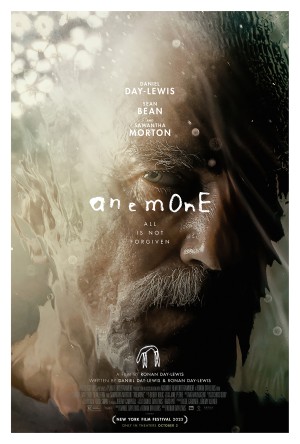
"Anemone," Ronan Day-Lewis' directorial debut featuring father Daniel's return to the screen, is an imperfect but nuanced and challenging film. It unfolds as a dual narrative: one thread follows Jem Stoker's journey to visit his brother Ray - a reclusive man living in self-imposed exile in the Northern English woodlands - while the other follows the lives Ray left behind: his estranged partner, played by Samantha Morton, and their son Brian, portrayed by Samuel Bottomley. The film moves between Ray's tense reunion with Jem and the quieter, emotionally charged scenes of Brian reckoning with the influence of a father he barely knows. The structure is often fragmented and jarring, but rewarding, relying on emotional echoes, visual motifs, and small, methodical revelations rather than straightforward exposition. Set against the tightly contained trauma of Ray's service during the Troubles, the film explores generational guilt, post-traumatic stress, the corrosive nature of silence, and the elusive possibility of forgiveness.
Daniel Day-Lewis returns to the screen not with a comeback, but with a seamless continuation, as if he'd never stepped away. As Ray, he channels a raw, internalized anguish that simmers beneath every glance and gesture. His portrayal is restrained and magnetic - arguably his most recognizable trademark. This is a study in emotional tautness that rewards viewers patient enough to closely observe him throughout the picture.
Opposite him, Sean Bean delivers a career-highlight turn as Jem, acting as a reluctant emissary of reconciliation. Their relationship is the film's emotional spine, defined not by dramatic confrontations but by guarded gestures, small moments, and the unfolding of a history hinted at but never fully articulated. Jem arrives not as a savior, but as a weary and even fragile bridge between Ray and the world he abandoned. Their dynamic is a study in emotional restraint: two men forged by similar fires, now living drastically different lives, with Jem trying to pull Ray back into the world; not for his own sake, but for that of his son.
Samantha Morton brings a brittle grace to her role as Nessa, portraying a woman who has long since stopped waiting for closure but still carries the emotional residue of Ray's absence. Her scenes are piercing, often unfolding in silence, the camera lingering on Morton as she ponders how best to comfort her son. Samuel Bottomley's performance is understated but deeply felt, capturing the confusion, longing, and resilience of a boy trying to make sense of a father he barely knows, and whether the violence he feels is inherited or inevitable. Less successful is the treatment of Hattie, played by relative newcomer Safia Oakley-Green. Introduced as a friend and possible love interest to Brian, her character is a blink-and-you-miss-it case of underdevelopment. Much of her arc may have been left on the cutting room floor, reducing her to a symbolic presence rather than a fully realized player in the story.
Visually, "Anemone" is often mesmerizing. Cinematographer Ben Fordesman captures the woodlands with clarity and intensity, using natural light and deep shadows to evoke both serenity and menace. Nessa and Brian's cityscapes, by comparison, are stark and bleak. Each composition is deliberate and immersive, panning and lingering just long enough to let the landscape envelop the characters, sometimes confining them, other times freeing them. However, some shots linger past their peak, tipping from meditative into indulgent. There are moments where Ronan Day-Lewis gets lost in the lens, leaving the viewer wondering why they're still watching a grove of trees long after Sean Bean has walked through them. In other scenes, he and editor Nathan Nugent cut away midway through emotional beats; the earlier parts of the film especially struggle with this tendency.
Symbolism plays a central role in "Anemone," though not always to its benefit. The film is rich with imagery - some evocative, others perplexing. The titular flower appears prominently, first cultivated by Ray and later dashed to bits after a freak hailstorm, presumably symbolic. Jem comments on the flowers and their connection to their father, which draws scorn from Ray but little explanation. Why would Ray grow these flowers if his father had such a negative influence? This is a prime example of how the film poses symbolic questions but offers few clues toward answers.
In some cases, a non-trivial amount of screen time is devoted to these symbols, such as Ray's encounter with a mysterious ethereal horselike creature with a human face. It's a long sequence arriving late in the film with no evident connection to Ray's trauma or his feelings toward his son. It's all left unclear, and like much of the film's symbolism, it feels more like a concept than an execution: layers of meaning lacking the interpretive anchors needed to make them whole. At times, it feels like Ronan Day-Lewis is playing with imagery for its own sake rather than in service of the story.
Still, these excesses don't overshadow the film's core achievements. "Anemone" is a bold, emotionally resonant work that showcases the power of performance and the potency of visual storytelling. It will be interesting to see what Ronan Day-Lewis does next - and what he can do with a troupe of actors that doesn't include Daniel to insulate against his less advised directorial choices. It's a film that does not spoon-feed, and it is often difficult to understand, but it lingers purely because of how well Daniel Day-Lewis and Sean Bean ultimately play off one another. For those willing to surrender to its rhythm, it offers a haunting, imperfect beauty that stays with you long after the credits roll.
| Movie title | Anemone |
|---|---|
| Release year | 2025 |
| MPAA Rating | R |
| Our rating | |
| Summary | Daniel Day-Lewis returns to the screen anchoring son Ronan’s directorial debut, an often visually mesmerizing exercise relying on emotional echoes and methodical revelations rather than straightforward exposition to offer a haunting, imperfect beauty that will linger long after the credits roll. |