Maggie Gyllenhaal's "The Bride!" is, like its two protagonists, a bold, complicated amalgamation of parts that adds up to an even stranger whole. Part classic metaphorical monster movie, part Bonnie and Clyde turned feminist revolutionaries, and part fantasy dance film, this film feels almost mythical in 2026. It is a grand, R-rated original that swings so hard it sometimes staggers, yet rarely stops being fascinating. Set in a beautifully heightened 1930s America (across Chicago, New York, and rural points in between) that looks like it was stitched together from gothic horror, gangster pictures, and silver-screen era Hollywood melodrama, "The Bride!" doesn't just reimagine Bride of Frankenstein; it hits it with a bolt of lightning and reassembles the pieces into something defiantly, sometimes deliriously, new. It's a messy creation, but a compelling one.
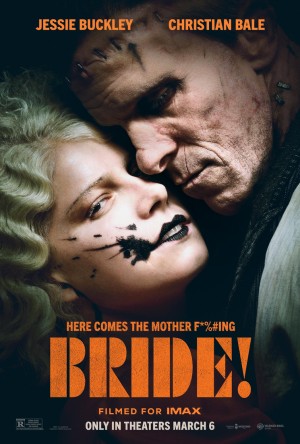
From its first frames, "The Bride!" pulls no punches, opening with a propulsive monologue by Jessie Buckley in the first part of an electrifying multi-character performance as Mary Shelley. The author of the original Frankenstein quite madly announces her intent to tell "A REAL STORY" and, oh yes, possess a nice young woman named Ida (also Buckley). Naturally, this turns out poorly for Ida for reasons that remain obscured until much later, but it puts her on a path toward Frank (the monster), played by a brilliantly made-up Christian Bale. Wandering the world alone for a hundred years has left Frank in severe want of a companion, so he turns to Dr. Euphronius (Annette Bening) to make him a compatible bride. The fact that Frank hasn't really thought about what happens once she's been "re-invigorated" allows the film to move fluidly from one unexpected and chaotic situation to the next.
Gyllenhaal and her collaborators have crafted a world that feels both mythic and tactile, flitting from mobbed-up speakeasies to hyper-sci-fi laboratories, back-alley underground orgies, and pastoral fields. The production design is exuberant and just fantastical enough without tipping fully into the sort of parody that often plagues Tim Burton. There is glamour and rot all around, and that tension is one of the film's quiet pleasures.
Horror has always been a genre where social anxieties slip on a rubber mask, and "The Bride!" fits squarely in that lineage. Gyllenhaal's film is as much about a feminist revolution as it is about reanimated flesh: the Bride's awakening and subsequent quest for mad vengeance sparks a broader uprising against powerful and corrupt men, turning classic monster-movie panic into a howl of anger at cultural wrongs. It also takes a nod toward queer identity - another classic horror commentary - when the Bride and Frank join an underground party that recontextualizes their "otherness" into a space where it is simply part of the norm. Alas, it's only temporary, as the ugliness of people reasserts itself, and we are reminded of Frank's repressed, hyper-violent nature.
The performances, though, are what really animate this creature. Jessie Buckley gives the kind of turn that is truly special; as Ida/Penny/Mary, she traverses feral, wounded, funny, and unexpectedly delicate territory in the span of a single scene. Because she's also carrying Mary Shelley as a passenger in her subconscious, she bounces from an American to Cockney accent, often within a single sentence. The Bride is discovering, in real time, that she is both more and less than human - and may or may not be allowed to define herself on her own terms. The strength of Buckley's performance fuels much of this film's velocity.
Christian Bale's Frank is a bundle of complexity that matches well with Buckley's Bride. Possessing a weariness and profound loneliness, Frank is desperate to keep her, yet he's clearly ill-equipped to cultivate this "human" connection. The weight of time and experience (clearly not all good) is present in every stitch, rivet, and scar; this monster has seen a lot. Bale is fully committed, reminding us yet again why he's consistently regarded as such a powerhouse actor.
The rest of the main ensemble each have their moments to shine as well. Bening's Dr. Euphronius sparkles with interest and depth, projecting fascination with the scientific prospect of the duo while expressing genuine sympathy for their plight. Peter Sarsgaard and Penélope Cruz add a nice levity and expositional lens as a pair of detectives following the trail of bodies left in the monster's wake, with Sarsgaard's Ronnie harboring a shadowy connection to pre-Bride Ida, while Cruz's Myrna just tries to earn due recognition as a detective and not a secretary. Special mention must also be made of Jake Gyllenhaal's delightful, tongue-in-cheek appearance as Frank's favorite matinee idol; it's a clever bit of casting that serves as both a whimsical plot device and a charming meta-nod to the film's creative lineage.
If the film has a particular flaw, it's that the plot has a tendency to wander, drifting from body horror to criminal thriller to romantic tragedy in ways that are often stimulating but not always coherent. The Mary Shelley specter, in particular, is a provocative conceit that never quite resolves; her ultimate motivations remain hazy - more metaphor than person - and the film doesn't fully clarify where she lands in relation to the Bride she's ostensibly shaping.
And yet, even when "The Bride!" threatens to lose its narrative way, it remains interesting and creatively alive. Scene to scene, there's almost always something fascinating happening: a visual composition that makes you think, a catchy bit of dialogue, or a performance choice that reframes a familiar trope. Gyllenhaal is making an ambitious play, and it mostly works, even if tidy plotting isn't her main concern. As an audacious piece of genre filmmaking - one committed to giving its monster a voice, a body, and a messy interior world - "The Bride!" is indeed ALIVE!
| Movie title | The Bride! |
|---|---|
| Release year | 2026 |
| MPAA Rating | R |
| Our rating | |
| Summary | Maggie Gyllenhaal’s take on the Frankenstein-and-Bride mythos is a fiercely original and visually arresting reimagining that’s anchored by an electrifying, multi-layered performance from Jessie Buckley. The narrative occasionally wanders into hazy thematic territory, but bold world-building and punk-rock energy make it a compelling, must-watch piece of genre filmmaking that prioritizes creative audacity over tidy plotting. |