Writer-director John Carney ("Once," "Sing Street") has built an entire career out of a beautifully simple premise: that a couple of mismatched souls can find salvation in a three-chord melody. His latest effort, "Power Ballad", tries to strike that same harmonious chord, pairing Paul Rudd and Nick Jonas for a transatlantic dramedy about artistic theft and mid-life creative crises. What could have been a thin, high-concept over-the-top revenge comedy is instead handled with enough confidence, restraint, and tonal discipline to feel genuinely plausible. The result is a warm, low-key, and satisfying addition to Carney's catalog of music-driven stories, even if it ultimately favors modest pleasures over a deep critique of the darker desires and influences of the music business.
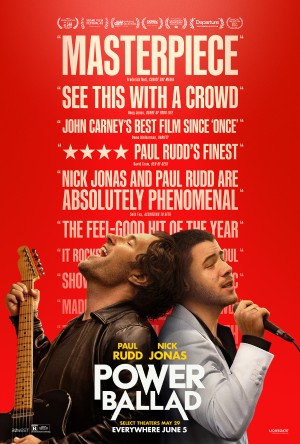
"Power Ballad" follows Rick (Rudd), a past-his-prime American singer fronting a wedding band in Ireland. Less of a "has-been" and more a "might-have-been," Rick chose to leave the rock band lifestyle to settle down with the woman he loved and raise their daughter. While clear-eyed about that choice, he still dreams of the thrill of real performance instead of the human jukebox lifestyle he's living. This acceptable, if perhaps underwhelming, existence is upended after an alcohol-fueled jam and songwriting session with Danny (Jonas), a stagnating boy-band superstar desperately trying to establish solo credibility. Riding the good vibes of musician's kinship, Rick reveals a deeply personal, unfinished ballad he has been nurturing for years. After parting on good terms, Danny passes off Rick's song as his own work in a moment of weakness, and it goes absolutely viral.
Rick discovers this theft over the background speakers of a local shopping mall while buying football boots for his daughter. It is a brilliant narrative choice; this is exactly the sort of song that lives in the hum of everyday life. Rick wants to believe that Danny is a good guy and this is just a mistake, but he soon learns that corporate machinery moves swiftly when a cash cow is threatened. After exhausting his options (and the nerves of all his friends and family) in Dublin, Rick sets off for Los Angeles to convince Danny to make it right.
From there, the film leans wisely on performance over plot mechanics or excessive humor. Rudd brings his well-known charm to Rick, while also suggesting a deeper feeling of his lingering ambition without ever straining for it. Rick is not consumed by bitterness - he is at peace with the life he has made - but some part of him still aches for the success that lies along a different path. Jonas is equally effective because the film resists turning Danny into a caricature of pop-star vanity. Rather than reading as outright malicious, Danny comes across as someone who simply drifts into a lie, or at least a version of events he is not eager to correct, making the central conflict far more interesting and human.
The supporting cast beautifully expands on these dynamics, particularly when Rick decides to fight back. Co-writer Peter McDonald is a standout as Sandy, a wonderfully humorous Sancho Panza to Rick's long-shot Don Quixote. McDonald provides a volatile comedic energy that is zany, dry, and unpredictable all at once. It is the perfect balance to Rick's starry-eyed impulses, keeping things grounded even as the duo travels to LA to tilt at the windmills of the music industry.
Meanwhile, Beth Fallon delivers a solid turn as Rick's seemingly disaffected teenage daughter, Aja. Her performance carries real weight, as Aja ultimately proves pivotal to the central ballad in multiple ways, serving as both a source of emotional inspiration for the track and a key catalyst in how the dispute over its ownership unfolds. The rest of the ensemble feels similarly well-rounded and deeply authentic to the setting, including Jack Reynor as Danny's manager, Mac. Reynor manages a difficult balancing act, playing the aggressive Hollywood agent as a thoroughly believable and formidable corporate barrier without ever letting the performance spill over into a ridiculous, over-the-top industry stereotype.
Carney has long favored stories where music is folded into ordinary life, and he treats the central track here, "How to Write a Song (Without You)," with identical pragmatism. The song functions as exactly the kind of mass-digestible pop hit this story needs: catchy and accessible, but inherently a bit saccharine, veering dangerously close to processed dad-rock. Yet the film wisely understands that its importance comes less from its artistic uniqueness than from how the characters react to it.
In fact, the track serves as a brilliant narrative pivot early on when Aja points out that modern audiences don't want traditional love stories anymore - they want revenge. It is an ironic bit of foresight, given that this gentle ballad ultimately becomes the center of a multi-continental dispute over artistic betrayal. The conflict is less about whether the song is an unblemished masterpiece and more about how meaning, ambition, and personal history get attached to something destined to become part of the cultural wallpaper.
"Power Ballad" does not dig especially deep into its thornier themes, but that restraint feels like a deliberate, humane choice that keeps the film buoyant. It teases at the ideas of credibility and authenticity in just the right amounts to get the audience on board without beating them over the head. It may not possess the lightning-in-a-bottle raw emotional magic of Carney's foundational works, but it succeeds entirely on its own terms by never overreaching. Anchored by the effortless chemistry of its leads and a story that resonates more than expected, it delivers a genuinely comforting blend of effective comedy and unforced stakes that make it a journey well worth taking.
| Movie title | Power Ballad |
|---|---|
| Release year | 2026 |
| MPAA Rating | R |
| Our rating | |
| Summary | This warm, low-key transatlantic dramedy starring Paul Rudd as a wedding singer whose deeply personal ballad is stolen by a stagnating pop superstar (Nick Jonas) brings surprising realism and strong ensemble performances to a sharp, witty script, delivering a genuinely comforting blend of effective comedy and unforced emotional stakes. It's a music-driven journey well worth taking. |