Christopher Nolan's "The Odyssey" achieves the ultimate cinematic magic trick: a work that is genuinely captivating in its staggering scale, yet remarkably intimate in execution. It is an adaptation that feels epic in the grandest modern sense, without ever losing the human focus of its ancient source material.
By leaning into a non-chronological timeline - honoring Homer's original narrative structure while deploying Nolan's signature temporal styling - the film masterfully reframes the legendary journey home as a fractured, deeply internal struggle to reconcile wartime trauma and PTSD with identity and humanity. Matt Damon's Odysseus isn't a pristine action hero; he's a careworn, guilt-ridden commander whose greatest battle isn't surviving the gods and monsters of the Aegean, but finding a way to spiritually return to the civilian he was before Troy. Damon plays him with a weathered physicality and a haunted interiority, letting the weight of years at war and the sack of Troy show in every stiff movement and wary glance.
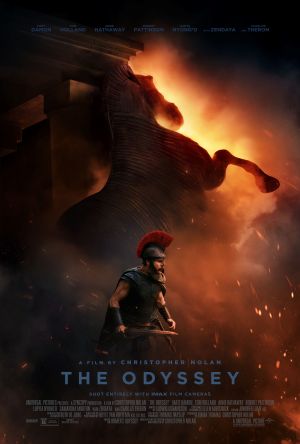
That emotional grounding extends across the ensemble. Anne Hathaway's Penelope is given considerable agency, fire, and emotional weight, emerging not as a passive figure waiting on Ithaca's shores but as a fierce anchor to the narrative. Hathaway plays her with sharp intelligence and coiled strength, making her waiting feel strategic rather than inert, her grief galvanizing rather than ornamental. Tom Holland, as Telemachus, delivers a vulnerable, standout performance that grounds the epic's familial stakes in raw, appropriately childish feeling; his uncertainty, frustration, and hope make the father-son dynamic one of the film's strongest threads.
Robert Pattinson, as Antinous, brings a chilling, human-scale villainy to the Ithaca sequences, embodying the corruption that has flourished in Odysseus's absence. Elliot Page also deserves mention as Sinon, the tragic figure who delivered the fateful wooden horse to the Trojans and later served as a crucial messenger alongside Tiresias in the underworld. While concentrated in just two pivotal scenes, Page's performance proves central to the film's emotional architecture, delivering with an intensity that cuts through the mythic grandeur with startling human clarity.
What makes all of this cohere is Nolan's control as both writer and director. As an adaptation, "The Odyssey" respects the structure and spirit of Homer while filtering the material through Nolan's long-standing fascinations with fractured time, memory, guilt, and identity. As a piece of direction, it shows him stretching into new territory: not just in the film's scale, but in its embrace of gothic horror, bodily dread, and a more openly emotional register than he often allows himself. Rather than flattening the myth into a generic blockbuster landscape of endless digital armies and massive CGI fleets, Nolan keeps his visual frame strictly focused on specific, vulnerable human beings, finding a way to make the ancient epic feel immediate, tangible, and wounded.
That is especially evident in the film's treatment of the monsters and trials. Instead of staging Odysseus's obstacles as clean CGI action beats, Nolan pairs practical effects with tense, claustrophobic staging to evoke visceral dread. In the Cyclops' cave, Polyphemus is a misshapen, uncanny presence brought to life through animatronics and puppetry, and the sequence plays like a slasher film. On Aeaea, the Circe episode embraces body horror in a raw, animalistic register - less fantasy pageantry than witch's curse - making the transformations appropriately harrowing without needless gore. During the sea crossing between Scylla and Charybdis, Nolan employs the classic technique of withholding the monster, keeping Scylla largely out of frame and focusing instead on the terrified reactions of the men. By choosing tactile, physical reality over digital polish, Nolan not only heightens the horror but reinforces the film's central themes about the bodily cost of war and the fragility of human identity.
Ludwig Göransson's score is a rich and layered feast that, much like the film at large, traverses the vast and the intimate with ease and grace. In its grandest moments, the music swells with ancient dread and mythic weight, while in its quieter passages it becomes tender and human, threading memory, longing, and loss through delicate motifs. The result is a soundscape that never feels ornamental and never overwhelms; it serves the story as directly as any line of dialogue.
The film's technical achievements are inseparable from its emotional impact. Shot entirely on IMAX 70mm cameras, "The Odyssey" is a masterclass in large-format cinematography. Hoyte van Hoytema's camera work is consistently breathtaking, moving with a fluidity and purpose that favors intimacy while still capturing massive and detailed images. The sheer size and bulk of IMAX cameras do not lend themselves to dynamic camera movement, and yet this film still carries tremendous kinetic energy. The film demonstrates an exceptional command of neutral and natural lighting, favoring available light and subtle augmentation over artificial sources, which gives the image an earthy, lived-in texture that grounds the myth in a tangible reality. This commitment to practicality extends to the film's extensive location shooting, which lends each environment a specificity and authenticity that studio sets could never replicate. The result is a visual experience that feels both monumental and immediate, a rare achievement in an era of digital dominance.
The film's shortcomings are all minor in nature, but worth noting. The commitment to natural lighting sometimes results in very dark scenes that demand a bright screen and a well-calibrated projection, and a handful of exterior moments read a touch flat - an unfortunate combination of lighting and landscape rather than a consistent issue. The dialogue uses some modern dialect ("Mom" and "Dad" ring out) which lands oddly, briefly puncturing the mythic tone, though these moments soon fade into the background and ultimately do not undermine the film's overall impact. There are also a few scenes where the dialogue is slightly crushed by ambient noise, such as the wind. That's something of a Nolan signature - think of Bane's muffled growl in "The Dark Knight Rises," or the moments in "Interstellar" where Hans Zimmer's organ drowns out key exchanges, with similar issues surfacing at times in "Dunkirk" and "Tenet." Even so, the dialogue here remains intelligible, making these complaints real but far from deal-breaking.
For all of its minor blemishes, "The Odyssey" is the kind of film audiences claim to want when they lament the disappearance of genuinely ambitious studio filmmaking: grand yet personal, technically overwhelming yet emotionally precise, classical in source and startlingly modern in execution. Coming off the tremendous success of "Oppenheimer," Christopher Nolan has not rested on his laurels; he has only raised the bar higher, doubling down on the very things that make his work unmistakably his. This is Christopher Nolan doing Christopher Nolan things - his grand vision, his technical capability, his command of large-scale pictures - and doing them at a level of filmmaking accomplishment that few directors have ever approached, let alone sustained. It deserves to be sought out, and it deserves to be seen on the largest, most technically capable screen available. Whether that means IMAX, Dolby Cinema, or another premium large-format presentation, "The Odyssey" is a film whose full power is only realized on a truly capable screen; it was made to be experienced in a theater, not at home. In an age of shrinking attention spans and disposable streaming content, "The Odyssey" stands as a rapturous reminder of what theatrical cinema can still do.
| Movie title | The Odyssey |
|---|---|
| Release year | 2026 |
| MPAA Rating | R |
| Our rating | |
| Summary | Christopher Nolan's latest cinematic undertaking reinterprets the classic Greek epic as a deeply personal exploration of wartime trauma and lingering psychological wounds, trading standard digital excess for practical craftsmanship and claustrophobic tension in a production that grounds its legendary monsters in a gritty, physical reality resulting in a brilliant melding of monumental scale and intimate human drama. |