"The Invite" is an expertly paced social pressure cooker, transforming a simple dinner party into a fiercely energized chamber-dramedy. Directed by Olivia Wilde - her third feature following "Booksmart" and "Don't Worry Darling" and adapted from Cesc Gay's 2020 Spanish film "The People Upstairs," the film is sharp and witty. Yet what makes it truly resonate is how emotionally well-rounded it remains beneath the biting humor.
The plot itself is deceptively simple: after months of listening to the passionate, notoriously loud escapades of their upstairs neighbors, a high-strung Angela (Olivia Wilde) insists on inviting them down for dinner, much to the chagrin of her husband, Joe (Seth Rogen). When the charismatic Hawk (Edward Norton) and Pina (Penélope Cruz) arrive, their radically open lifestyle and boundary-pushing propositions turn awkward small talk into a chaotic evening of uncomfortable truths, forcing Joe and Angela to confront the fractured state of their own relationship.
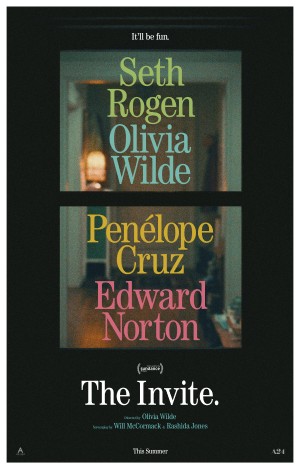
This premise proudly carries the cinematic DNA of "Who's Afraid of Virginia Woolf?," relying entirely on the strength of its central quartet as a polite gathering steadily devolves into a psychological battleground. The ensemble work here is nothing short of exceptional, with each performer finely tuning their comedic and dramatic registers. Rogen delivers a wonderfully pressurized performance as Joe, trading his usual lovable charm for a deeply resentful misanthropy. He plays Joe as a man tightly bottled up, his frustrations barely contained beneath a facade of sarcastic, defensive hostility. He is matched perfectly by Wilde, directing herself with fearless commitment. Her Angela vibrates with a brittle, neurotic energy, teetering between insufferable and deeply sympathetic as the night wears on.
Across the table, the upstairs neighbors provide the perfect foil. Norton plays Hawk with a sort of endearing affability that feels inherently suspicious, using his innate charisma as a psychological battering ram against Joe's defenses. Cruz, meanwhile, is the film's stealth MVP. The zen-like sexologist Pina is written with a disarming earnestness and incisive candor. Cruz leans into that radical openness perfectly, making her the ideal catalyst for the ensuing chaos. The script, penned by Will McCormack and Rashida Jones, gives this powerhouse quartet a wealth of layered, rapid-fire dialogue. No character is reduced to a simple caricature; each is more than meets the eye, while the humor organically reveals the vulnerabilities and cracks in their respective relationships.
What stands out most is Wilde's command of the space. Staging a film almost entirely inside a single San Francisco apartment is a massive challenge, but the directing, meticulous blocking, and production design support the intimate scale of the action beautifully. The apartment itself is packed with symbolism, acting as a battleground in Joe and Angela's marriage. It becomes a representation of Joe's past, tied to his sense of identity and self-worth, as well as the object of Angela's obsession, into which she pours her unspent creative energy. Adam Newport-Berra's cinematography keeps the setting from feeling like a static stage play; his use of savvy angles, dynamic framing, and lingering reaction shots makes the environment feel kinetic and cinematic. This is further elevated by incisive editing that maintains a steady, weaponized pace and never lets up or feels tiresome. Cuts land with the precision of a punchline, ensuring the setup never drags while amplifying the claustrophobia of the couples' buried secrets.
Fueling the film's beautiful, slow-motion trainwreck is Devonté Hynes' atmospheric score. His string-heavy compositions ratchet up Joe and Angela's verbal sparring with every phrase. At a few points, the music almost threatens to overtake the dialogue, but it generally works to great effect, acting as another presence that supercharges the atmospheric push-pull in the room.
As the night unfolds, the film pulls off an impressive tonal balance. What begins as a deliciously cringey comedy of manners gradually deepens into a profound, melancholic study of a failing marriage, echoing the bruising emotional exposure of Edward Albee's classic. Rather than abandoning its humor in the third act, the film tempers and modulates it, skillfully balancing the fun, saucy details of Hawk and Pina's sexual escapades against the ongoing collapse of Joe and Angela. It also deftly avoids leaning too far into Joe and Angela's despair, or the absurdity of the temptation of Pina and Hawk. It proves that the film isn't just about the spectacle of a dinner party gone wrong, but about the tragedy of two people who have stopped recognizing each other.
Ultimately, it's a confident, funny, and poignant look at modern marriage that expands into a broader examination of communication and honesty. It asks difficult questions about what it means to truly see your partner, and the painful necessity of recognizing when a relationship is fundamentally broken. If you're looking for a sophisticated adult comedy that doesn't sacrifice human complexity for a punchline, "The Invite" is well worth the RSVP.
| Movie title | The Invite |
|---|---|
| Release year | 2026 |
| MPAA Rating | R |
| Our rating | |
| Summary | The latest offering from actor/director Olivia Wilde turns an agonizingly awkward dinner party into a fiercely funny, deeply resonant pressure cooker; anchored by four knockout performances and razor-sharp direction, it’s a sophisticated comedy of manners that cuts right to the heart of modern marriage. |