The sheer scale of World War II's D-Day invasion has long been immortalized on screen through sprawling epics of combat and blood-soaked heroism. Yet Anthony Maras's "Pressure" reminds us that history's most massive amphibious assault almost did not happen on June 6, 1944 - not because of German defenses, but because of a volatile North Atlantic weather system. Adapting David Haig's acclaimed stage play, the film transforms meteorological data into a gripping, ticking-clock psychological thriller, trading the battlefield for the high-stakes bureaucracy of a military briefing room.
Set during the agonizing 72 hours leading up to Operation Overlord, the story centers on the friction between two conflicting weather forecasts. On one side is Group Captain James Stagg (Andrew Scott), a rigid Scottish meteorologist who detects two massive, impending storms that could decimate the Allied fleet. On the other is Colonel Irving Krick (Chris Messina), a slick American weather analyst using historical analog data to predict clear, sunny skies. With the invasion force locked and loaded, Supreme Allied Commander Dwight D. Eisenhower (Brendan Fraser) faces an excruciating dilemma: trust the cautious Scotsman and delay the war effort, or trust the optimistic American and risk sending hundreds of thousands of men to their graves.
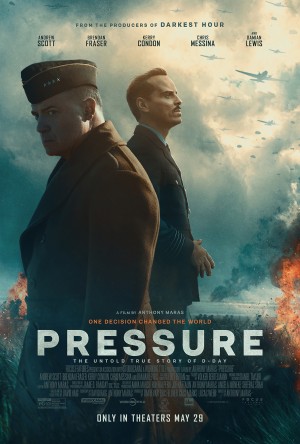
This narrative symmetry extends beautifully beyond the weather room. Stagg and Krick represent competing philosophies of forecasting, while Eisenhower and British General Bernard Montgomery (Damian Lewis) form a second, more political duel. Interestingly, this mirroring creates an inverted transatlantic dynamic: in the weather room, the American Krick possesses all the swaggering, self-assured confidence while the British Stagg embodies wary restraint, but in the command room, that national temperament completely flips, leaving the British Montgomery fiery and prone to overstatement while Ike remains the picture of contained caution, forced to project calm while carrying the weight of every possible consequence. It is smart storytelling, and it gives "Pressure" a clean structural balance that strengthens the narrative against some of the limitations of its theatrical roots.
With this solid dramatic framework established, the film's greatest strength becomes its trio of central performances. Andrew Scott is excellent as Stagg, playing a man constantly trying to contain himself and maintain composure under mounting pressure. Scott makes that internal struggle palpably vivid, and the gradual release of all that restraint pays off in a candor-filled final monologue that lands with real force. Chris Messina is equally strong as Irving Krick, bringing the aforementioned American bravado to a man who believes he has the situation completely solved. That certainty makes him a perfect foil for Scott, and Messina turns the character's wrongheadedness into one of the film's most effective dramatic engines. Kerry Condon, meanwhile, gets a rich showcase as Kay Summersby, and the role lets her do what she does best: fuse intelligence, warmth, and steel in a way that feels utterly unforced. Kay gives the film a welcome human pulse, while never seeming out of place among men making profound and fateful decisions
By contrast, the high-profile military commanders receive a more tempered response, suffering from a distinct disconnect between page and performance. Brendan Fraser delivers an emotionally effective nonverbal performance as Eisenhower, using his eyes and posture beautifully to convey the crushing, isolating exhaustion of a man holding the lives of millions in his hands. Even so, Fraser's vocal delivery and overall presence feel fundamentally miscast, a problem exacerbated by a script that fails to give the iconic general his historical gravitas or strategic depth, often saddling him with thin, exposition-heavy lines.
Damian Lewis fares similarly as Montgomery, delivering a performance defined by an abrasive, highly specific affectation. There is, fair or unfair, the inescapable shadow of HBO's now-classic miniseries Band of Brothers hanging over his casting; for a generation of viewers, it will be difficult to watch Lewis step back into a World War II uniform and not look for the quiet, understated heroism of Dick Winters. Instead, he is asked to channel a very different military icon. While Lewis is technically accurate in mimicking Montgomery's historical eccentricities - namely his clipped, pompous cadence and distinctive speech patterns - the choice carries a real risk. For viewers unfamiliar with the real general's idiosyncratic speaking style, it may cross the line from historical accuracy into unintentional histrionics. That leaves his Montgomery feeling slightly out of step with the rest of the ensemble, functioning primarily as a loud, rigid contrarian with little to do but pace the room repeating inflexible military platitudes.
Maras and DP Laurie Rose are clearly working with a stage play adapted for a broader canvas by Haig himself. The film shows some first-time-at-this-scale inexperience with historical epics, a limitation perhaps compounded by a playwright finding it difficult to cut too deeply into his own dialogue-heavy theatrical text. To be fair, the film flashes genuine promise in some of its shot compositions, most notably in the sweeping, haunting vistas of the beaches during the tragic Exercise Tiger scenes and the framing around the expansive grounds of Southwick House. Yet the production ultimately retreats from that sense of scale, with a script that frequently feels stage-bound, keeping characters rooted in single rooms as they exchange dialogue.
Rather than trusting those wider spaces, the camera routinely leans into tight close-ups that feel a little overused. Instead of always deepening the claustrophobia of the war room, the framing can seem slightly restrictive, as if the director and DP are still finding their footing in staging the material more dynamically. That said, the storytelling remains solid, and the script's clean dramatic architecture does a lot of heavy lifting. The structure carries the film through most of its technical limits, even when the final act's depiction of the Normandy landings feels undercooked, and jarringly out of place compared with the rest of the movie.
Ultimately, "Pressure" overcomes its technical constraints and occasional thinness through the strength of its central performances and an inherently fascinating historical premise. It is a smart, old-school piece of filmmaking that turns barometric pressure and wind speeds into a pot-boiling, relentless brand of suspense that builds steadily toward its historical climax. While some of its visual language lacks a seasoned touch and the script occasionally circles the same narrative points, it remains a thoroughly engaging, cerebral addition to the WWII cinematic canon. It is the type of intelligent, adult-minded drama that traditional studios rarely make anymore; and while its visual limitations keep it from cinematic greatness, the gripping battle of wills at its core makes it a journey well worth taking.
| Movie title | Pressure |
|---|---|
| Release year | 2026 |
| MPAA Rating | R |
| Our rating | |
| Summary | Director Anthony Maras overcomes technical constraints and some first-time-at-this-scale inexperience to deliver an engaging, cerebral addition to the WWII cinematic canon based on the play by David Haig and heavily elevated by brilliant performances from Andrew Scott, Chris Messina, and Kerry Condon. |