If you're looking for tight, Oscar-caliber storytelling, you're in the wrong arena. But if you want a movie that is fun, funny, and packed with gratuitous-yet entirely IP-appropriate-violence, "Mortal Kombat II" delivers a flawless victory. It embraces the absurdity of its video-game roots and gives fans exactly the kind of energetic spectacle they've been waiting for.
The movie's pulse is its humor, driven by two wildly entertaining performances, but Karl Urban - riding the hot streak of his scene-stealing turn from The Boys - provides a surprising emotional core as Johnny Cage. His arc, from washed-up action hero nursing his faded glory to finding redemption amid the desperate interdimensional stakes, grounds the chaos without undercutting the comedy. Cage also serves as the audience's lens into the whole scenario, functioning as an expositional key that catches newcomers up on the plot without making it feel like homework. He nails the egotistical showman persona, bringing undeniable swagger and charisma while also revealing the vulnerability beneath that keeps the character from becoming a one-note joke.
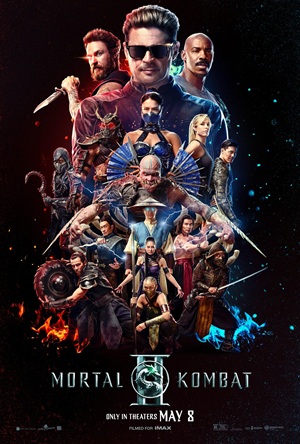
While Josh Lawson returns as Kano and once again exceeds expectations as the franchise's go-to comic relief - cutting through the mythology with razor-sharp humor - the rest of the main cast (Jessica McNamee as Sonya Blade, Ludi Lin as Liu Kang, Tadanobu Asano as Raiden, and others) often don't have much to work with beyond the lore-heavy plot. Still, they are entirely game for the absurdity and keep the team dynamic believable. At the story's true center, though, is Adeline Rudolph's Kitana: her transformation from reluctant princess to Outworld's defiant savior gives the sprawling ensemble a crucial narrative anchor. Special mention goes to CJ Bloomfield as Baraka, whose makeup and prosthetics turn him into a genuinely ferocious, blade-armed ghoul that stands out amid the CGI-heavy effects.
On the technical front, the special effects are solid, with some shots even leaning toward a deliberate video-game aesthetic that feels right at home for this universe. They may not be game-changing or boundary-pushing, but they do exactly what they need to do: make the magic, the realms, and the fatalities look brutally effective.
Where the film truly shines is the fight choreography. It's a highlight that feels like a love letter to the source material, with each fighter's signature style given room to breathe: Liu Kang's elegant fire kicks, Sonya's brutal military precision, Johnny Cage's - ahem - "signature punch," and more. The sequences are inventive and kinetic, blending practical stunts with crisp digital enhancement to create matches that feel both cinematic and authentically game-like. The multi-fighter brawls are staged with smart spatial awareness, making the chaos readable while still delivering those bone-crunching impacts and over-the-top finishers fans crave. There are moments where jump cuts threaten to intrude, but they are mercifully restrained.
The main exception is Shao Kahn. His character is not especially layered, and the film does little to disguise that he is essentially a garden-variety Big Bad: pure evil, no nuance, no real intrigue, and not much beyond the brute-force menace you'd expect from a final boss. He is intimidating in the broadest possible sense, but also frustratingly one-note, which makes the boss-fight energy feel less like dramatic escalation and more like repeated punishment by an especially large obstacle. In the fight scenes, he is too often reduced to the role of the lumbering heavy, and the film compounds that problem with a structural misstep: the MacGuffin amulet that makes him effectively immortal. Once the audience understands that he cannot truly be threatened, the tension in those sequences evaporates, turning what should be thrilling encounters into exercises in watching a massive brute absorb damage while we wait for his opponents' eventual, inevitable Fatality.
This lack of dramatic tension unfortunately bleeds into the broader narrative, which suffers from a distinctly bloated plot. The script struggles to rein in its massive, expanding roster of realms, rules, and characters, leaving little room for narrative breathing. This overcrowding is most keenly felt with returning standouts Hiroyuki Sanada (Scorpion) and Joe Taslim (Sub-Zero), whose immense talents and cinematic rivalry from the first film are frustratingly limited to supporting action in the third act.
Compounding this clutter is a glaring resurrection problem. For a franchise literally built on the bloody specatacle of the "Fatality," death rarely feels final here. The script too often relies on contrived mechanics to undo - or simply avoid - its most impactful kills, undercutting the narrative weight and further diminishing the stakes across the board.
The film isn't perfect - the mythology can feel overstuffed and the stakes occasionally muddled by fan-service lore - but it mostly gets by on energy, charisma, and a clear sense of what kind of movie it wants to be. "Mortal Kombat II" is a bloody, crowd-pleasing ride with enough humor, spectacle, and well-staged combat to make its rough edges easier to forgive, even if it never quite rises above being a solid, entertaining diversion.
| Movie title | Mortal Kombat II |
|---|---|
| Release year | 2026 |
| MPAA Rating | R |
| Our rating | |
| Summary | This blood-soaked video-game sequel leans on Karl Urban’s entertaining Johnny Cage performance, Josh Lawson’s reliable Kano comedy, inventive fight choreography and a generally committed supporting cast, but its bloated plot and thin villainy keep it from becoming more than a solid, crowd-pleasing diversion. |