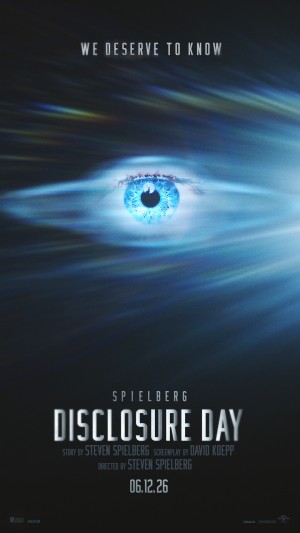
"Disclosure Day" is not quite Steven Spielberg at his absolute peak, but it is a persuasive reminder of how much of modern blockbuster filmmaking he still understands better than almost anyone else. What makes the film work is that it doesn't feel like a nostalgic rerun or a victory lap; it feels like Spielberg taking the machinery of his own legacy apart, rearranging the pieces, and making them feel newly urgent.
The film plainly traces its ancestry to "Close Encounters of the Third Kind," which also navigated the themes of how humanity comes to grips with learning we are truly not alone in the universe. Where that film featured a shadowy government entity orchestrating first contact, "Disclosure Day" centers on the shadowy Wardex corporation and its weary, intimidating leader, Noah Scanlon (Colin Firth) as they maintain a massive cover-up. It more plainly questions humanity's readiness to handle the revelation of alien existence, framed within today's bleaker social context. Spielberg again demonstrates his mastery at mirroring wonder with fear, as "Disclosure Day" leans into that tension with real confidence.
At the same time, the movie has another engine running under the hood, and that is where another great Spielberg film comes into focus:"Minority Report." If "Close Encounters" supplies the spiritual vocabulary, "Minority Report" supplies the velocity. Attempting to expose this 79-year-old secret is cybersecurity whistleblower Daniel Kellner (Josh O'Connor), whose anxious, vibrating vulnerability makes for an unconventional hero. Through his journey, "Disclosure Day" builds a chase structure that steadily tightens its grip while methodically revealing the mysterious forces at work. Spielberg uses that framework to create a sustained sense of pressure, highlighted by frequent collaborator Janusz Kaminski's agile, dynamic camerawork - most notably during a thrilling and terrifying scene involving a car and a speeding train. The pacing stays urgent without ever feeling mechanical, weaving emotional stakes into the chase instead of just relying on movement.
That combination gives the movie its charge. Spielberg is not simply borrowing from his past; he is showing how durable that past remains when filtered through a more anxious present. The film's concerns - distrust of institutions, the fragility of belief, the vulnerability of ordinary people, the possibility of grace, and the potential for fundamental goodness that lies in each of us - are familiar territory, but they feel freshly calibrated here. There is a modern nervousness to the film that keeps it from settling into pure reverie.
In what may be a career-best performace, Emily Blunt is crucial to that balance. As Margaret Fairchild, a Kansas City meteorologist whose life is upended when she unwittingly becomes a conduit for an alien language, Blunt gives the movie its emotional ballast. She brings intelligence, emotion, and just a touch of frenetic energy to keep the film focused on the human stakes even when Spielberg is working at scale. Her performance helps bridge the movie's twin moods of wonder and crisis, capturing the terrifying awe of grappling with a force she cannot comprehend.
Around her, the cast delivers effectively from a variety of dimensions. O'Connor's Kellner shifts from a conventional hero to a partner in Blunt's journey, as his own burden driven by alien knowledge is explored. Firth's Scanlon is ruthless and calculating as he tries to stop them, but proves more nuanced and wounded than you might initially perceive. Colman Domingo continues a streak of great performances of late: his Hugo Wakefield is the voice of hope and optimism to balance Scanlon's fear and pessimism. And by voice, I mean Domingo's literal voice could not be better suited for this performance; much of the time he's on the phone, and his timbre is perfectly matched for the lines. Eve Hewson does well as Daniel's girlfriend, Jane, despite suffering from challenging writing - alternating between damsel in distress, insider threat, and a proxy for the faithful in the audience. Wyatt Russell lands a few solid comedic relief beats as Margaret's "dude-in-a-band" boyfriend Jackson who can't understand what's happening to his girlfriend.
One other key aspect of this film is the music. Spielberg's greatest collaborator, John Williams, has delivered a score that moves gracefully between nervousness and tenderness throughout "Disclosure Day." It may not lodge itself in the brain with the instant force of "Raiders of the Lost Ark" or "Star Wars," but it has a subtler power, one that feels more supportive than showy. Williams isn't announcing the movie so much as guiding it, lending shape, lift, and emotional continuity to Spielberg's images. If this is indeed his final film score, it feels fitting that it should sit alongside his more subtle and contemplative work, such as "Schindler's List" and "Saving Private Ryan."
If "Disclosure Day" doesn't quite reach the transcendent heights of Spielberg's greatest masterpieces, it is because it functions as a triumph of familiar craftsmanship rather than a groundbreaking new vision. David Koepp's 145-minute screenplay occasionally trips over its own ambition, becoming bogged down in wordy exposition and relying on convenient MacGuffins throughout the film. The last twenty minutes shift pace considerably from the rest of the film in a way that may be jarring to viewers and seem just a little too on the nose considering current events. Furthermore, the visual style occasionally tips from expressive into distracting. While intended to evoke otherworldly awe, the heavy lens flares can become more noticeable than helpful, undercutting Kaminski's otherwise masterful spatial clarity. And the CGI animals, important to the plot, look decidedly unfinished in this otherwise very well-crafted film.
Even so, that feels like a small price to pay for a major studio film that intrigues and satisfies with a well-told story wrapped in a well-executed production. "Disclosure Day" is shaped, paced, and emotionally calibrated by a filmmaker who still believes that spectacle can carry feeling without sacrificing intelligence or heart. It may not be the best Spielberg film, but it has something more important than novelty: it has conviction, craft, and the rare sense that wonder still matters.
| Movie title | Disclosure Day |
|---|---|
| Release year | 2026 |
| MPAA Rating | PG-13 |
| Our rating | |
| Summary | Steven Spielberg's latest is a strong, confident return to familiar territory that employs emotional wonder and propulsive urgency to tell a story that feels both classic and current. While it doesn’t quite reach the heights of the director's greatest work, it's still a smart, heartfelt studio movie with real craft and personality. |