"Project Hail Mary" is a spectacular reminder of what studio filmmaking can still achieve when the right story arrives in the hands of the right creative talents. It's a science-fiction epic that presents massive scale while still delivering intimacy - rigorously crafted yet emotionally layered. It's the kind of film that reminds you why premium-format theaters exist; a truly dazzling big-screen experience that absolutely demands the largest, loudest, most immersive presentation you can find.
The film opens with science teacher Dr. Ryland Grace (Ryan Gosling) waking up aboard the Hail Mary, a lone spaceship light-years from Earth, with no memory of who he is, how he got there, or why the sun is dimming and threatening to doom all of humanity. Soon after arriving at the star which is the Hail Mary's destination, Grace's story pivots from isolated despair into a tale of first contact, transforming his solitude into a partnership of discovery and hope as they race to find a cure for the astrophage (Greek for star-eater) that is the cause of the dying stars.
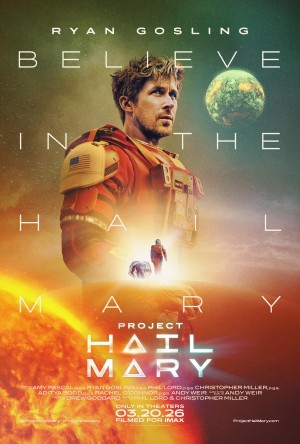
Andy Weir's novels have already proven fertile ground for adaptation, with "The Martian" landing with great success in 2015. But the story of "Project Hail Mary" presented a considerably higher bar: crossing the stars, meeting strange and very different life forms, and doing so in a non-linear narrative structure. Yet, directors Phil Lord and Christopher Miller have pulled off their own Hail Mary, as the enthusiasm and complexity of the source material are effectively preserved without excessive oversimplification or drastic changes. Writer Drew Goddard clearly understood the assignment while adapting Weir's prior work for the big screen, and he understands it here just as completely: streamlining and reshaping where needed, but never losing the book's brainy ingenuity or its beating heart. At over two and a half hours, the runtime is undeniably long, yet it earns every minute. The story breathes, the mission has weight, and you feel the accumulation of problems, calculations, and desperate improvisations. This is that rare blockbuster where the extra length plays like a feature, not a bug; there are virtually no wasted beats, just a steady deepening richness of character, background, and discovery.
In an early scene, the film establishes a sentiment that echoes throughout the picture and which resonated deeply with me. Soon after Grace has awoken, he encounters a series of golden plaques while exploring the Hail Mary's compartments. It feels like a deliberate nod - or even a tribute - to Carl Sagan, architect of the Golden Records sent to the stars on the Voyager probes. Here, they evoke Sagan's faith in our better angels; those Voyager records reimagined as a reminder that even when staring down oblivion, we still choose to introduce ourselves to the universe with curiosity and poise. That small bit of set dressing, an arguably throwaway image, functions as a sly thesis statement for everything that follows: this is a story about a species that refuses to surrender its wonder and optimism even in the face of desperation -hallmarks of Sagan's legacy.
From that moment, "Project Hail Mary" traces Grace's journey from suffocating isolation and creeping panic to an almost ecstatic sense of purpose and connection. What begins as a nightmare of amnesia and impending extinction slowly opens into something disarmingly hopeful. The film never pretends that survival is easy or guaranteed, but insists our greatest tools are the ones that define us at our best: ingenuity, cooperation, and the willingness to reach out instead of turning inward. This manifests clearly in both narrative timelines. On Earth, the Hail Mary team draws from across the world in pursuit of a single purpose. In space, Grace and his new interstellar best friend literally risk their lives to save the stars together. In this, I cannot help but think of Sagan's optimism, joy, and hope - even as I smile at Lionel Boyce's minor character named Carl, who aids Grace in a few essential moments on Earth.
At the center of it all is Ryan Gosling, delivering a performance that deserves every comparison to Tom Hanks in "Cast Away" while quietly reshaping what that reference even means. Like Hanks, he spends long stretches essentially alone, carrying the film through charisma, comedic timing, and the smallest flickers of reaction. But where "Cast Away" leaned into a stripped-down, almost existential despair, Gosling's Dr. Ryland Grace is defined by an undercurrent of curiosity and, once he's aware of the mission, commitment to the seemingly impossible task. His desperation is palpable, but it's shot through with humor. The jokes become a survival mechanism rather than a tonal undercut, a way of holding onto his humanity as the odds stack higher and higher against him. If it feels familiar, it's because we've seen it in "The Martian," as Weir clearly has a particular set of traits for his protagonists. But Grace is not a carbon copy of Watney, and Gosling brings a different charm than Damon, despite having many fewer potatoes with which to work. And unlike Hanks and his pal Wilson, Gosling gets a much more dynamic friend than a volleyball - but more on that later. This is perhaps Gosling's most fully realized and endearing performance, drawing laughs and tears in effective measures alike.
Sandra Hüller brings a crisp, commanding authority to Dr. Eva Stratt, the architect of Earth's last-chance plan in the flashbacks before Grace left Earth. Stratt provides the film's moral gravity and certitude; she is the person who can see what must be done and who is willing to bear the cost of it. Hüller plays her as flinty but never cartoonishly stony, pragmatic yet recognizably human. Her dynamic with Gosling adds a quiet emotional undertow that pays off beautifully when the film's larger themes of cooperation and sacrifice come into focus as he slowly regains memories of the time before his voyage. In a poignant scene, and a wise character deviation from the novel, she lets down her steely guard just enough to make a considerable impression on everyone on the PHM team, and it's a superb moment from Hüller. This is Grace's story, but Stratt's role in it is pivotal - but to say more would be spoiling it for anyone who hasn't read the novel.
And yet, for all that, the true character masterstroke of "Project Hail Mary" lies in the execution of Grace's most alien companion, Rocky. Realized through a seamless blend of animatronic puppetry and digital augmentation, he is one of the most remarkable screen creations in recent memory. The filmmakers give Gosling something tangible and reactive to play against: an alien engineer with weight, texture, and presence, operated by a team of "Rockyteers" and voiced with remarkable warmth and specificity by lead puppeteer James Ortiz. What could have been a mere effects showcase becomes the film's emotional core, as the relationship between Grace and Rocky grows into a symbiotic, funny, and deeply moving partnership that grounds the technical wizardry in something intensely human. It is not unreasonable for people to say that Rocky is now their favorite friendly alien.
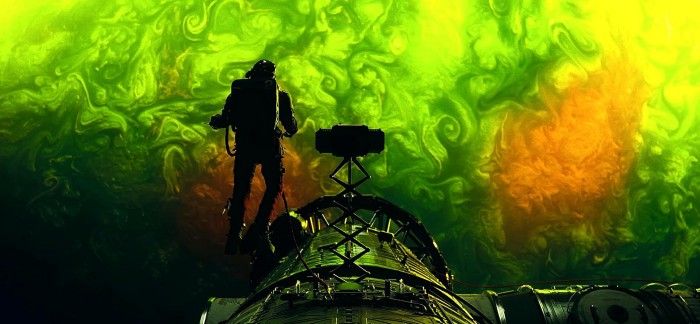
The care and creativity behind Rocky's design carries through the entirety of the "Project Hail Mary" production. From its first images, the film announces itself with a tactile, lived-in realism you can almost reach out and touch. The cinematography captures the claustrophobic interiors of the ship with a detail that feels startlingly plausible, anchoring the high-concept science in an almost documentary sense of physical reality. Light behaves the way it should, surfaces and controls look engineered and handled, and the camera compositions keep you oriented inside the chaos. Rocky's ship is incredibly different and alien, perfectly befitting a life form so completely unlike our own. Moving outside, as Rocky and Grace visit the planet nearest to Tau Ceti, we are bathed in the terrifying expanse of space and the incredible visual beauty of the planet's upper atmosphere. We are witness to a breathtaking and tranquil moment while they collect samples of astrophage, and then a few short scenes later that serene beauty becomes a fireball as the Hail Mary strains at the edges of its capability. You're not just dazzled by the visual spectacle; you're embedded in it, constantly aware of what it would be like to be there.
Daniel Pemberton's score deserves its own standing ovation - a masterful, chameleonic achievement that shifts effortlessly from foreboding dread to grand, epic swells to moments of pure whimsy, always in support of the onscreen action. It heightens and amplifies the emotional impact of every scene without ever becoming intrusive or cloying. These themes serve as essential sonic architecture that makes the triumphs feel cosmic and the quiet and somber beats resonate that much deeper.
By the time the film reaches its final movements, it feels less like a narrowly averted disaster and more like an earned triumph of knowledge, empathy, companionship, and stubborn hope. In a landscape crowded with interchangeable content, "Project Hail Mary" stands out as the real thing: a big-budget, major-studio science-fiction marvel that actually feels daring, heartfelt, and meticulously imagined. It's thrilling, funny, visually astonishing, and ultimately profound - a brainy, high-stakes thriller that never loses sight of its humanity. This is a four-star, all-timer of a movie, and precisely the kind of cinematic voyage that reminds you why "see it on the biggest screen you can" isn't just marketing copy. It's a promise the film keeps.
| Movie title | Project Hail Mary |
|---|---|
| Release year | 2026 |
| MPAA Rating | PG-13 |
| Our rating | |
| Summary | This spectacular, emotionally layered science-fiction epic brilliantly translates the brainy complexity of Andy Weir’s novel to the big screen, with Ryan Gosling delivering a captivating, surprisingly funny performance as an isolated astronaut, anchored by a profound and seamlessly executed partnership with his unforgettable alien companion, Rocky. Absolutely see this thrilling and deeply hopeful cinematic marvel in the largest, most immersive premium format possible. |