Documentaries tend to serve two audiences at once. For the uninitiated, they can be the first real roadmap into a subject's history and meaning, while for the well-schooled, they're more like a return visit to familiar ground, an opportunity to see known stories reframed, deepened, or complicated. "Man on the Run," the new Paul McCartney documentary, walks a delicate path: on the one side are those who may only have a general awareness of McCartney's post-Beatles band Wings (for instance, I recognize and enjoy their hits but wouldn't call myself a proper fan) and on the other is one of the most dedicated fan bases in all of pop culture (again, I know the hits, but I'm no Beatlemaniac). This film is not a revelatory act of excavation so much as an expertly assembled, deeply pleasurable enrichment of an era that fans already know well. What it lacks in shocking discovery, it more than makes up for in texture, warmth, and pure engagement.
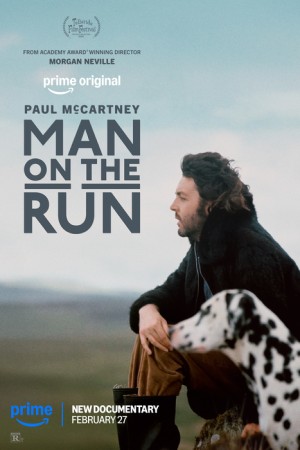
Directed by Morgan Neville, already well-proven in the space with his Oscar-winning "20 Feet from Stardom," the film narrows its focus to the crucial, often misunderstood stretch between the fracturing of the Beatles and the ascendance of Wings. That choice immediately gives the documentary a welcome sense of shape: this is not simply "the story of Paul McCartney," but the story of a man trying to rebuild a life and a band under the crushing weight of history. Neville leans heavily on archival footage, period interviews, and Linda McCartney's photography to keep us anchored in the 1970s, and the result is a film that feels more alive than just dutifully chronicled. You don't just hear about the shift from Beatlemania to barnyard recording sessions and impromptu university tours; you feel the scruffiness and uncertainty of it.
For casual viewers or younger fans, "Man on the Run" will likely play as a generous, almost overflowing primer on this era. The film walks through McCartney's post-Beatles crisis, his creative partnership and marriage with Linda, and the improbable rise of Wings from critical punchline to stadium draw. It sketches the contours of that journey with clarity and verve, stitching together music, home movie intimacy, and glimpses of tabloid hostility into a coherent, emotionally legible arc. Even if you don't know the discography in detail, you come away understanding why this period mattered - to McCartney, to his family, and to the pop landscape. And, by God, does it serve up some "Hey, I know that song!" moments.
For longtime McCartney and Beatles obsessives, the experience is different but still rewarding. The film doesn't unearth a trove of unheard stories or radically recontextualize the 1970s output; most of what's here will likely be broadly familiar to anyone who has spent time with the biographies and box set liner notes. The pleasures instead are cumulative and textural: the way McCartney tells a story you've heard before but with a slightly different inflection, or the way a piece of Linda's footage or a casually captured backstage moment suddenly crystallizes something about their relationship or his work ethic. Neville's structure favors emotional through-lines and character over granular song-by-song analysis, and that choice keeps the film moving even when the information itself isn't new.
Linda, meanwhile, gradually emerges as a surprise emotional center in the film. Neville and McCartney resist reducing her to the familiar "rock star's wife" shorthand. She appears instead as a stabilizing collaborator, the person who helps anchor him as the Beatles collapse and the world questions his every move. The domestic life they build together comes across not as a retreat from artistic drive but as the infrastructure that allows that drive to continue, giving his second act its particular shape and tone.
Even decades after her death, you can feel McCartney's affection for Linda radiating through his reflections, a tenderness that softens and deepens the film's look back at this era. For casual viewers, it plays as an unexpectedly central love story woven through the music; for longtime fans, it reinforces the sense that there is no post-Beatles Paul, and certainly no Wings, without Linda's steadying presence at his side.
"Man on the Run" remains so interesting and engaging, even in the absence of major revelations, due to Neville's sense of rhythm and his instinct for letting images do the talking. The film avoids the static talking-heads arrangements common to the documentary format, instead using contemporary audio interviews as a kind of commentary track over archival material. Voices of collaborators, family members, and fellow musicians float in over footage of McCartney fumbling toward a new sound and identity, and that separation of sound and image preserves the illusion that we're traveling back and reliving the past with him. It also keeps "Man on the Run" from lapsing into pure hagiography; even when the tone is admiring, there's an undercurrent of tension about what it means to be in a band with a genius who is also your husband, your boss, or your idol.
Neville is particularly good at balancing "McCartney the legend" with "Paul the slightly goofy, surprisingly vulnerable human being." The film never quite pierces the core mystery of someone who could write songs that reshaped popular music, but it does get closer than many glossy portraits. You see a man alternately wounded and defiant about post-Beatles criticism, proud of his domestic choices yet clearly aware that those choices came with artistic and interpersonal costs. The movie's best passages are the ones that linger in that ambiguity, where success and insecurity coexist and "starting over" seems both liberating and terrifying.
If there is a limitation here, it's that the film sometimes feels more like a beautifully curated exhibition than a hard interrogation. The blessing of McCartney as executive producer is direct access to the subject; the curse is that the film inevitably has the polish of someone guarding a legacy. Controversies and frictions are acknowledged but rarely lingered on. Instead, the emphasis is consistently on resilience, love, and the eventual triumph of the music. Some viewers may wish for a little more abrasion, a bit more willingness to sit with the less flattering implications of McCartney's drive or the frustrations of his bandmates. But the film is honest enough to avoid outright worship, and generous enough to send you back to the records with fresh ears. It's also fair to say the narrative momentum gets jumbled as the film moves into its third act, and adding extra internal drama at that point would likely feel forced and introduce more stress than insight.
As an entry point, then, "Man on the Run" is a richly accessible introduction to one of the most misread chapters in McCartney's career. As enrichment for those who already know the beats, it's less a trove of new information than a chance to spend time in a meticulously reconstructed world, guided by a subject who remains charismatic company. The revelations may be few, but the film's combination of craft, feeling, and sheer watchability more than justifies the journey. It's the very concept of a greatest-hits album made into film.
| Movie title | Man on the Run |
|---|---|
| Release year | 2026 |
| MPAA Rating | R |
| Our rating | |
| Summary | This new Paul McCartney documentary serves both newcomers and longtime fans by vividly chronicling McCartney’s post-Beatles reinvention with Wings, presenting an engaging, emotionally textured portrait that prioritizes craft over revelation. |