Long before she was a champion, Billie Jean King was the kid on the playground yelling for the ball, whatever the game happened to be. Directors Liz Garbus and Elizabeth Wolff borrow that demand for the title of "Give Me the Ball!" It turns out to be about the most efficient biography imaginable: a girl who wanted in, and who was never going to settle for watching.
Most people know that King matters. Fewer have spent enough time with her to understand why. Knowing the accomplishments is not the same as understanding the competitive drive, personal uncertainty, and considerable stubbornness behind them.
I caught the film at the Middleburg Film Festival, where King was scheduled for a post-screening Q&A before illness forced her to cancel. The room didn't need her there to make its feelings known. The audience, made up largely of fans and the plainly curious, greeted the film warmly. King gave them plenty to cheer.
Even so, "Give Me the Ball!" is not an especially adventurous documentary. Garbus and Wolff work with the familiar materials of the biographical portrait: archival footage, present-day recollections, and interviews with people who shared or benefited from the subject's journey. The construction is conventional. The woman at its center is anything but.
A documentary does not have to reinvent its form to justify revisiting a well-known life. It has to make its subject feel like more than a list of achievements, and King makes that look unfairly easy.
She is funny, direct, and comfortable taking charge of her own story. Garbus and Wolff give her the space to do so, frequently framing her in close-up as she addresses the camera. She comes across less as an expert being consulted than as a person making sure you understand what happened and, more importantly, what it felt like. King is excellent company, but the film finds more in that presence than charm. Even in recollection, she is still competing.
The competitive streak behind that childhood demand never went away. Her desire to participate could not be satisfied by politely accepting the conditions of entry, and her fight for better compensation and a viable professional future for women grew out of the same impulse that drove her on the court. Being allowed to play was not enough if the people running the sport could still dictate how little that participation was worth.
The film is most engaging when those supposedly separate identities - the athlete and the activist - become impossible to pull apart. Building opportunities for women was not a charitable sideline to King's tennis career. It determined whether that career, and those of the women around her, could exist at all. And changing the sport was one more demand on a woman already expected to keep winning.
The 1973 match against Bobby Riggs gets its due. It is the chapter most familiar to viewers whose tennis knowledge begins and ends with the phrase "Battle of the Sexes," and it comes with an obvious dramatic advantage: even when you know the result, the stakes remain absurd. One woman was expected to answer a much larger argument by winning a tennis match. Apparently, the rest of the evidence was insufficient.
Garbus and Wolff make the sequence work by keeping King's experience in view rather than simply replaying a famous cultural victory. In her telling, the match becomes a pressure cooker again, restoring uncertainty to an event that has long since hardened into a highlight reel. The outcome may be familiar; the burden of having to produce it is another matter.
The film is even more revealing when it measures the distance between the authority King commanded in public and the freedom she couldn't find in private. Her marriage to Larry King (no, not that one), her struggle to understand her sexuality, and the consequences of being publicly outed complicate any easy progression from talented child to triumphant pioneer. She could push an institution toward fairness while remaining painfully constrained in her own life.
King's willingness to discuss that contradiction gives the film much of its emotional weight. She talks about her marriage and her eating disorder without converting every hard experience into another flattering lesson in resilience, and the candor gives the admiration something more substantial to rest on. The pain isn't positioned as a speed bump on the way to glory; it's simply part of the record. For all its celebration, the film's best passages let her be a person rather than a monument. The humor helps. So does the sense that she has spent years thinking about these experiences without sanding away their difficult edges.
The filmmakers make another smart choice by largely saving the explicit testimonials about her legacy for the conclusion. We spend time with the life before being told what to take from it. When younger players discuss what King made possible, their presence gives that history a tangible continuation rather than scoring every scene with tributes. Just as telling is who does the talking.
Every player the film calls on is a woman, and some viewers may read that as an omission. It reads to me as the point. Women describing the opportunities they inherited are not offering incomplete testimony. Demanding that a film about women claiming authority over their own careers go looking for a male stamp of approval gets the whole thing backward.
If the film has a limitation, it's that the filmmaking rarely matches the personality driving it. The archival material and interviews are assembled with clarity and momentum, but this is recognizably a polished career retrospective. Anyone hoping for a radical reconsideration of King, or of the biographical documentary, won't find one. Familiarity isn't redundancy, though. "Give Me the Ball!" makes a persuasive case for hearing a well-known story from someone who still has the energy, perspective, and candor to make it immediate. You come away appreciating not only what King changed, but how much of her life the effort consumed, and how much personality disappears when a complicated woman is reduced to an inspirational name.
Now streaming on ESPN on Disney+, "Give Me the Ball!" may follow an established path - if so, it's because Garbus and Wolff simply had the good sense to give King the ball.
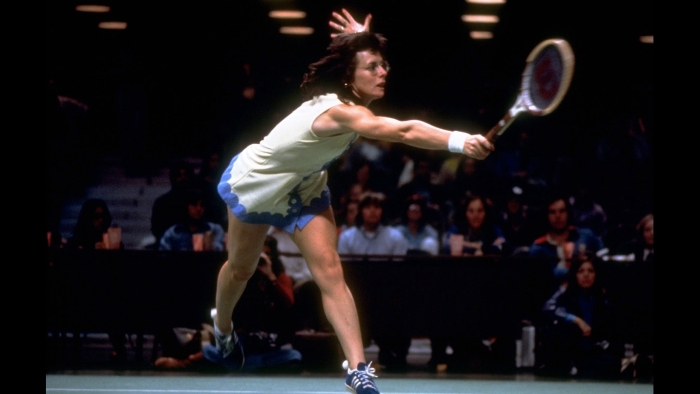
Billie Jean King - Photo credit: Ellen Griesedieck. Image courtesy of ESPN (espnpressroom.com)
| Movie title | Give Me the Ball! |
|---|---|
| Release year | 2026 |
| MPAA Rating | NR |
| Our rating | |
| Summary | This new entry in ESPN’s “30 for 30” series won't reinvent the sports doc, but with Billie Jean King telling her own story, it doesn't need to. It's a smart, affectionate portrait of a legend who never settled for the conditions of entry. |