Benny Safdie's "The Smashing Machine" is a film that resists easy categorization. It's a sports biopic that sidesteps triumphalism, a character study that trades charisma for earnestness that yields to quiet collapse, and a love story that burns with volatility rather than warmth. Anchored by a seemingly odd performance from Dwayne Johnson and a blistering turn by Emily Blunt, the film is a jagged, jazz-scored meditation on identity, addiction, and the toll of loving something that can only hurt you.
"The Smashing Machine" follows the rise and unraveling of Mark Kerr, a dominant force in the early days of mixed martial arts. Set in the late 1990s and early 2000s, the film traces Kerr's ascent through brutal fights and championship wins, while chronicling his descent into addiction, codependency, and self-doubt. Central to this is his turbulent relationship with Dawn, a woman whose mood swings as quickly as Kerr's fists. As Kerr battles opponents in the ring, he faces even harsher blows outside it - from painkiller dependency to the pressures of a toxic relationship.
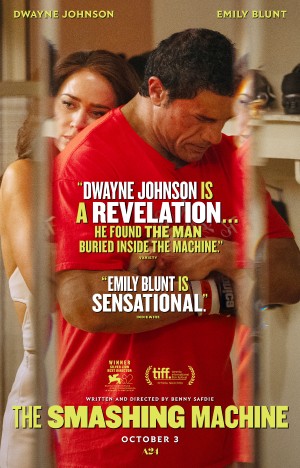
Johnson's portrayal of Kerr is one of the most peculiar choices of his career - and one of the most quietly effective. To say he's built for the role is a hilarious understatement; his physique throughout the film is formidable. What's compelling is how he transforms into a seemingly mild-mannered man who, in the right moment, is capable of great and terrible violence. There's a strange calm to his performance, contrary to the exultant triumphs typical of sports films. It's an unexpected shift from one of Hollywood's most kinetic stars, but it works, offering a welcome diversion from Johnson's usual swagger. At times the performance feels overly stylized, but it clicks in the closing minutes, when Safdie provides crucial context that reframes everything.
Blunt, meanwhile, is electric. As Dawn, Kerr's volatile partner, she delivers a performance that's raw, unpredictable, and heartbreakingly human. Their dynamic - equal parts intimacy and implosion - adds nuance to Kerr's professional ambitions. But Dawn and Mark are no Adrian and Rocky; they sparkle and seethe, swerving between support and degradation. Blunt's scenes crackle with tension, and her chemistry with Johnson lifts the film beyond its bruised exterior.
Visually, "The Smashing Machine" is a masterclass in physical transformation. The makeup work is nothing short of extraordinary. Kerr's face - swollen, scarred, and perpetually damp with sweat - becomes a canvas of punishment. But what's most impressive is how the team manages to make Dwayne Johnson, one of the most recognizable faces on the planet, vanish into Kerr. The transformation is uncanny; you know you're watching "The Rock," but the face is wrong in all the right ways (to say nothing of the cauliflower ear). It's a rare feat in celebrity casting, and one of the film's quietest triumphs.
Safdie's direction is equally unconventional. He experiments with different media throughout, from videotape for Kerr's early fights in Brazil to 16mm and 35mm in later sequences. The fight scenes vary in proximity, sometimes filmed from a distance, other times up close, but always focused on grit over spectacle. In several moments, the film takes on a distinctive documentary quality. But it's the music that truly sets these sequences apart. Instead of the usual symphonic bombast, composer Nala Sinephro employs jazz - moody, syncopated, and strangely intimate. Each hit on Kerr is punctuated by a chord, cueing the audience to the moments that matter. The result is hypnotic; violence becomes rhythm, without overtly steering the viewer's emotional response.
That said, "The Smashing Machine" isn't immune to genre tropes. There's a training montage - of course - set to music, but the selection of Elvis Presley's "My Way" is unexpected and amusing. Yet somehow, it works. The song's melancholy bravado mirrors Kerr's internal conflict at that point in the story, adding a layer of irony to the familiar beats. It's a nod to convention, but with a wink.
"The Smashing Machine" is not a crowd-pleaser in the traditional sports film sense. It's a character study, a jazz-tinged dirge about a man chasing his love for violence and finding both the highest highs and lowest lows. Ultimately, it may not be detailed enough for those who know Kerr's story, and it may be too experimental to pull in those who don't. But with strong performances and a distinctive voice, like a good fighter not yet beaten, don't count this film out.
| Movie title | The Smashing Machine |
|---|---|
| Release year | 2025 |
| MPAA Rating | R |
| Our rating | |
| Summary | The latest from Benny Safdie is a jazz-tinged character study of a man chasing his love for violence. |