"This marriage ain't big enough for the both of them." That tagline may be cheeky, but Jay Roach's reimagining of 1989's "The War of the Roses" is anything but frivolous. With a sharp script by Tony McNamara ("The Favourite," "Poor Things") and powerhouse performances from Olivia Coleman and Benedict Cumberbatch, "The Roses" slices into the anatomy of a modern marriage with wit, venom, and surprising tenderness.
Ivy and Theo Rose appear to have it all: love, a thriving career for Theo, mostly well-adjusted children - a life that, on the surface, screams success. But when Theo's professional downfall coincides with Ivy's meteoric rise the dynamic of their marriage shifts, revealing previously unseen fragility, and the foundation begins to fracture. What starts as quiet resentment escalates into psychological warfare, with their dream home becoming a battleground for ego, ambition, and emotional survival.
One cannot help but think of the 1989 original - Michael Douglas and Kathleen Turner locked in operatic combat under Danny DeVito's gleefully nihilistic direction - but "The Roses" is as much a new adaptation of Warren Adler's novel as it is a remake of the film. McNamara draws directly from Adler's darker, more psychologically grounded source material, shifting the tone from slapstick destruction to emotional realism. The result is a film that honors the original's acidic spirit while deepening its emotional core. Where DeVito's version reveled in escalating absurdity, Roach's finds tragedy in the slow erosion of intimacy. It's satire with a scalpel, not a lifted four-by-four truck.
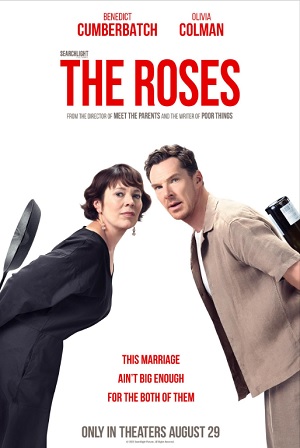
McNamara's script is the film's bedrock. The dialogue crackles with intelligence, and the humor - dark, dry, and devastating - feels tailor-made for today's audience. Roach's direction embraces this shift, grounding the conflict in moments that feel disturbingly familiar. The film doesn't just update the setting; it reframes the stakes. Gender roles, professional identity, the importance of communication, and the myth of the "perfect couple" are all interrogated with precision. Theo's unravelling in the shadow of Ivy's success flips the traditional power dynamic, turning ambition into the film's true antagonist. The house itself becomes a metaphor: its pristine surfaces and meticulous design contrast the emotional rot beneath, and its architecture mirrors the couple's psychological collapse.
Colman and Cumberbatch are extraordinary as Ivy and Theo. McNamara's script doesn't just complement their talents - it seems engineered to unleash them. His writing is so precise, so emotionally volatile, that it locks perfectly into their rhythms, allowing both actors to operate at full voltage. Colman moves between icy detachment and raw vulnerability with surgical control, while Cumberbatch builds a slow implosion that's equal parts combustible and tragic. Their chemistry is volatile, magnetic, and deeply human. You believe every barb, every glance, every moment of silence. And unlike the original, where the couple devolves into pure hatred, Ivy and Theo retain a glowing ember of affection - small, buried, but unmistakably alive. It's that lingering heat that makes their unraveling more tragic, and more believable.
The supporting cast adds just the right amount of friction to keep the film unpredictable. Andy Samberg and Kate McKinnon inject bursts of absurdity as Barry and Amy - Theo and Ivy's American friends - with Barry eventually serving as Theo's divorce attorney. Their characters feel like they've wandered in from a different genre and decided to stay, leavening the satire and preventing the emotional tension from collapsing into pure gloom. There are moments when McKinnon seems encouraged to riff and play "Kate McKinnon," which can briefly distract from an otherwise consistent scene. For the most part, though, they serve as an intriguing counterweight to Theo and Ivy's Britishness.
Allison Janney, appearing in just one scene as Ivy's divorce attorney, stands out by delivering a masterclass in calibrated intensity. She is icy, deliberate, and laced with a surreal edge that makes the negotiation - and her demolition of both Theo and Barry - feel both terrifying and hilarious. She integrates seamlessly into Theo and Ivy's verbal ballet, never putting a word or a foot wrong. Her appearance may be brief, but it's so precise and tonally perfect that you'll find yourself wishing the film had carved out more room just to let her keep slicing through the chaos still to come.
Compared to the 1989 film, "The Roses" feels less like a cautionary tale and more like a mirror held up to our curated lives, as it's sharper, sadder, and more resonant than its predecessor. It's a comedy that hurts, a drama that bites, and a remake that justifies its existence by being smarter, sharper, and more emotionally honest.
"The Roses" is a rare remake that earns its place - not by replicating the original's chaos but by reimagining it with emotional precision and modern bite. It's a film that understands the quiet violence of ego, the fragility of connection, and the way ambition can curdle into resentment behind even the most beautiful facade. Anchored by razor-sharp writing and two powerhouse performances, it's as funny as it is devastating, and never less than compelling. Whether you come for the satire, the heartbreak, or the sheer craft, "The Rose" is absolutely worth your time.
| Movie title | The Roses |
|---|---|
| Release year | 2025 |
| MPAA Rating | R |
| Our rating | |
| Summary | This remake of 1989's "War of the Roses" shifts the tone from operatic slapstick to something deeper and more emotionally resonant, and it is absolutely worth seeing. |