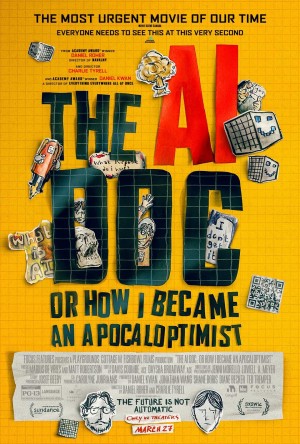
The AI Doc: Or How I Became an Apocaloptimist" is a nervy, often engaging tour through our collective AI anxiety that rarely feels boring, but just as rarely feels essential. It's the sort of film that will play like a gripping panic attack to viewers casually following the AI conversation, while anyone already steeped in the discourse may find themselves nodding along more than sitting up straight.
Daniel Roher structures the movie as a personal quest, framing himself as a soon-to-be father trying to understand what kind of world his child is about to inherit. That conceit is sturdy enough; it gives shape to what could have been a purely didactic info-dump, and it lets Roher toggle between experts, doomsayers, and evangelists without pretending to stand above the fray. But the film's personality-driven framing never quite becomes a point of view. Roher is mostly an anxious conduit, mirroring whatever the last interviewee told him, rather than a documentarian with a clearly argued thesis about power, capital, or responsibility.
That wobbliness becomes more glaring because the world is moving so much faster than his movie. This is often a trap with contemporary-issue documentaries, but AI is an especially unforgiving subject. Since the film locked, we've seen Elon Musk openly treating Grok as a meme machine and political cudgel, and an unusually aggressive public rupture between the Department of Defense and Anthropic over safety, access, and alignment.
Those developments don't just add new data points; they sharpen questions about who steers this technology and to what end. I appreciate that the filmmakers had to find a moment to end, but I found myself wishing for a late-addition title card addressing some of these factors. As it is, their main call to action for the audience seems to be "get the government involved." It is quite a juxtaposition to watch that same government punish the company most strident about building AI for safety because it won't help them build AI for maximum lethality.
As a primer on concepts, though, it mostly works. If your understanding of AI is fuzzy headlines and the occasional doom-scroll, "The AI Doc" does a competent job of laying out the basics: large language models, alignment concerns, labor displacement, synthetic media, and the specter of runaway systems. The explanations are clear, the pacing steady, and the tone accessible without plunging into condescension. You come away with the table of contents of the AI debate, even if the film rarely reads any one chapter closely. Let me be clear: this film will not help anyone (like our aging parents perhaps) understand how to use AI in any personal, day-to-day situations.
What keeps it from feeling like a grim lecture is its visual playfulness. Roher and his team punctuate the talking-head stretches with witty animated interludes that sketch in history, define jargon, or literalize abstract ideas with a kind of wry, infographic energy. I could not help but think of Weird Al Yankovic's music videos for "Word Crimes" and "Mission Statement," and those are excellent examples to be associated with. Those sequences don't just break up the information load; they establish context with a light touch, turning concepts that might otherwise feel dense or opaque into something closer to a sardonic explainer. The contrast between the polished, often self-serious interview setups and these more freewheeling visual asides gives the film a welcome sense of rhythm, and occasionally sneaks in sharper commentary that amplifies the on-screen experts nicely.
What's missing is a stronger analytical spine. Roher assembles a gallery of proselytizers - some genuinely brilliant, all clearly selling a worldview (be it doom or utopia) or a product - but he stops short of pressing them on contradictions or tracing their claims back to the ecological, economic, and geopolitical stakes underneath. When the movie does land on specifics, you can feel its potential: a stray line about natural resource decimation here, a brief nod to military applications there. Too often, though, it retreats into generalized dread or generalized hope instead of following the money, the governance structures, or the likely covert deals between states and companies that will actually define AI's trajectory.
The result is a film that's interesting, but not revelatory. It captures a mood more than it advances an argument. In a landscape where the technology, and the PR around it, is mutating week to week, that may be the best a theatrical documentary can do. Yet you can't help wishing "The AI Doc" had aimed for something more time-resilient: a sharper dissection of power, a bolder willingness to call out its own most charismatic interviewees, or a clearer stance on what, concretely, ought to change.
Even so, as a time capsule of this phase of the AI conversation, it's valuable. Ten years from now, we may look back on Roher's panic, his toggling between existential risk and utopian promise, the earnest experts and confident evangelists, and see a remarkably accurate portrait of how confused we all were. Right now, though, "The AI Doc" plays like an energetic, sometimes thoughtful snapshot of a moving target - capturing the blur of the moment without ever quite snapping into focus.
| Movie title | The AI Doc: Or How I Became an Apocaloptimist |
|---|---|
| Release year | 2026 |
| MPAA Rating | PG-13 |
| Our rating | |
| Summary | Director Daniel Roher's latest is an engaging, visually playful documentary that serves as a solid entry-level primer on our collective anxieties surrounding artificial intelligence, though it’s hampered by the sheer speed of evolution of its subject and a lack of analytical bite. |