Action movies have a certain rite of passage: do well enough, for long enough, and you don't just star in them - you become an archetype. We've had Schwarzenegger movies, Stallone movies, Neeson revenge thrillers; entire subgenres are built around a single persona and its promises. It's fair to say we've now arrived firmly in the era of the Statham movie. That phrase doesn't promise surprise or reinvention so much as a contract: hard-edged competence, bruising set pieces, and a protagonist whose emotional range is mostly measured in degrees of stoicism. Ric Roman Waugh's "Shelter" adheres to that contract with almost disarming sincerity. It doesn't transcend or evolve the Statham template; it polishes it and presents it as a reassuringly familiar package. If anything, it's a reminder of why the template exists in the first place.
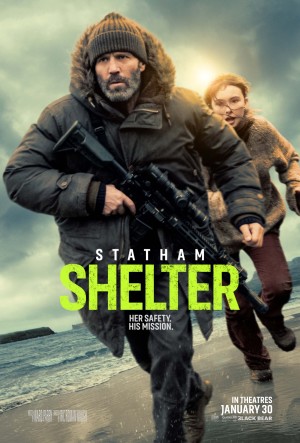
Statham plays Mason, a recluse living off-grid on a remote Scottish island. His quiet routine - chess, isolation, and a very Statham-esque dog - is interrupted when he rescues a young girl, Jessie (Bodhi Rae Breathnach), from a deadly storm. This act of kindness draws the attention of his old handlers and forces him violently out of hiding. It's less a fresh narrative than a slightly reconfigured chassis for a very familiar engine.
The film's cinematic genealogy is worn proudly on its tactical sleeve. The Bourne franchise looms large in its fondness for dossiers, surveillance paranoia, and terse, logistical violence, though "Shelter" borrows the flavor without the paranoia or formal experimentation. This is Bourne with the edges sanded down, served as a sturdy, digestible star vehicle. Layered on top is a decidedly safer riff on "Léon: The Professional": the lethal loner and the endangered girl who cracks his shell, stripped of the troubling implications that have aged "Léon" into a complicated artifact. "Shelter" wants the emotional charge of that dynamic but keeps it firmly in Dad-movie territory: paternal, guarded, and thoroughly de-sexualized. It's "Léon" by way of risk management.
As filmmaking, "Shelter" is nothing if not competent. The action scenes are cleanly staged and spatially legible; early attacks on Mason's island home and later urban set pieces showcase crisp choreography and a clear sense of geography, even when the camera tightens and shakes. Gunfights have weight, punches land with a familiar crunch, and the pacing rarely drags. There's a workmanlike clarity that is appealing in this era of infinite jump cuts, even if there is also a lack of distinct personality that leaves the movie reaching for, but never grasping, that image or moment that could only exist in this story, with these characters. We've seen this before, and "Shelter" ends up less an evolution of the genre than a well-executed iteration.
Statham does a variation on a role he could probably play in his sleep, and that's both the attraction and the ceiling. He glowers, growls, and dispatches bad guys with the weary precision of someone who has filled out this timesheet many times before, with the film only occasionally hinting at a more introspective, wounded core. His inner life is mostly silence and clenched jawlines. It works for the persona of "Jason Statham, movie protagonist," but it confirms that "Shelter" has little interest in pushing him - or his archetype - anywhere new.
The pleasant surprise comes from Breathnach, whose casting here doubles as a post-"Hamnet" coming-out party for mainstream audiences. As Jessie, she's grounded and reactive, holding her own against Statham's granite presence and lending their scenes a believable, low-key chemistry. The problem is the script, which saddles their relationship with dialogue so boilerplate it borders on self-parody; stock lines about trust, redemption, and second chances that feel a generation past their sell-by date, including at least one exchange that plays as unintentionally funny in its earnest cliché. You can see the intention; you can also hear the gears grinding.
Those corny exchanges point to a hard truth about the film's core identity. "Shelter" isn't trying to redefine what a Statham movie can be; it's perfectly content inhabiting what that phrase already means. It borrows from "Bourne," nods to "Léon," adds a dash of "John Wick," and slots those influences into a familiar star persona built on reliable violence and weary decency. As an action thriller, it's actually perfectly fine. As a career pivot, it's negligible. But as a Statham movie, it's just like Mason-it's the gold standard: brisk, competent, derivative in reassuring ways, and anchored by a star who long ago turned this exact mode into a brand. I just wish the Statham movie formula would allow him to return to some variation of the humor and verve from his earliest Guy Ritchie days, when his turns as Turkish in "Snatch" and Bacon in "Lock, Stock, and Two Smoking Barrels" proved he can deliver the wit without turning silly.
| Movie title | Shelter |
|---|---|
| Release year | 2026 |
| MPAA Rating | R |
| Our rating | |
| Summary | The latest action thriller from stoic stalwart Jason Statham is perfectly fine. As a career pivot it's negligible, but as a Statham movie it's the gold standard: brisk, competent, derivative in reassuring ways, and anchored by a star who long ago turned this exact mode into a brand. |