"Roofman" is a strange, appealing, and bittersweet retelling of one of the most unusual true crime stories in recent memory. Channing Tatum plays convicted robber Jeffrey Manchester who, after escaping prison, hides inside a Toys "R" Us for months while planning his proper getaway. Blending surreal charm with emotional depth, Tatum leads a strong cast in this small-scale, intimate comedy-drama that follows Jeff's search for connection as a way to preserve his sanity during isolation.
Tatum portrays Manchester with wounded sincerity; his performance is a blend of charisma and quiet yearning. Jeff, having lost so much already, isn't chasing redemption so much as human contact. Initially, he interacts from afar, but soon makes choices that bring him into the orbit of Kirsten Dunst's Leigh, a single mom working at the store where he's in hiding.
Leigh is first framed as the object of Jeff's attention, but she quickly becomes more compelling as the story unfolds. Dunst sheds any lingering Manic Pixie Dream Girl tropes and infuses Leigh with warmth and sparkle, welcoming Jeff into her life and that of her daughters. Their whirlwind romance feels authentic, buoyed by strong chemistry, even as Jeff's deception casts a shadow. The viewer is left with a growing sense of dread, wondering when and how it might all unravel.
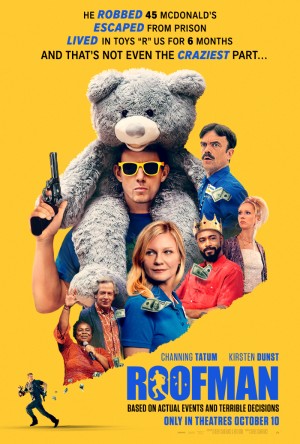
Though the film centers on Tatum and Dunst, the supporting cast is consistently strong. Peter Dinklage makes a sharp impression as Mitch, the store manager, a dismissive jerk who provides laugh out loud comic relief in key scenes. Uzo Aduba and Ben Mendelsohn bring grounded sincerity to their roles as pastors in Leigh's church, avoiding overplayed evangelist clichés. LaKeith Stanfield's concise role as Jeff's former sergeant-turned-fixer is pivotal - he's wry, wise, and never wasted. Juno Temple, Tony Revolori, and Jimmy O. Yang each deliver memorable moments in brief but impactful scenes.
What makes "Roofman" satisfying isn't just the performances; it's the way the film treats its bizarre setup with emotional gravity. Director Derek Cianfrance avoids sensationalism, using Manchester's hideout as a lens to explore themes of isolation, longing, and the fragile ways people seek belonging. The visual style is restrained and nostalgic, with muted tones and soft lighting that evoke a sense of faded Americana. Toys "R" Us, now largely vanished, becomes more than a setting; it's a symbol of suspended innocence and a quiet elegy for a bygone era.
The film's pacing is deliberate, occasionally meandering, but always purposeful. It lets the emotional moments breathe and trusts the audience to sit with discomfort. As "Roofman" reaches its conclusion, there's no tidy resolution or moral grandstanding - just a strange, sad story told with compassion. In a thoughtful twist, the credits include news footage and interviews that offer context for what followed after the final scene.
Ultimately, "Roofman" doesn't demand much from its audience, but it offers more than a simple retelling. It's a meditation on loneliness, reinvention, and the quiet desperation behind one man's attempt to rewrite his story. It may stumble occasionally in Jeff's overzealous efforts to impress, but its heart is unmistakably in the right place. "Roofman" may be about a man living in a toy store, but it's no gimmick. It's a soft-spoken, well-built character study that isn't flashy, preachy, or trying to be more than it is - and that's exactly why it works.
| Movie title | Roofman |
|---|---|
| Release year | 2025 |
| MPAA Rating | R |
| Our rating | |
| Summary | Channing Tatum’s latest film uses an unusual true crime story as the basis for a bittersweet meditation on loneliness, reinvention, and how we seek belonging. |