In Jean-François Richet's "Mutiny," Jason Statham plays Cole Reed, a former London police officer and British Special Forces operator who finds himself framed for the assassination of his billionaire employer. Writing about "Shelter" earlier this year, I noted that we have arrived firmly in the era of the Statham Movie - a modern action subgenre defined not by surprise or reinvention, but by a reliable contract of hard-edged competence, bruising physical set pieces, and a protagonist whose emotional bandwidth is measured purely in degrees of stoicism. "Mutiny" does not attempt to disguise its stripped-down machinery. Give Statham a tight perimeter, an overwhelming squad of disposable heavies, and a thin excuse for retaliation, and he will methodically dismantle everything in his path.
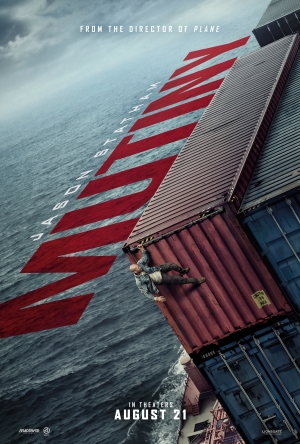
Reed works private executive protection in Bangkok, but his employer's murder sends him fleeing across international lines and eventually aboard a massive cargo freighter adrift at sea - one full of armed men, corporate intrigue, and increasingly practical opportunities for blunt-force retaliation. If "Under Siege" was "Die Hard" on a battleship, "Mutiny" is "Die Hard" aboard a freighter leaving Patapsco Terminal during the second season of "The Wire." But where David Simon brought tragic, textured humanity to Baltimore's waterfront economy, Richet reduces the film's human-trafficking subplot to little more than a perfunctory device for raising the stakes.
The picture unfolds in three distinct arcs, and its sea legs are considerably stronger than its land legs. The opening Bangkok scenes are a slog of familiar corporate deal-making, thin father-son posturing, and a baffling decision on Reed's part leading to the aforementioned assassination. Richet and Statham seem trapped in a middling international-thriller mode, moving Reed through a plot whose principal purpose is to get him aboard the freighter. The final return to Bangkok is more serviceable, as it wisely pays off on some earlier Chekov's Gun moments and neatly ties up loose ends. But it still struggles to fully compensate for the film's lumbering departure.
Once aboard ship, however, "Mutiny" finds smoother sailing. The freighter gives Richet a more useful toolset: narrow companionways, claustrophobic vents and crawlspaces, noisy engine rooms, exposed decks, and towering stacks of shipping containers that lend the close-quarters skirmishes a heavy, tactile crunch. The movie becomes more alert when it begins treating this industrial maze as more than a setting. Every lead pipe, wrench, bulkhead corner, and cramped passageway becomes a practical problem-solving tool, with Statham dispatching adversaries with the grim, economical efficiency of a tradesman completing a shift.
Richet also resists drowning that action in frantic handheld camerawork and rapid-fire cuts. The choreography is generally cleanly staged and spatially coherent, allowing the audience to understand not only who is hitting whom, but why a particular piece of machinery, doorway, or stretch of deck has become strategically useful. There is, however, a point at which the film's fondness for staging gunfights in stairwells starts to feel less like a use of the ship's vertical geography than a reliance on its most convenient location.
Still, Statham remains a remarkably precise physical performer: he sells the weight, fatigue, and ugly efficiency of the fighting without turning Reed into an invulnerable cartoon. It is not an especially inventive action movie, but during that central passage it is a satisfyingly functional one. "Mutiny" may not discover a distinctive new mode for Statham, but it at least locates some interesting terrain for his particular brand of blunt-force problem-solving.
That clarity does not extend to the rest of the film's roster. The villains Reed encounters remain largely faceless and interchangeable, nothing approaching the caliber of Tommy Lee Jones or Alan Rickman that a siege premise (shipboard or otherwise) ought to provide. Annabelle Wallis brings game effort to the underwritten role of Angie Ellis, but she is only barely elevated above standard-issue damsel-in-distress territory, hemmed in by boilerplate dialogue and stock exposition. The movie never finds a compelling counterweight to Statham's granite presence; everyone else is either an obstacle, a source of potential betrayal, or a helpless victim waiting for Reed to solve their problem with his fists.
Ultimately, "Mutiny" functions like the cargo ship it is set aboard: slow to maneuver, unconcerned with elegance, and carrying just enough brute-force cargo to reach its destination intact. Its Bangkok material is uneven enough to make the overall trip feel longer than it needs to, and the final stretch cannot entirely match the sturdy pleasure of the film's middle passage. Even with the industrial comfort of watching an action star who still treats bone-crunching fundamentals with absolute dedication, it is safest to stay on shore for this one unless you are a devoted action-movie enthusiast-or, better yet, a Statham movie completionist.
| Movie title | Mutiny |
|---|---|
| Release year | 2026 |
| MPAA Rating | R |
| Our rating | |
| Summary | Director Jean-François Richet and star Jason Statham deliver the brutal, efficient action fans expect once “Mutiny” gets aboard its cargo-freighter setting, even if its faceless villains and sluggish Bangkok bookends keep it from rising above the genre's well-worn formula. It's a reliable entry in the "Statham movie" subgenre — not reinventing anything but competently cashing the check its star has built a career on. |