For more than two decades, Will Arnett has defined a specific archetype of comedic brokenness: the man who masks deep insecurity with even deeper delusion. From the magic-trick bravado of Gob Bluth in Arrested Development to the self-destructive spiral of BoJack Horseman, his characters have almost always used irony as a shield. But as we noted in our review of "Is This Thing On?," that shield is gone. In its place is a performance of startling vulnerability, where Arnett steps into the role of Alex: a man navigating a "no-blame" divorce not with heightened absurdity, but with quiet, devastating reality.
To achieve this career-redefining pivot, Arnett had to do more than just drop the funny voices; he had to change his relationship with fear. The process required a total dismantling of his usual comedic defenses, a feat accomplished by performing live stand-up for unsuspecting New York crowds and acting with Bradley Cooper directing in real-time, often filming inches from his face. We sat down with Arnett to trace this journey from the "heightened" to the human, discussing the terror of the open mic and the liberation of finally having nowhere to hide.
Note: there are some plot-specific details discussed in this interview. So if you hate spoilers, go watch the movie first and come back for the commentary!
***************
BPBS: You often play characters who mask pain with bravado and absurdity. What was it like to step into Alex, who just doesn't do it that way?
Will Arnett: I've never really been given the opportunity to play a character who had to express emotion in a really genuine way. I've played a lot of heightened characters. I wanted to say that I gave myself the opportunity - I wrote a bunch - but it was really Bradley coming on which shifted and enhanced the kind of movie we were trying to make. I think it was him saying that he believed it was something I could do... that I probably didn't know if I could do myself.
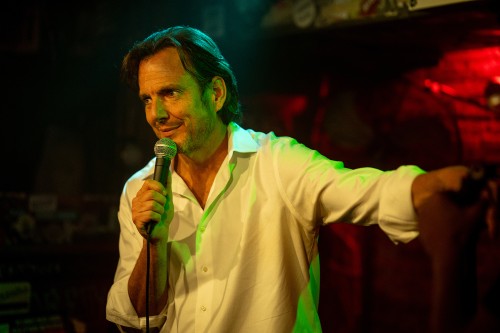
People say, "Was it scary going and doing the stand-up?" Certainly, that was scary. But it was much scarier having to delve into the emotion and play this character in a way that's really genuine. He doesn't have an accent or a limp or anything like that. He's just a regular person who's going through a real life experience. That was very difficult, and to be honest, it was something I wasn't sure I could do.
BPBS: You built this from John Bishop's original story. What anchored you to that idea?
Will Arnett: Mark Chappell, my partner, described it as this "chain of sensibility" that remained intact. John Bishop goes on to become the great comic that he is today, but what resonated with me was him talking about the feeling he had on Mondays when he dropped his kid off, and then he goes and does stand-up by mistake. He unwittingly has this transformative experience through speaking to strangers and connecting... communicating in a way that he never had before. He didn't go back because he thought he was good at stand-up, he went back because it made him feel good. That relief. I really related to that.
BPBS: The scene where his wife comes to see him by accident - is that based on actual events?
Will Arnett: If we'd written it, people would have said it was bullshit. But those are the parts that are the truth. She comes in and sees him, and he's telling a joke about her in his set. It was a crass, loose joke - something like, "I got rid of my wife... I still got her head in the freezer." Just a dumb laugh. But she hears the laugh, and she comes up and finds him after. She points to the stage and says, "That's the man I married. Not this person I've been living with."
She saw the guy who's up there talking about his life, who is open and enjoying life. From that moment, they started having an affair... sneaking around. They started coordinating vacations - they went to Portugal once and he just showed up like, "Hey, look who's here!" It was all by design. When he finally told his mum that he was doing stand-up, she actually said, "Oh my god, I had no idea your life was this bad."
BPBS: Tess and Alex are incredibly emotionally sound with each other. Is that a reflection of where people are in 2025, or a specific narrative choice?
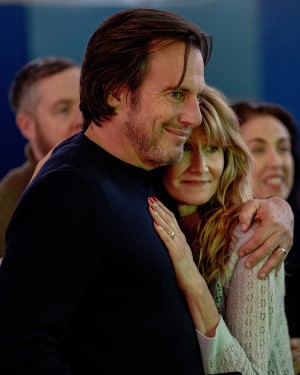
Will Arnett: I think that every situation is different. These are two people who are dedicated to their kids. They're not horrible people. We could have told the story of people who get mad, throw all their belongings on the front lawn, lock them out, get a court order... that's a different story. These are people who live amongst us who are just level-headed. Nobody cheated. It wasn't like that. It's complicated; it's a series of emotional slights.
BPBS: Fatherhood (in movies) is often played for a joke or dysfunctional. What felt different about portraying it here with vulnerability?
Will Arnett: Bradley and I talk a lot about this. The way masculinity is represented today is kind of all over the map. I think the masculinity that we experience in the friendships I have with men in my life is much closer to what we see in the film. Men aren't often portrayed as vulnerable as they really are.
I'm not here to try to carry a message, but I think that needs to be reflected in a real way. Alex takes being a father really seriously. His relationship with his sons is important. It's not like it was generations ago... fathers have a much more equal footing in the emotional relationship with their kids. We wanted that to be accurate.
BPBS: What did doing the stand-up teach you about emotional exposure?
Will Arnett: This whole process - doing stand-up every night for six weeks, three times a night - was as transformative to me as a person as it was comedy-wise to Alex in the film. It required me to strip my ego down to the studs.
I've played a lot of characters with a lot of bravado over the years. Arrested Development, Gob Bluth is nothing but bravado. Lego Batman... BoJack Horseman. I don't think I have a lot of bravado in my own actual life, but it was scarier doing the stand-up... [but] it was much scarier to be vulnerable in this way that I had never really done. It required me to strip all of that away and trust Bradley.
BPBS: You filmed with the camera literally in your face in the club scenes. Was that a new experience?
Will Arnett: 100%. Bradley likes to talk to you as you're shooting as well. So he's talking to you in real time, in my face. Very vulnerable, there's nowhere to hide. We never shot without an audience... the direction to the audience was: "React the way you want to react to this guy. They don't know anything. If he's funny, laugh. If he's not, don't."
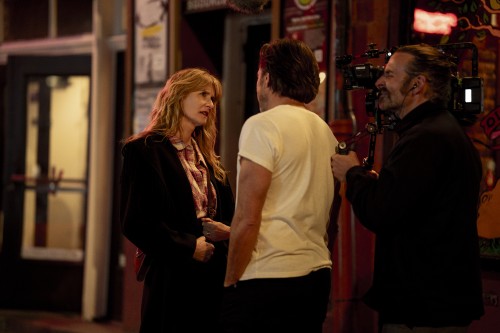
We didn't shoot a master and then get into close-ups. Everything was shot handheld, Bradley operating most of the time on a 40mm lens in that 1.66:1 aspect ratio. You can't hide and "save it for the close-up." Everything happens in real time. It was a real test.
BPBS: How did you keep the flow going when he's giving you direction mid-scene?
Will Arnett: It's almost a "yes, and..." in the filmmaking process. You don't stop and go back. If you're doing it, then you keep going. I'm just listening and doing it and staying in the flow. If he says "Look at Jill," I look at Jill. He understands that I'm going to go back and say the line. That was probably the thing that my comedy background helped me bring to this part.
BPBS: Do you think Alex gets back up on stage after the movie ends?
Will Arnett: We just want to hint that, yeah, maybe he stays doing it. Does he sell out arenas? No. It's not like... we're gonna make the sequel, "Is This Thing Still On?"
BPBS: Fantastic. And it's safe to assume that you're not looking to put yourself up on open mic nights anymore?
Will Arnett: I went last night.
BPBS: You went last night?!
Will Arnett: In New York. We did a Q&A... and I texted a friend who writes with Nikki Glaser. He goes, "I think we have to go to the Cellar." So I went last night. I looked at some material... and just went like, "I think I could do this." Did 10 minutes. It's hard to say how I did... I think I did pretty well...a lot of people were happy to see me. But I think a lot of people thought that [when I was rehearsing in character as Alex] maybe I was having a nervous breakdown or doing some sort of Andy Kaufman tribute.
***************
Our thanks to Will and to Searchlight Pictures for making this interview possible.