In "Dead Man's Wire," director Gus Van Sant returns to the fertile ground of "stranger-than-fiction" Americana, turning the 1977 Tony Kiritsis hostage crisis into a tightly focused, unnervingly intimate chamber piece. It is one of his most vital and confident works in years - a lean, tragicomic exploration of class rage that feels at once period-specific and brutally current in its view of debt, power, and media spectacle. The film operates as a thriller built on the accumulation of detail and pressure rather than familiar genre beats, maintaining a quiet relentlessness that tightens its grip without ever needing to raise its voice.
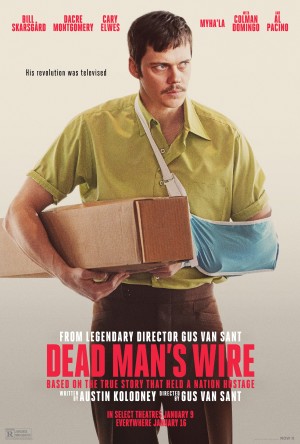
The film's greatest asset is its casting, an ensemble Van Sant marshals with immense confidence. Bill Skarsgård delivers career-best work as Kiritsis, playing him as a volatile mix of wounded pride and chaotic showmanship; a man vibrating with desperate, righteous fury. Opposite him, Dacre Montgomery captures the raw, agonizing terror of hostage Richard Hall in a subdued performance that brings real pathos to a man living second-to-second at the end of a gun barrel. The supporting cast is equally formidable, with everyone bringing a grounded quality that keeps the stakes human even as the plot machinery tightens like the wire around Richard's throat.
Colman Domingo continues his run of great performances as slick, laid-back radio DJ Fred Temple, radiating the kind of charismatic calm that makes it instantly clear why a panicked city would cling to his voice. His velvet tones and wry humor give the film flashes of looseness that only draw contrast to the tension, suggesting a man who understands he's part of a show but still feels a duty of care toward the people trapped inside it.
Al Pacino, meanwhile, provides both an explicit link to "Dog Day Afternoon" and a brief but memorable turn as Richard's father and the target of Tony's indignation, mortgage magnate M.L. Hall. What could have been a broad caricature becomes something sadder and more complicated: this hostage crisis is not just a public nightmare but the revelation of a long-rotted relationship between M.L. and Richard. And, even in limited screen time, Cary Elwes provides an indelible and vital anchor as Detective Grable, offering a weary, wry lens through which we view the unfolding "shitshow."
Van Sant's 1970s Indianapolis is not a postcard; it is a claustrophobic, cigarette-stained pressure cooker. The world-building here is impeccable - from the authentically beige palette to the bulky tech of era-specific broadcast news - creating a lived-in atmosphere that echoes the spirit of Sidney Lumet's aforementioned "Dog Day Afternoon" without feeling derivative. It is precise and subtle, but never showy, about this time and place. Everything feels authentically 1970s in a way that just works without ever winking at the audience, and the use of period footage and vintage formats only strengthens the style. This place has weight, and its spaces look used rather than decorated.
Elevating this atmosphere are a stunning soundtrack and score that act as the movie's heartbeat. Danny Elfman's original music is a minimalist, synth-leaning work that infiltrates the drama, using low-frequency hums to underscore the mechanical dread of the "wire" itself while leaning into the story's off-kilter strangeness. Complementing this is a meticulously curated and pleasingly diverse selection of 1970s needle-drops, from Eumir Deodato's jazz-funk to an ironic use of Gil Scott-Heron's "The Revolution Will Not Be Televised, tracks that capture the era's disillusionment and provide a jarring, ironic contrast to the violence on screen. The music is crucial to the film's identity, jolting scenes from dread into absurdity and back again through the pointed, sometimes darkly comic use of familiar songs.
"Dead Man's Wire" operates with a level of control that is easy to underestimate. While the opening movement is breathtaking and perilous, Van Sant maintains a purposeful pace throughout the long siege, using a rhythmic, almost percussive editing style that mirrors the frenetic energy of Kiritsis. At 105 minutes there is scarcely a moment that feels rushed or indulgent; even when the narrative briefly levels off, the mood, performances, and moral focus stay razor-sharp.
If the film doesn't quite achieve absolute perfection, it comes impressively close, a welcome return for Van Sant and a standout thriller of its kind. "Dead Man's Wire" isn't trying to reinvent the genre so much as refine it, stripping away excess and trusting craft over spectacle. The result is a haunting, bracingly entertaining film, rigorous in its construction, rich in its performances, and lingering long after the credits (which are worth sticking around for, as they feature some great period footage of scenes from throughout the film) as a grim reminder that while technology changes, the volatile cocktail of economic resentment and the need to be seen is timeless.
| Movie title | Dead Man's Wire |
|---|---|
| Release year | 2026 |
| MPAA Rating | R |
| Our rating | |
| Summary | Gus Van Sant’s "Dead Man’s Wire" is a vital, tragicomic return to form that transforms the 1977 Tony Kiritsis hostage crisis into a tightly controlled chamber thriller about class rage, debt, and media spectacle. Exceptional ensemble work from Bill Skarsgård, Dacre Montgomery, Colman Domingo, Al Pacino, and Cary Elwes anchors impeccable 1970s world-building and Danny Elfman’s off-kilter score. |