Bart Layton's "Crime 101" doesn't overhaul the heist film so much as it reaffirms the enduring power of its blueprint. Adapted from Don Winslow's lean novella, the movie embraces the familiar architecture of the "one last score" thriller - the clinical opening heist, the ritualistic preparation, and the tightening of the screws as loyalties fray - and executes it with such confidence that the well-worn becomes newly pleasurable. It is a demonstration of how smoothly a genre wheel can still spin when every component is machined to professional spec, even if that wheel is cruising down a well-traveled road.
It is impossible to discuss "Crime 101" without acknowledging the long shadow of Michael Mann's "Heat" - a shadow that the film inhabits with a mix of reverence and savvy. The L.A.-at-night ambience, and the parallel lives of thief and detective, are treated here as a kind of genre inheritance rather than a hollow imitation. Layton borrows the meticulous craft and lonely discipline of "Heat" but strips away the operatic grandeur in favor of something leaner and more intimate. The result is a film that feels less like a reinvented classic and more like a high-end restoration, trading scope for a focused, character-first restraint.
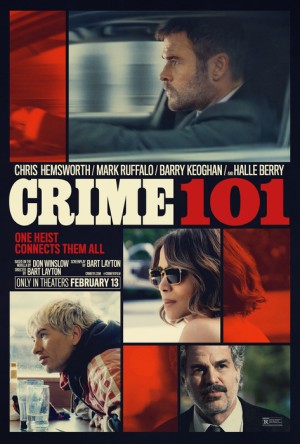
One notable departure from Winslow's novella is the absence of the protagonist's explicitly stated rules. On the page, those principles are so foregrounded they function as an operating system that governs every decision he makes. Layton keeps the spirit of those rules but lets Chris Hemsworth's performance, and a handful of contextual cues, convey the structure and ritual instead. It's an elegant choice that spares the film from didactic exposition, but it also sacrifices some of the granular specificity that made the source material's worldview so sharply defined. Without the literal "101" list, the rules become an atmospheric pressure rather than a narrative engine.
What elevates the film is its attention to character. Layton understands that a heist is only as compelling as the people pulling it off, and here the ensemble does the heavy lifting. Chris Hemsworth anchors the film as Mike Davis, a meticulous jewel thief whose success is built on caution, preparation, and an almost monastic adherence to routine. Hemsworth delivers one of his most contained performances: there's no swagger, no winking charrm, just a coiled intensity. He can put on the charm like a mask when it suits his purposes, but he flounders in ordinary social interactions. Mike is a man who has lived so long inside his own framework that any deviation feels like a small act of self-harm. It's a performance built on interiority rather than bravado, and it gives the film its taut center of gravity.
Mark Ruffalo, as detective Lou Lubesnick, is the perfect counterweight. Rumpled, dogged, and perpetually out of sync with fellow officers whose fixation on clearance rates makes you wonder if they're reporting to Bill Rawls in the Baltimore PD, Lou shuffles where Mike glides. But Ruffalo never lets him become a caricature of the weary cop. There's a sharp, intuitive mind ticking beneath the exhaustion, and his refusal to let go of a pattern everyone else has dismissed gives the film its moral spine. Watching him piece together Mike's methodology has the low-key satisfaction of a well-constructed detective novel.
Halle Berry brings a crucial human charge as Sharon, an overqualified insurance broker whose corporate ascent has stalled due to misogyny and who has begun looking sideways at the life she's built. Berry plays her with vibrant intelligence and a visible undercurrent of frustration, letting her career stagnation curdle into quiet anger without tipping into caricature. Crucially, the movie resists turning her into a damsel in distress or a default romantic partner, which only lets the character breathe more fully. You can see her constantly running the numbers - on risk, reward, and how many more compromises she's willing to make - as the heist plot tightens around her. Her scenes with Hemsworth and Ruffalo crackle not because of any romantic tension but because all three characters recognize that every new connection is both a lifeline and a liability.
Barry Keoghan cuts a vicious figure as Mike's volatile rival Ormon, a psychotic young biker thief brought in to take over a job when Mike's caution is mistaken for weakness. He channels a feral, twitchy menace with a relentless, brutal ambition that makes him a constant threat even next to the more physically imposing Mike. He doesn't dominate through bombast but through pent-up volatility and a willingness to use violence that keeps everyone off-balance. In a film anchored by professional discipline, Ormon's chaotic self-interest is the force that frays every plan and heightens the sense of dread.
The score leans into a brooding, synth-driven undercurrent that aligns with the film's broader nods to '90s crime cinema. The atmosphere of ambient electronics, drifting pads, and minimalist pulses build tension without overwhelming the frame. The music favors texture over melody, low electronic hums and spare percussion that mirror Mike's preferred order.
The action scenes follow the film's commitment to control: cleanly staged, tightly framed, and grounded in physical detail rather than excess spectacle. Visual effects are used sparingly and almost invisibly; nighttime composites and environmental touch-ups that support the frame without ever announcing themselves. That said, there are a few car chase shots that don't quite convey the right sense of speed. But overall, we have a series of crisp, procedural bursts of violence that feel aligned with the film's aesthetic and flow.
Ultimately, "Crime 101" succeeds as a work of high-level curation. By leaning so heavily into the aesthetic and moral vocabulary of "Heat," Bart Layton has crafted a film that is immensely watchable, even if it is a bit too comfortable in its borrowed skin. It is a solid work of craft and arguably a new defining turn for Hemsworth, but the film's refusal to step out from under Michael Mann's wing leaves one wondering if the genre is currently capable of moving forward, or if it is destined to keep circling the same L.A. interchanges. It is a sharp, polished, and deeply satisfying echo - a film that honors its rules, even when it's afraid to break them.
| Movie title | Crime 101 |
|---|---|
| Release year | 2026 |
| MPAA Rating | R |
| Our rating | |
| Summary | "Crime 101" is a sleek, disciplined heist thriller that executes familiar genre beats with precision, drawing heavily - sometimes too heavily - on the aesthetic, structure and vocabulary of Michael Mann’s "Heat". Craftsmanship, performances, and cool restraint make it quite watchable, even as a reluctance to step out of its influences’ shadow keeps the film from becoming something truly its own. |