"Tony" finds Anthony Bourdain before the television persona, the culinary celebrity, and even the confident literary voice: a restless 19-year-old still insisting he is a writer, only to travel to Provincetown chasing a girl named Nancy (Emilia Jones) and stumble into a kitchen that gives his life an entirely different direction. Matt Johnson's warm, well-crafted biopic understands that this formative summer did not redirect Bourdain away from writing so much as give him the world he would eventually write about.
Johnson signals his intentions from the outset, opening the film with Bourdain's own blunt self-assessment of who he was at 19-by his own account, an "irredeemable" and thoroughly unlikable young man. It's a bold choice for a biopic to lead with its subject's harshest verdict on himself rather than easing viewers toward affection, but it earns the film license to let Tony be genuinely grating without apology. That opening frame becomes a kind of contract with the audience: whatever charm or insight Bourdain would later be known for, none of it is owed to us here.
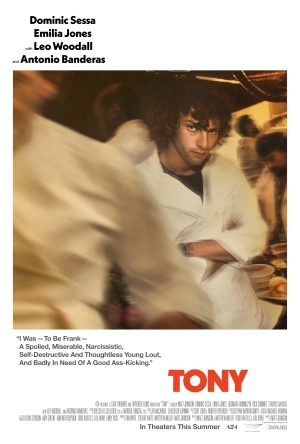
Dominic Sessa follows his breakthrough in "The Holdovers" with another remarkably assured performance, playing Tony as smart, cocky, and visibly hungry for a version of himself he has not yet figured out how to become. He avoids reducing Bourdain to a checklist of familiar mannerisms; this is not an imitation of the man audiences knew, but a convincing portrait of the insecure, performative, and often prickly young person who might grow into him.
Tony's immersion in the brash, demanding, and unexpectedly communal ecosystem of professional cooking drives the film. Johnson brings us right up close to the visceral, unglamorous mechanics of kitchen labor - the burns, cuts, endless dish piles, and relentless pace - showing how raw experience molds the arrogant young upstart.
At the center of that furnace are two contrasting visions of 1970s blue-collar manhood, each vying for Tony's developing worldview. Antonio Banderas is wonderfully dynamic as "Chef," the restaurant owner who offers discipline, craft, accountability, and genuine mentorship, recognizing something in Tony even when that faith has not yet been earned. Countering that steadying influence is Leo Woodall's Sal, a fellow kitchen worker who gives the film a valuable jolt of instability; he embodies the alluring, drug-fueled, and recklessly nihilistic side of line culture. Their relationship provides "Tony" with much of its live-wire energy, capturing the peculiar chemistry of restaurant colleagues: competitive, antagonistic, inseparable, and bonded by the controlled chaos of service.
Johnson and cinematographer Michael Bauman richly realize Provincetown as a place of seasonal possibility - sunlit, crowded, sensual, and a little dangerous - balancing golden seaside warmth with the sweat and grime behind the line. Paired with Curt Lobb's fluid editing, the film captures the kinetic, drifting rhythm of a coastal summer without turning every frame into an overworked 1970s postcard. The period texture is present in the clothes, work rhythms, social atmosphere, and especially the music, but it never smothers the characters beneath nostalgia.
Jay McCarrol's piano-driven score is an especially effective accompaniment to Sessa's angsty, uncertain Bourdain. Its themes carry a note of melancholy without tipping into depression, giving emotional shape to someone who has not yet found his calling or his place in the world. The music supervision is equally sharp, blending notable needle drops with deeper cuts that enrich the 1970s vibe while tracking Tony's awakening to a larger, stranger, more intoxicating world.
"Tony" is at its best when it exercises restraint as an origin story. Rather than treating every revelation as a neon sign pointing toward the future celebrity, Johnson lets him discover the beauty, cruelty, camaraderie, and narrative drama embedded in the kitchen itself. That approach feels appropriate for a figure ultimately remembered not only as a chef and television host, but as a provocateur, listener, and unusually empathetic guide to the wider world. The film does not pretend one summer can explain the fully formed Bourdain audiences came to know, and it is stronger for recognizing that the person on screen remains unfinished.
The summer itself carries a quiet, accumulating weight. Provincetown is captured as it should be: full of possibility, heat, late nights, temporary friendships, and the intoxicating belief that a new life might begin at any moment. Because summers are always fleeting, the film's bittersweet awareness of that impermanence lands more forcefully given Bourdain's tragic death. Without exploiting that knowledge or turning the film into an exercise in foreboding, "Tony" makes this brief, decisive chapter feel both vividly alive in the moment and deeply moving in retrospect.
More a portrait of self-discovery than a conventional cradle-to-fame biopic, "Tony" earns its warmth through the tactile specificity of its setting and the unsettled humanity of Sessa's performance. Anchored by Banderas's generous mentor figure, energized by Woodall's mercurial presence, and given its emotional pulse by McCarrol's score, the film becomes a funny, melancholy, and richly realized portrait of work and friendship. It makes one formative summer feel like the beginning of a life - without falsely suggesting it contains all the answers.
| Movie title | Tony |
|---|---|
| Release year | 2026 |
| MPAA Rating | R |
| Our rating | |
| Summary | Before Anthony Bourdain became the writer, chef, and provocateur the world would come to know he was an overconfident, often unlikable 19-year-old chasing a girl into a Provincetown kitchen, and writer/director Matt Johnson wisely keeps the focus there for this enjoyable, sharply-observed biopic. |