Antoine Fuqua's "Michael" is a massive, $200 million event picture arriving under the weight of a legacy so immense it can hardly be contained by a single film. This is not a documentary; it's a Jackson-family-sanctioned tribute to its most famous member, and - like Michael himself - it is complicated. The best way to approach it is through two different lenses: the first belongs to the fan who wants a celebration, a nostalgic return to the music; the second belongs to the critic who wants the movie to interrogate the myth instead of venerating it.
For the fan, this will likely be a satisfying meal. If you grew up moonwalking in your living room, the film might feel less like a biopic than a resurrection. Jaafar Jackson doesn't merely imitate his uncle; he seems to inhabit him, capturing the physicality, the rhythm, and that unmistakable vocal softness with uncanny precision. He deserves real praise for how fully he embodies Michael, with moments when he disappears into the part almost completely - not a copy, but a conduit of the same creative force.
The film understands that Michael Jackson was not just a pop star but a singular performance artist, and it wisely leans into the thing he did better than almost anyone in history: turn music into spectacle. The film traces major eras in Michael's musical journey, from the first gleaming smiles and simple yet deceptively complex choreography of the Jackson 5, through the breakthrough of Off the Wall, to the smash hits of Thriller, and culminating in Bad, with needle drops and earworms aplenty throughout. It invites the audience into the creative decisions behind some of the most enduring images and sounds in modern pop culture. If you are here for the songs, the choreography, the iconography, and the rush of seeing the legend restored in full cinematic detail, "Michael" delivers that experience with real vitality. For that viewer, the film's reverence does not feel like hagiography so much as welcome recognition delivered with energy and enthusiasm.
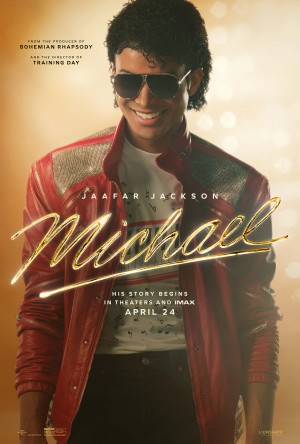
For the critic, though, the film's very devotion becomes its limitation. "Michael" is so carefully managed that it scours away the messiest, most revealing parts of its subject's life. By pulling back from the most significant controversies and refusing to dig too deeply into the psychological and historical contradictions that shaped him, the film chooses safety over inquiry. The result is a beautiful surface with very little friction underneath. It moves from landmark performance to landmark performance, but too often without asking what those achievements cost, what wounds helped create them, or how Michael's private life and public image became so inseparable. The movie is polished, controlled, and frequently exhilarating, but it also feels curiously airless. What it offers is not a complete biography so much as a meticulously curated tribute.
The film does not shy away from the already well-established view of Joe Jackson as a deeply flawed and often cruel force in Michael's life. But other family tensions, including the rivalry between Michael and Jermaine, are conspicuously absent. Everyone except Joe seems to regard Michael with nothing but love and support, which ultimately does a disservice both to the film and to the truth. The movie tries, with mixed success, to suggest that Michael's abbreviated and troubled childhood produced a man who was emotionally stunted, even as he became astonishingly focused and creatively exacting.
Michael often appears unable to function in ordinary social settings - to the point of surrounding himself with animals as friends - yet becomes unwavering when channeling his artistic vision. Unfortunately, none of this is explored in any real depth; both the triumphs and the trauma often feel like placeholders as the film prepares to drop that next song we all know by heart. One of the more curious omissions is Janet Jackson, arguably the family's next most famous member, who is nowhere to be found, presumably because of her more recent friction with the Jackson estate and broader family dynamics. Her erasure is a strong reminder of the family's influence on the production.
One area where the film's narrative caution works well is the approach to Michael's physical transformation and to the acknowledgment of his vitiligo. Both are handled directly, in a way that feels both tactful and necessary. We saw these changes unfold in real time, but Michael's lifelong tendency toward privacy and mystery meant that they were often abandoned to rumor mills and gossip columns; the film provides context for both without succumbing to over-dramatization.
However, for a film with such an immense budget, there are curious and distracting technical inconsistencies that appear throughout. The cinematography frequently leans too heavily on extreme close-ups, creating a sense of visual claustrophobia that eventually feels less like intimacy than a lack of aesthetic variety. Most puzzling is the framing: in multiple key dialogue scenes, parts of characters' heads are conspicuously cut off by the upper edge of the frame, a basic compositional error that feels almost inexplicable for a production of this scale. The visual effects are also surprisingly uneven. The digital rendering of Bubbles the chimp is jarringly poor, pulling the viewer out of the scene, and even more disappointing is the recreation of the infamous Pepsi commercial accident. The CGI fire lacks any visceral threat, coming across less like a terrifying pyrotechnic failure that altered the course of Michael's life and more like a low-budget digital overlay. These technical lapses introduce a layer of unreality that feels out of place for such a high-stakes project.
That said, even the most skeptical viewer has to reckon with Colman Domingo's extraordinary work as Joe Jackson. Domingo gives the film its sharpest edge and most unsettling emotional presence. He plays Joe as more than a villain, which is exactly what makes the portrayal so effective. He is intimidating, yes, but also complicated: a man who lives through the success of his children while also resenting the power that success gives them. There is ambition in him, but also damage, pride, fear, and a kind of warped conviction that he is preparing his family for a hostile world. Domingo never lets Joe become cartoonish. Instead, he makes him feel tragically human, which is far more disturbing. In many ways, he is the only actor in the film who gives it real dramatic teeth.
In the end, "Michael" is the kind of film that will play very differently depending on why you walk into the theater. If you go in longing for the rush of his music, the thrill of his movement, and the sense of a long-overlooked genius finally being given a proper canvas for a new generation of potential fans, you will likely leave exhilarated. If you go in hoping for a more serious, probing, or even uncomfortable portrait of one of pop's most complicated figures, you will leave feeling that the film stopped short of its own courage. Both reactions are correct; the movie simply doesn't try to reconcile them. What remains is a technically impressive, performance-driven film that knows how to celebrate the legend, but not how to fully examine the man.
| Movie title | Michael |
|---|---|
| Release year | 2026 |
| MPAA Rating | PG-13 |
| Our rating | |
| Summary | This $200 million biopic spectacle functions as a thrilling resurrection for fans of the King of Pop but a sanitized, frequently airless tribute for critics. Jaafar Jackson and Colman Domingo deliver electrifying performances in a film that does capture the lightning of the performer, but leaves the complex, fractious reality of the man firmly in the shadows. |