"Mercy" is one of those films that sits in the strange middle ground between failure and competence - a movie that never quite coheres, yet never fully collapses either. It lives in that hazy space where the premise, a few sharp ideas, and just enough interesting imagery keep you watching even as the whole drifts along, never quite fully connecting. It is, in many ways, the quintessential January release: a high-concept project that does not pass muster for a prestige window or a summer blockbuster slot, finding its home instead in the month where studios traditionally dump their "interesting misfires." It is intermittently engaging, occasionally frustrating, and rarely as smart as its hook promises.
The film's premise - in a near-future justice system where capital crimes are tried in the "Mercy Court" by an AI judge, LAPD detective Chris Raven is put on trial for his wife's murder in something close to real time - remains the strongest thing it has going. The screenlife structure allows for ticking-clock tension and an exploration of how an all-seeing algorithm might weaponize every scrap of digital exhaust against a defendant. However, the screenplay struggles to escalate cleanly, looping through reveals that feel more mechanical than exhilarating. The rules governing the AI appear to shift to suit whatever twist is needed, sometimes helping Chris and other times wasting his precious seconds. The pacing is similarly undercut by a rather simplistic whodunit narrative and a third act that ends up feeling more obligatory than cathartic.
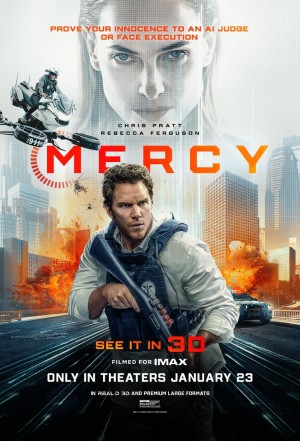
Rebecca Ferguson, playing the AI Judge Maddox, fares the best, finding a cool, disquieting register that suggests both programmed neutrality and something more pointed lurking underneath. Even when the writing vacillates - portraying her as an omniscient super-system one moment and a more vibe-coded interrogator the next - Ferguson threads in a sly curiosity that saves the character from collapsing into just one more plot device.
Chris Pratt's Raven is trapped within a more challenging character construct. Not only is he engaged in a life-and-death scenario, he is haunted by personal demons that combine to make him dour and, frankly, unlikeable.This leaves Pratt without his most reliable tool: his easygoing charm. Strapping him into an executioner's chair for the majority of the runtime does yield a sense of helplessness, but it simultaneously robs him of his kinetic energy. Without that looseness, he leans on strained anger and earnestness, and the performance never quite compensates for the thin narrative and emotional arc he has been given.
Technically, the film is a mixed bag, especially for those who seek it out in IMAX 3D (the format of my screening). While Timur Bekmambetov has earned a reputation as a pioneer of the digital aesthetic, "Mercy" often feels visually "ugly," plagued by a digital sheen that resembles a mid-tier video game rather than a cinematic blockbuster; the climactic chase scene in the finale is particularly guilty of this poor craftsmanship. The decision to release in 3D is especially questionable. Because the frame is constantly cluttered with pop-up windows and floating data streams on different planes of focus, the experience is often more distracting than immersive.
The heavy use of police bodycam footage and feeds conspires to make this one of the worst shaky-cam films I have seen to date. Those with motion-sickness, consider yourselves warned. Put simply, the 3D does not add to the impact of the film at large. It is a technical showcase that somehow manages to make the vastness of an IMAX screen feel claustrophobic and cluttered rather than grand.
Where the film briefly sparks is in its clear nods to contemporary surveillance infrastructure. The "Mercy Cloud" echoes technologies like Flock Safety camera networks - quietly tracking vehicles at scale - and data-fusion platforms akin to Palantir, already in use by agencies such as ICE and CBP to stitch together disparate databases. "Mercy" imagines the endgame of this capacity, where an adjudicating intelligence treats patterns and probabilities as proof, and the accused are guilty until and unless they can prove their own innocence. These touches give the movie a chilling plausibility and a veneer of contemporary relevance, even when the script rarely pushes beyond the surface-level implications of these ideas.
Ultimately, "Mercy" lands as a sleek, reasonably tense technical showcase that lacks the narrative weight to back up its ambitions. It is a movie that is essentially "not bad," but in the world of high-concept sci-fi, sometimes being "just okay" is the greatest sin of all. It is the kind of movie you might not recommend, yet would not necessarily tell someone to avoid if they are craving an action movie with a slightly novel premise or are curious about the intersection of AI and modern surveillance capitalism. You just need to keep your expectations calibrated for a January release.
| Movie title | Mercy |
|---|---|
| Release year | 2026 |
| MPAA Rating | PG-13 |
| Our rating | |
| Summary | This "interesting misfire" of a thriller is the quintessential January release, living in that hazy space where the premise, a few sharp ideas, and just enough interesting imagery keep you watching even as the whole drifts along, never quite fully connecting. |