
Since DVRs are effectively just large hard drives inside a cable box, I figured something was wrong with mine. After two visits from my cable guy and two replacement boxes, the problem persisted. My cable provider (to remain nameless) was at a loss. "It must be something with the line outside the building," was the straw they grasped at, leaving me relegated to the unsolved mysteries category.
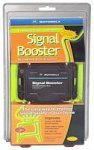
To me, it seemed like the cable signal was weak, so I invested around $40 in a Motorola Signal Booster. The simple little device plugs into the wall and has one input for your cable feed and one output, which I connected to a splitter which feeds my cable box and cable modem.
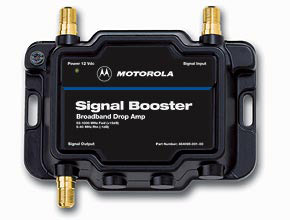
It's important to put the booster as close to the source as possible (i.e., connected directly to the main cable or antenna wire coming into your house) so the booster amplifies the signal and not the additional noise that can be introduced by splitters. Any splitters should be of high quality and should be inserted after the booster for best effect. Also, if you have a cable modem or plan to watch Video-On-Demand or Pay-Per-View, you'll need a bi-directional (two-way) amplifier so it can pass the return feed from the cable box and cable modem. The Motorola is just such a device.
After installing the booster and recording several shows, I only noticed one slight skip (and it was during "Robot Chicken," so who cares?) out of about ten recorded tests. Over the last couple of weeks the amount of drop-outs and pixilation I've seen on both live and recorded HDTV has dropped significantly, with no additional noise or distortion introduced by the amplifier. The signal booster really seems to have made a difference - and just in time for the writer's strike. D'oh!
The booster is available with a single input/output (as reviewed) or in a 2-port or 4-port version. The only difference being that the 2-port version has two outputs and the 4-port version has four outputs, so you will not need to buy a separate splitter to use this with multiple TVs or one TV and a cable modem.
Final Thoughts
If you just can't get a solid signal on your cable box or cable modem and your cable company is giving you the runaround, give this little booster a shot. It made a world of difference for me.
Where to Buy:
[editor's note: if you are having trouble receiving DTV channels from an antenna, connecting your antenna directly to your TV, this product will most likely not solve your problem. Instead you may need a better antenna or an antenna preamp, or you may even need to mount your antenna outside for the best reception. This cable booster is primarily useful in being able to split a cable TV and modem signal out to multiple devices with minimal loss and for boosting the strength of borderline CATV signals].
Features/Specifications:
Manufacturer's Contact Information:
Motorola, Inc.
1303 East Algonquin Road
Schaumburg, Illinois 60196 USA
Telephone: +1 847 576 5000
Web site: www.motorola.com
| Overall | |
|---|---|
| Value | |
| Performance | |
| Features/Ergonomics |