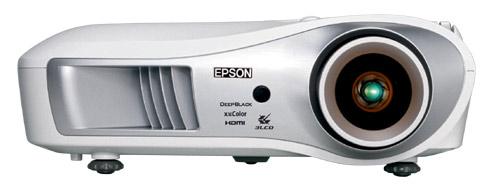
Unlike other projectors we have reviewed, the 1080 UB emitted an odd odor, like cooking plastic, the first few dozen hours of use (it was never particularly objectionable and it faded over time). Epson tells us that this is normal as the unit burns in but not all units will emit this smell. And though it may be tough on the nose (temporarily), it's certainly easy on the ears. Its whisper quiet fan (24 dB) can only be detected if you place the unit just a few inches from your ear. It was never audible to me during regular use with the projector less than 2 feet from my ears.
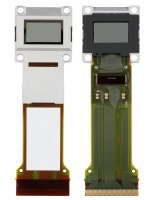
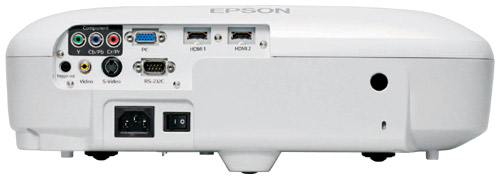
In terms of inputs/outputs, the 1080 UB is generous enough with 2 HDMI 1.3 inputs and one each of component video, S-video, composite and VGA/DB15 (for a PC or Mac). It's likely that most people will use just one or two of these and allow their receiver, video processor or video switcher to switch between multiple sources (in order to minimize the need for multiple long cables) so this jack-pack should be more than adequate for most purposes.
Ergonomically Correct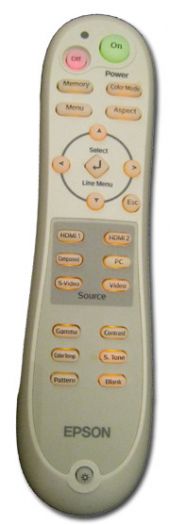 The 1080 UB's remote features direct input access and full backlighting at the touch of a button.
The 1080 UB's remote and menus were extremely easy to navigate. During calibration, I appreciated having "Color Temp" and "Contrast" buttons right on the remote. This made adjusting these settings simple (no need to go back in and out of the sub-menus over and over). With no less than twelve different color temperature settings (from 5500 to 10000 K), this would have been tedious to navigate had the color temp settings only been available via a deep menu option. I only wish they had done the same with the Brightness, Color and Tint settings, but the menus were pretty simple for these options so getting in and out to do the adjustments wasn't so bad.
In addition to these buttons, the remote includes full back-lighting for all keys, direct input buttons for each input, "Aspect" and "Color Mode" buttons plus a few other picture controls and, of course, the Menu and Navigation buttons, all of which were fairly logically laid out. The projector does not have a "vertical stretch" aspect mode so if you want to use this with an anamorphic lens for a fixed height ultra-wide screen installation you'll need an outboard processor to do the anamorphic squeeze.
"Testing, Testing"
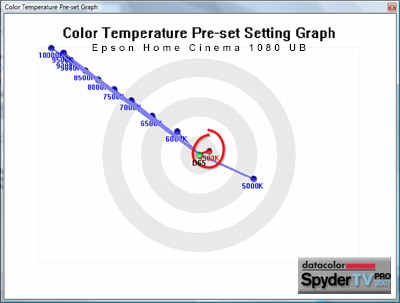
With a quick run of an HDMI cable from our Onkyo HDMI-switching receiver, the Epson projector was ready to shine (pun intended), with source material coming from two Blu-ray Disc players (Panasonic DMP-BD30 and Sony PS3), a Sony High Def DVR, two different HD DVD players (the Smithsonian Museum didn't want them) and some standard definition sources. After disabling the auto-iris feature and calibrating the image with our SpyderTV Pro 2007 software package and colorimeter, we got down to business.
First up was the Silicon Optix HQV test disc (Blu-ray version) to see how the projector handled 1080i material. The 1080i video resolution loss test presents the display device with an interlaced 1080 line (1080i) signal, sourced from a 1080p original. If a display's de-interlacer is worth its salt, you should be able to see the full 1920x1080 details as the video processor pieces the 1080i signal back into its 1080p original whole. On the 1080 UB projector, this test pattern was rock solid with no strobing and single pixel high horizontal lines appearing exactly as expected.
On the similar 1080i film detail test sequence, there was mild flicker as the projector's video processor "caught up" with the inherent 2:3 cadence (this occurred each time the moving lines changed direction), but this flaw was not as pronounced as on some other displays we have tested. On the 1080i "jaggies" test, the projector did an excellent job reproducing a spinning white line with no visible stair-stepping distortion. And in the film detail sequence, where a camera pans across a football stadium, individual rows of seats were clear with no moiré patterns visible in the stands.
Moving on to the more challenging Standard Definition HQV Benchmark DVD the projector's performance was similar to the Panasonic PT-AE2000U, a spinning line became slightly wavy at 20 degrees of rotation but then went back to smooth. And in the 3-line jaggies test, there was some minor stair-stepping on the bottom of three lines. This represents very good (but not perfect) diagonal filter performance in upconverting a 480i signal to 1080p. In the actual film-based jaggies test sequence (a waving flag with brick background), the image exhibited some minor jaggies, but nothing serious. Details in the brick background, and in the separate "detail" test on the disc were a bit softer than I've seen in the best upconverting video gear, but not too far behind.
In the 2:3 cadence test (an extract from “Super Speedway”), the unit was able to lock quickly to the underlying film-based cadence segment, leaving the grandstands nicely detailed without a hint of waviness which is evident on some lesser displays and processors. On the final "mixed content" tests (scrolling horizontal and vertical video titles superimposed on a film-sourced background), the projector passed both tests easily.
I Like to Watch
In Blu-ray Disc movie watching, the projector's performance was excellent - superb detail without a trace of screen-door effect from about 8 feet away on a 92-inch screen (no visible lines between pixels), great contrast and very good color accuracy/saturation. The "UB" in the product name is for "Ultimate Black" and compared to earlier generation LCD projectors, the name is quite appropriate. Blacks are about as inky as they get from consumer projectors, without losing detail in the whites or light colors. Blacks are still not quite as deep as some three-chip DLP and DILA projectors (models which cost two to three times as much as the 1080 UB, if not more), but the performance is excellent overall and at least on par with the current generation Sanyo and Panasonic projectors.
The opening shots from Blade Runner: The Final Cut on Blu-ray Disc looked awesome - deep dark skies, golden yellow and red flames and excellent detail from the Tyrell corporate headquarters building and the human eye that fills the screen. Starry night sequences from films such as Serenity and Sunshine looked, well, positively "stellar." Blacks and shadow details on dark murky films such as "AVP: Requiem" were excellent - still no comparison with the latest generation Pioneer Kuro and Panasonic plasma flat panels. But hey, as ISF guru Joel Silver says, it’s difficult to project the color black.
Performance on standard definition material was very good as well. In the Rome flyover sequence on the Gladiator DVD, lesser video processors make a mess of the diagonal lines in the rooftops. On the Epson, these lines were rock solid. This again shows thet the Epson is able to lock to the underlying 2:3 cadence of film-sourced material and decode it properly for 60 Hz playback. When we received press screeners of I Am Legend on both DVD and Blu-ray Disc, I actually had the standard DVD in the player for several minutes before I figured out I wasn't watching the Blu-ray version. I thought maybe it was a less than stellar transfer, but the DVD was actually quite watchable even blown up to 92 inches (by the way, the real Blu-ray Discs does look much better).
Final Thoughts
Overall, the image from the Epson Home Cinema 1080 UB is impressive, with great blacks and contrast, realistic colors and breathtaking detail, particularly with high definition sources such as 1080i broadcast HDTV and 1080p Blu-ray Disc movies. Its performance with standard definition material isn't as impressive, though it's better than we've seen with many other projectors. Considering how good the projector makes 1080p sources look, you'd be best served investing in a high quality upconverting DVD player, or a high-end receiver or video processor so you can send the projector an optimized 1080p signal, and let the 1080 UB do what it does best.
The Epson Home Cinema 1080 UB's price, feature set, installation flexibility and performance contribute to make this a strong contender in the home theater projector market and one of our top picks.
Where to Buy:
Projection System
Projection Method
LCD
Projection Lens
Lamp
Screen Size: (Projected Distance)
Brightness: (typical)
Contrast Ratio
Color Reproduction
Adjustment Function
RGB
Video I/O
General
| Overall | |
|---|---|
| Value | |
| Performance | |
| Features/Ergonomics |